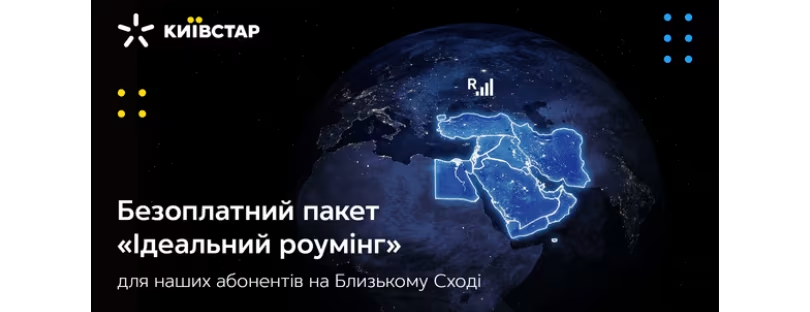
Kyivstar Prepares Users for EU Roaming Shift in 2026
Kyivstar just made a quiet but very strategic move. On the surface, it looks like a simple bonus package for roaming. In reality, it is a clear signal that Ukraine’s telecom market is already preparing for a structural shift that will reshape how millions of users stay connected across Europe.
What actually changed
Kyivstar has introduced a new roaming bonus package that gives subscribers 250 bonuses, effectively worth 250 UAH, valid for 30 days. These bonuses can be used for calls and mobile data while abroad, with pricing starting at 1 UAH per minute for calls and 0.10 UAH per MB for data.
The mechanics are simple, but the timing is not. This rollout comes just months ahead of Ukraine’s planned entry into the EU’s common roaming area on January 1, 2026. Once implemented, Ukrainians will be able to use mobile services across EU countries under significantly more favorable conditions, closer to the Roam Like at Home model already standard within the EU.
Kyivstar is also expanding its existing roaming footprint, with its Roam Like at Home service now covering 32 countries. The message is clear: the operator is not waiting for regulation to force change. It is trying to get ahead of it.
Why this matters in practice
If you travel frequently between Ukraine and EU countries, this is where things start to shift in a meaningful way. Historically, Ukrainian users faced high roaming costs, inconsistent pricing structures, and a lack of predictability. Even short trips could result in disproportionate mobile bills.
This new bonus model introduces something the market has lacked: a transitional pricing layer. It is not full EU-style roaming yet, but it reduces friction. Calls at 1 UAH per minute and low-cost data access begin to close the gap between domestic and international usage.
For business users, especially those operating across borders, this is even more relevant. Predictable roaming costs are not just about convenience. They directly affect operational efficiency, communication reliability, and ultimately cost control.
For consumers, the impact is simpler but just as important. Less hesitation to turn data on. Fewer workarounds with local SIM cards. Less reliance on public WiFi.
The competitive angle
This is not happening in isolation. Across Europe, operators have already adapted to a post-roaming world where cross-border usage is normalized. The EU’s Roam Like at Home regulation effectively removed roaming premiums within member states years ago.
What makes Kyivstar’s move interesting is that it sits in a pre-integration phase. Unlike EU operators that were forced into compliance, Kyivstar is using this transition period to shape user expectations and retain control over pricing narratives.
At the same time, this puts pressure on alternative connectivity players. Travel eSIM providers have built significant traction by solving exactly this problem: expensive and unpredictable roaming. If Ukrainian users suddenly gain access to near-EU roaming conditions through their domestic operator, the value proposition of many eSIM offers weakens, at least for regional travel.
However, the impact is not uniform. Global eSIM providers still win on flexibility, multi-country coverage beyond Europe, and instant activation. Kyivstar’s offer is still tied to its network ecosystem and limited geographic scope.

Who actually benefits
Frequent cross-border travelers are the immediate winners. This includes business professionals, logistics operators, and anyone regularly moving between Ukraine and EU markets. The reduced cost and simplified structure remove a layer of friction that has been a constant pain point.
Kyivstar also benefits strategically. By introducing these bonuses now, it strengthens customer retention before regulatory changes level the playing field. Users who become comfortable with improved roaming conditions are less likely to switch providers or experiment with alternatives.
There is also a brand positioning play here. Being seen as proactive rather than reactive matters, especially in a market that is about to undergo structural alignment with EU standards.
Who loses ground
The biggest pressure falls on smaller roaming resellers and low-differentiation eSIM providers targeting regional European travel. If their core pitch is simply “cheaper than roaming,” that argument becomes harder to sustain.
Operators that delay similar adjustments risk looking outdated. Once one major player moves, expectations shift quickly. Users begin to question why comparable offers are not available elsewhere.
There is also a subtle but important shift in global telecom positioning. As roaming costs normalize regionally, differentiation moves away from pricing and toward experience, coverage quality, and additional features like network control or IP management.
What does this signal next?
This is not just a promotional package. It is part of a broader transition toward integration with the EU telecom framework. And that transition will not stop at pricing.
Expect further alignment in areas like service quality, transparency, and consumer protection. Operators will need to rethink not only how they price roaming, but how they package connectivity altogether.
For the market, this reinforces a larger trend. Roaming as a premium product is disappearing. Connectivity is becoming continuous, expected, and increasingly invisible to the user.
The real competition is shifting. It is no longer about who offers the cheapest megabyte abroad. It is about who controls the experience of staying connected across borders without interruption, confusion, or hidden trade-offs.
Kyivstar’s move shows that this shift is already underway. The regulation in 2026 will formalize it. But the market is clearly moving ahead of the deadline.