Is eSIM Safe? Here’s the Real Answer
If you strip away the marketing and the fear, the honest answer is this: yes, eSIM is safe. In many real-world scenarios, it’s actually safer than a physical SIM. But like everything in telecom, the truth is a bit more nuanced than that.
Let’s unpack it properly.
What “safe” actually means in eSIM
When people ask if eSIM is safe, they’re usually thinking about three things:
- Can someone hack it?
- Can someone steal my number?
- Is my data protected?
At a technical level, eSIM uses the same core security framework as traditional SIM cards. Your identity is still protected by operator-grade encryption and authentication protocols defined by the GSMA.
But here’s where it gets interesting: the way eSIM is delivered and managed changes the risk profile entirely.
Why eSIM is often safer than a physical SIM
There are a few very practical reasons why eSIM has an edge.
No physical attack vectorA traditional SIM can be removed, cloned, or swapped into another device. That’s the basis of many fraud cases, especially SIM swap attacks. With eSIM, that attack vector basically disappears. There’s nothing to physically remove or duplicate. In real-world fraud, the weak point is often physical access. |
Harder to cloneCloning a physical SIM is rare but possible under certain conditions. eSIM profiles are digitally provisioned and tied to a secure element in your device. In simple terms, copying an eSIM is not like copying a file. It’s more like trying to copy a hardware-locked identity. |
Remote control advantageThis is underrated. If your phone is lost or stolen, your carrier can remotely deactivate your eSIM profile. With a physical SIM, if someone pulls it out quickly, you’ve already lost control. That small difference can save accounts, especially those still relying on SMS-based authentication. |
But eSIM is not bulletproof
This is where most content gets lazy. eSIM is not “more secure full stop.” It just shifts where the risks are.
The weakest point moves to your account
With eSIM, the biggest vulnerability isn’t the SIM itself. It’s your carrier account, email, or app login.
If someone gains access to that, they could request a new eSIM profile or transfer your number.
That’s why phishing and social engineering are still major risks.
So instead of someone stealing your SIM physically, they trick you digitally.
Different method. Same outcome.
QR codes and activation links
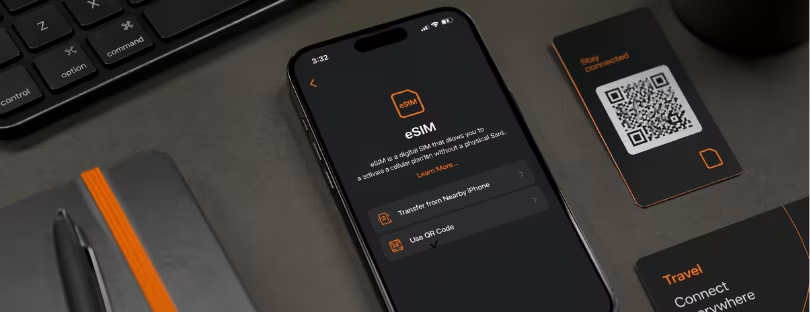
Most eSIMs are activated via QR codes or apps. If that QR code is intercepted or reused improperly, there is a small window of risk.
In practice, providers mitigate this by making codes single-use or time-limited, but it’s still something to be aware of.
Software always introduces complexity
Because eSIM relies on software provisioning, it inherits the broader risks of any digital system.
There have been rare vulnerabilities discovered in eSIM infrastructure. For example, a flaw in a test profile system could theoretically allow malicious access under very specific conditions, though it has since been patched.
This isn’t a reason to avoid eSIM. It’s just a reminder that security is a moving target.

eSIM vs physical SIM: what actually matters
Let’s cut through it.
- Physical SIM risk = theft, swapping, cloning
- eSIM risk = account compromise, phishing, bad setup
Both are secure at the core network level. The difference is where the weak link sits.
And if you look at how people actually get hacked today, it’s rarely through deep telecom exploits. It’s almost always through:
- weak passwords
- reused credentials
- fake emails
- social engineering
In that context, eSIM is not the problem.
What this means for travelers (the part most people care about)
For travel, eSIM is generally a net security win.
You’re not:
- buying random SIM cards at airports
- handing your phone to strangers to install them
- carrying tiny plastic cards that can get lost
You stay in control of the entire process, from purchase to activation.
That’s a big shift.
It also reduces reliance on public Wi-Fi, which is still one of the most common real-world security risks.
How providers are approaching security now
This is where the market is evolving fast.
Some providers are starting to position security as a feature, not just a baseline. For example:
- built-in VPN layers
- encrypted traffic options
- app-level protections
According to industry comparisons, providers like Saily are already leaning into security as a differentiator, bundling privacy features alongside connectivity.
At the same time, infrastructure players and enterprise platforms are doubling down on remote provisioning security, authentication layers, and device-level control.
This is important because it shows where the market is heading:
Connectivity is no longer just about data. It’s about identity and control.
What you should actually do (practical advice)
If you’re using eSIM, the basics matter more than anything else:
- Use strong, unique passwords for your carrier and email
- Enable two-factor authentication wherever possible
- Don’t reuse QR codes or share activation details
- Only download eSIM profiles from trusted providers
- Keep your device updated
None of this is complicated. But it’s where 90% of real security issues come from.
The real answer
eSIM is safe. In many everyday scenarios, it’s safer than a physical SIM. But it’s not magically secure.
What it really does is remove physical risks and replace them with digital ones.
And here’s the key point most people miss:
That shift actually aligns with how security works today.
The world is moving toward account-based identity, API-driven telecom, and remote provisioning. eSIM fits that model perfectly. Physical SIM doesn’t.
If you look at where the industry is going, from consumer travel apps to enterprise platforms and embedded connectivity, eSIM is not just a safer option. It’s the foundation of how connectivity will be managed going forward.
Compared to traditional SIMs, it’s already more resilient in theft scenarios. Compared to newer players adding security layers on top, it’s becoming part of a broader “secure connectivity stack.”
So the better question isn’t “is eSIM safe?”
It’s this:
Are you managing your digital identity safely?
Because that’s where the real risk has moved.