Iridium 9604 Brings Hybrid Satellite IoT to Devices
Satellite connectivity is entering a new phase. For years, companies building global IoT devices had to choose between satellite coverage and cellular efficiency. Now that line is beginning to disappear.
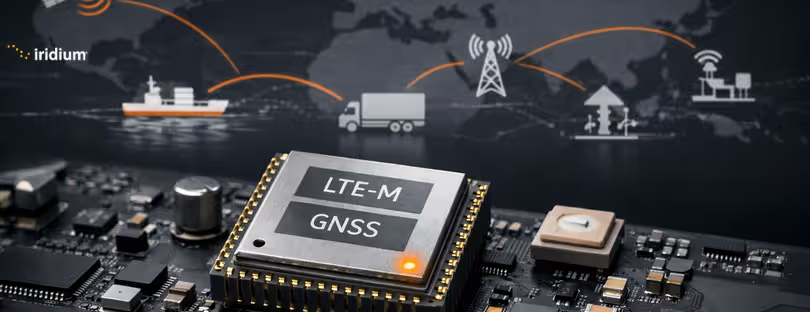
Iridium has introduced the Iridium 9604, a compact three-in-one IoT module that integrates Iridium Short Burst Data® (SBD®) satellite service, LTE-M cellular connectivity, and GNSS positioning into a single platform.
At first glance, it looks like another hardware release. In reality, it reflects something bigger happening in connectivity. The industry is moving away from single-network designs toward hybrid connectivity architectures that intelligently switch between terrestrial and non-terrestrial networks.
By combining satellite, cellular, and positioning capabilities in one device, the Iridium 9604 reduces hardware complexity, lowers integration costs, and speeds up development timelines. For many companies building global IoT devices, that combination has historically been difficult to achieve without expensive custom engineering.
Why hybrid connectivity matters now
Many IoT deployments operate in environments where cellular coverage is inconsistent or unavailable. Think logistics tracking across oceans, remote infrastructure monitoring, maritime applications, environmental sensors, or vehicles operating in rural regions.
Traditionally, solving that problem meant installing separate satellite and cellular modules, each with its own antenna, power architecture, and firmware integration. That added cost, complexity, and physical size.
The Iridium 9604 changes that equation by integrating everything into a 16 mm × 26 mm × 2.4 mm module, built on the u-blox SARA-R5 platform. The result is a compact system designed for large-scale IoT deployments where cost and power efficiency are critical.
This kind of design also enables smarter connectivity decisions. Devices can prioritize cellular networks when available and automatically switch to satellite coverage when terrestrial signals disappear.
In practice, that means global coverage without the complexity of multi-component designs.
Three connectivity paths inside the Iridium ecosystem
The new module also highlights how Iridium is expanding its IoT strategy beyond traditional satellite-only solutions.
Today the Iridium network offers three main IoT service architectures.
Hybrid satellite and cellular modules
The new Iridium 9604 integrates SBD satellite connectivity with LTE-M and GNSS, allowing devices to dynamically use both networks.
Standards-based direct-to-device connectivity
Iridium is also developing Iridium NTN Direct, enabling standards-based non-terrestrial connectivity through third-party chipsets.
Industrial-scale satellite messaging
For applications requiring larger payloads and higher data throughput, Iridium offers Iridium Messaging Transport (IMT®) on the Iridium Certus 9704 platform.
Together, these options give developers flexibility to design solutions based on cost, bandwidth requirements, and deployment scale.
Industry partners already see economic impact
Hardware integration may sound like a technical detail, but for IoT manufacturers, it directly affects product economics.
Tim Last, Executive Vice President at Iridium, explained the strategic thinking behind the new platform.
“By integrating cellular, GNSS, and Iridium satellite into a single, power-efficient module, we’re giving customers the flexibility to design and deploy lower cost, smaller, power-efficient, and location-aware solutions without the burden of integrating multiple components. With our best-in-class proprietary satellite IoT service and upcoming standards-based NB-IoT service debuting this year, anyone thinking about IoT beyond terrestrial networks is thinking about Iridium first.”
Early developers confirm that the integration changes real-world hardware design.
Alastair MacLeod, CEO of Ground Control, said:
“As an early Iridium 9604 developer, utilizing the three-in-one module has already fundamentally changed our product economics. We eliminated two components from our bill of materials, reduced our board size, and simplified our power architecture. Additionally, having dual mode connectivity options enables a smarter, location-aware network selection in our application. The Iridium 9604 turned what would have been a complex multi-component design into a single-module solution. This is a major breakthrough for our IoT solutions.”
Cloud infrastructure companies also see advantages in hybrid connectivity.
Dean Welten, CEO of Everlink, added:
“Our customers require essential data and real-time intelligence to operate with confidence anywhere in the world. By integrating the Iridium 9604 with our secure cloud platform, we can now enable global connectivity, greater operational efficiency, and measurable impact at scale.”
The broader shift toward non-terrestrial networks
The Iridium 9604 launch also fits into a broader trend: the rapid expansion of non-terrestrial networks (NTN).
Satellite operators are increasingly positioning themselves as extensions of cellular infrastructure rather than standalone systems. According to the GSMA Mobile Economy 2024 report, IoT connections globally are expected to exceed 38 billion by 2030, with remote monitoring and industrial automation driving much of that growth.
At the same time, the 3GPP Release 17 NTN standard is enabling satellite connectivity to integrate more seamlessly with cellular networks.
Several companies are pursuing similar hybrid approaches.
Companies such as Skylo, AST SpaceMobile, and Lynk Global are developing direct-to-device satellite connectivity using standard cellular protocols. Meanwhile, device manufacturers including Qualcomm and MediaTek are embedding satellite capabilities directly into chipsets.
Iridium’s strategy is slightly different. Rather than focusing only on smartphones, the company is targeting industrial IoT, infrastructure monitoring, and asset tracking, where reliable connectivity often matters more than high data speeds.
That positioning aligns with sectors like logistics, maritime, agriculture, and energy, where connectivity gaps still exist even in developed markets.
Commercial availability and developer access
Iridium plans to begin commercial availability of the Iridium 9604 in June 2026.
To accelerate adoption, the company will release a development kit allowing developers to test both satellite and cellular connectivity in real-world deployments.
For IoT device manufacturers, the goal is clear: simplify integration while enabling global coverage.
And in an industry where deployment scale often determines success, that simplicity can be the difference between a pilot project and a global rollout.
The bigger picture
What makes the Iridium 9604 interesting is not just the hardware itself. It reflects a structural shift in connectivity architecture.
The old model assumed devices would connect primarily through terrestrial networks, with satellite acting as a niche fallback. The emerging model treats satellite and cellular as complementary layers of a single global network.
As non-terrestrial network standards mature and hardware becomes easier to integrate, hybrid modules like the Iridium 9604 may become the default design for global IoT devices.
In that sense, the real story is not the module. It is the gradual merging of space and terrestrial infrastructure into one connectivity fabric.
And that transformation is only just beginning.