There was a time when eSIM was treated as a quiet technical upgrade. A cleaner way to provision connectivity. A logistics improvement. A way to avoid swapping plastic SIM cards in the field.
This week, Simetric announced a strategic partnership with Thales that signals something much bigger: eSIM is no longer a background utility. It is becoming the operational control plane of the IoT and edge ecosystem.
“eSIM is no longer just a provisioning function—it has become the operational and security control plane for the network edge,”
said Allen Boone, CEO of Simetric.
And for anyone watching how global IoT deployments are evolving, that statement is not hype. It is structural.
From Provisioning to Orchestration
At the center of this partnership is Simetric’s Single Pane of Glass platform, often referred to as SPoG. The idea is simple but powerful: enterprises should not have to jump between dozens of carrier portals, satellite dashboards, and legacy connectivity tools to manage distributed device fleets.
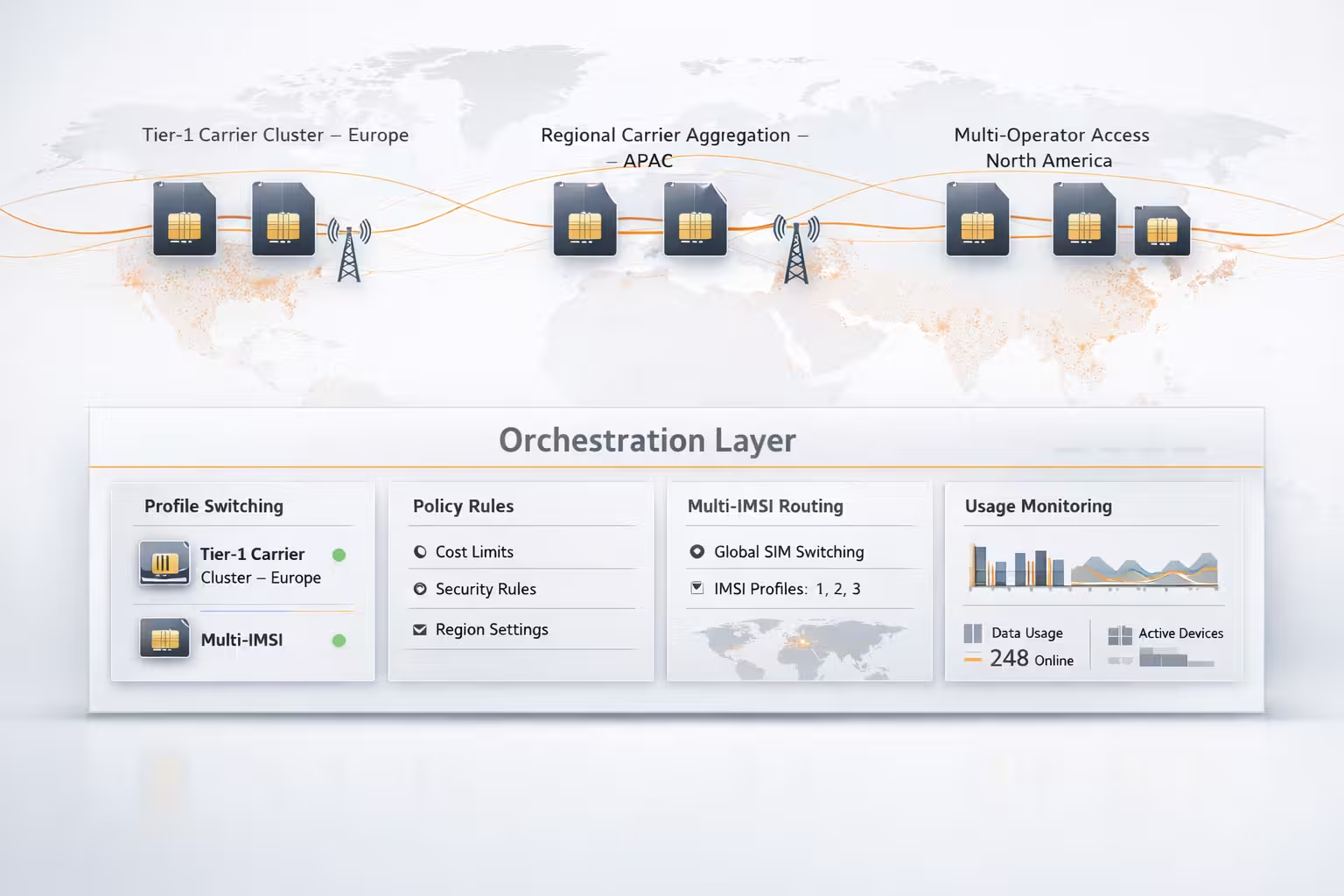
SPoG acts as an orchestration layer above networks, terrestrial and satellite, and above connectivity management platforms. Instead of logging into multiple systems, enterprises gain centralized visibility and policy control across carriers, geographies, and device types.
By integrating Thales’ GSMA-certified eSIM provisioning and Advanced eSIM Orchestration capabilities, Simetric is effectively embedding secure, standards-based remote SIM provisioning directly into this orchestration layer.
The result is not just easier provisioning. It is lifecycle control.
The Operational Reality of Global IoT
Let’s be clear about the scale of the problem enterprises are facing.
Utilities are deploying smart meters in the millions. Video security providers are managing distributed cameras across continents. Automotive OEMs are building connected fleets. Medical device manufacturers are shipping edge-enabled diagnostics. Retailers rely on mPOS devices. Logistics firms operate global asset tracking networks.
Each of these verticals has moved beyond the pilot phase. They are operating at an industrial scale.
But connectivity has remained fragmented. Multiple carriers. Different regional compliance rules. Separate connectivity management platforms. Physical SIM swaps in some markets. Remote profile downloads in others. Manual ticketing systems layered on top.
Maintaining service continuity in that environment requires:
Real-time profile activation and deactivation
Intelligent fallback logic
Performance policy management
Diagnostics and remediation
Unified governance and analytics
This is where orchestration becomes non-negotiable.
Simetric positions its SPoG platform as the policy and workflow layer above these networks, while Thales provides the secure eSIM foundation underneath. Together, they aim to normalize operational discrepancies across more than 300 cellular and satellite networks.
That normalization is not cosmetic. It directly impacts uptime, compliance, and cost governance.
Accelerating OEM Adoption
For OEMs, the challenge starts long before deployment. It begins in manufacturing.
Embedding eSIM into devices is one thing. Managing profile downloads across regions, aligning with GSMA standards, and preparing for evolving regulatory requirements is another.
The joint Simetric–Thales solution promises:
GSMA SGP.32-compliant provisioning and orchestration
Simplified onboarding across global networks
Centralized lifecycle control from factory to field
Faster international launches with reduced integration complexity
SGP.32, the emerging GSMA standard for IoT remote SIM provisioning, is particularly important. It is designed to move IoT eSIM from fragmented operator-controlled models toward more enterprise-friendly orchestration. Players like GSMA have made it clear that the next wave of IoT growth depends on standards-driven interoperability.
By embedding SGP.32-compliant orchestration into SPoG, Simetric and Thales are aligning themselves with where the industry is heading, not where it was.
Enterprise-Grade Governance
For enterprises managing mission-critical fleets, visibility is currency.
A “single pane of glass” is not just about aesthetics. It is about auditability, compliance, and risk reduction.
The combined solution delivers:
Centralized visibility across carriers and geographies
Advanced eSIM profile and policy orchestration
Workflow automation integrated into enterprise IT systems
Improved cost control and operational resilience
Simetric’s integration into platforms like ServiceNow is particularly telling. Connectivity is no longer a telecom silo. It is becoming part of broader IT observability, asset management, and cybersecurity posture management.
That shift reflects a larger industry trend. Connectivity is moving from the telecom department into the CIO and CISO domain.
Security by Design
Security is often discussed in IoT deployments as a bolt-on feature. But in distributed environments with millions of endpoints, security must be embedded at the silicon and provisioning layer.
Thales has long positioned itself as a leader in eSIM security infrastructure. Its eSIM platforms are used by mobile operators and enterprises worldwide, providing certified, standards-based remote SIM provisioning.
Simetric builds on that trusted foundation with governance, analytics, and automation at the orchestration layer.
Together, the companies emphasize:
Global enforcement of provisioning and security policies
Reduced risks associated with manual SIM handling
End-to-end auditability across device lifecycles
Guillaume Lafaix, VP Connectivity Solutions and Embedded Software at Thales, put it plainly:
“Orchestrating secure connectivity at global scale requires more than provisioning—it requires trust, standards compliance, and operational simplicity.”
That last phrase matters. Operational simplicity is often the missing variable in IoT security frameworks.
A Broader Market Shift
The Simetric–Thales partnership does not exist in isolation.
Across the industry, we are seeing similar moves toward orchestration layers that abstract carrier complexity. Connectivity management platform vendors, cloud hyperscalers, and security firms are all positioning themselves as control-layer players rather than connectivity sellers.
Companies like Cisco, Ericsson, and emerging orchestration platforms are also pushing toward unified IoT lifecycle control. At the same time, analysts from firms such as Gartner and IDC have repeatedly emphasized that IoT scale failures often stem not from hardware limitations but from operational fragmentation and governance gaps.
The convergence of eSIM, remote provisioning standards, and orchestration platforms suggests the market is entering a consolidation phase around control layers.
In that sense, Simetric’s strategy aligns with a broader structural shift: eSIM is no longer about avoiding plastic. It is about embedding programmable connectivity into enterprise workflows.
The Real Implication
What makes this partnership noteworthy is not just technical integration. It is the reframing of eSIM as infrastructure.
If eSIM becomes the security and operational control plane at the network edge, then orchestration platforms become the equivalent of cloud management consoles for distributed physical assets.
Enterprises will no longer ask, “Which carrier are we using?”
They will ask, “Which orchestration layer controls our global connectivity policy?”
The answer to that question will define competitive advantage in industries where uptime, compliance, and resilience are existential.
The Simetric–Thales collaboration is a clear signal that the control layer battle has begun in earnest. Similar to how cloud orchestration reshaped enterprise IT in the last decade, eSIM orchestration is reshaping IoT at the edge.
And as global IoT deployments accelerate, the winners will not be those who provision fastest. They will be those who orchestrate best.
Driven by wanderlust and a passion for tech, Sandra is the creative force behind Alertify. Love for exploration and discovery is what sparked the idea for Alertify, a product that likely combines Sandra’s technological expertise with the desire to simplify or enhance travel experiences in some way.