Visible Launches World Cup 2026 eSIM Travel Pass
The FIFA World Cup 2026™ will be one of the most complex tournaments ever staged. With matches spread across multiple cities in the United States, Canada, and Mexico, millions of international fans will be constantly on the move. And if there’s one thing that tends to break under that kind of pressure, it’s not just logistics. It’s connectivity.
That’s exactly the gap Visible is stepping into — one that’s quickly turning into the most contested space across both telecom operators and eSIM players.
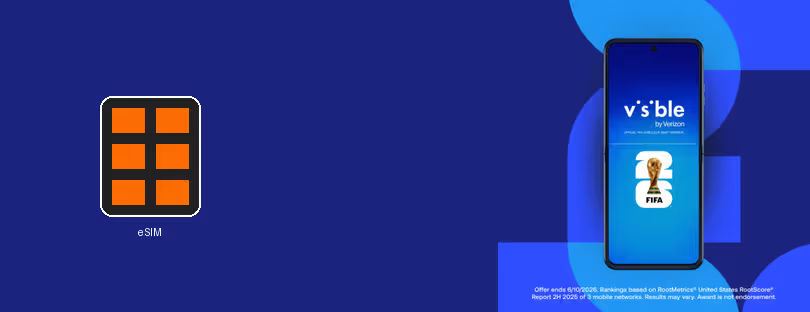
As an official connectivity sponsor of FIFA World Cup 2026™, the Verizon-owned digital carrier has launched a dedicated eSIM Travel Pass aimed specifically at international visitors heading to the U.S. The pitch is simple: land, activate, and stay connected without dealing with roaming fees, SIM cards, or unreliable public Wi-Fi.
But behind that simplicity sits something more interesting. This is not just another travel eSIM product. It’s a clear signal of where telecom is heading during global events.
A Product Built Around Movement, Not Location
Traditional roaming was designed for occasional travel. The World Cup is something else entirely. Fans will move between cities like Los Angeles, Dallas, Miami, and New York in a matter of days. Connectivity, in that context, needs to follow the user seamlessly.
Visible’s Travel Pass leans into that behavior.
The eSIM can be pre-ordered before departure, meaning users can activate service digitally as soon as they land in the U.S. No store visits. No physical SIM swaps. No uncertainty.
That’s increasingly becoming the baseline expectation. According to the GSMA, global eSIM adoption is accelerating rapidly, with travel use cases driving a significant share of that growth. Events like the World Cup only amplify that trend.
What the Travel Pass Actually Includes
Visible is positioning the offer as straightforward and predictable, with four duration-based plans:
Quick trips
Multi-city travel
Across all plans, the structure stays consistent:
- Access to Verizon’s 5G network, including Ultra Wideband
- Unlimited talk and text within North America
- International calling minutes (ranging from 90 to 500 minutes, depending on plan)
- Unlimited texting to 200+ countries
This is important. Many travel eSIMs today are still data-only. Visible is clearly pushing toward a more complete telecom experience, including voice and messaging.
That puts it closer to traditional telecom operators than most eSIM-first brands.
Why This Matters More Than It Looks
At first glance, this looks like a standard product launch tied to a global event. But it actually reflects a deeper shift in the market.
For years, travel connectivity was fragmented. Airport SIM cards, expensive roaming, inconsistent coverage. eSIM changed that by removing friction. Now, the next phase is about integration and predictability.
Visible’s approach highlights three key trends:
First, timing matters. Pre-ordering connectivity before travel is becoming standard. Users want to solve connectivity before the trip starts, not after arrival.
Second, network ownership still has weight. Unlike many travel eSIM providers that rely on wholesale agreements, Visible is directly tied to Verizon infrastructure. That changes both performance expectations and cost dynamics.
Third, bundles are evolving. This is not just data. It’s voice, messaging, and cross-border usability packaged into a single product.
That’s closer to a full telecom service than a typical travel add-on.
The Sweepstakes Layer: More Than Marketing
Alongside the Travel Pass, Visible is running a large-scale sweepstakes campaign, offering customers the chance to win tickets to World Cup matches, including the final in New York City.
From April 8 to May 31, 2026, existing Visible customers can enter daily by selecting host cities. Winners are drawn weekly and notified via email.
On the surface, this is a classic promotional tactic. But it also serves a strategic purpose.
Telecom is increasingly competing on engagement, not just pricing. By tying connectivity to experiences, Visible is positioning itself closer to lifestyle and entertainment, not just infrastructure.
This mirrors what we’re seeing across the industry, where telecom brands are moving into partnerships with sports, travel platforms, and digital ecosystems.

Where Visible Actually Sits in the Market
Visible isn’t just another travel eSIM offer.
What makes this launch different is where it sits in the stack. Most travel eSIM providers operate as distribution layers. They aggregate access, resell connectivity, and compete on pricing, bundles, or UX.
Visible comes from the opposite direction.
It sits directly on top of Verizon’s network, which means it controls both the infrastructure and the user experience. That changes the equation. Instead of stitching together coverage across partners, it delivers a single-network experience with predictable performance.
At the same time, it behaves like a modern eSIM product. Fully digital, pre-orderable, and designed for short-term usage without contracts.
That combination is where the real difference is.
Not better or worse. Just a different layer of control.
And that’s increasingly where the market is splitting.
The Bigger Picture: Events Are Becoming Connectivity Battlegrounds
Large-scale events like the FIFA World Cup are no longer just sports milestones. They are stress tests for digital infrastructure.
And increasingly, they are opportunities for telecom players to redefine their role.
We’ve seen similar moves during events like the Olympics, where operators push temporary plans, partnerships, and network upgrades. But eSIM changes the equation.
Instead of selling connectivity locally, companies can now distribute it globally before the traveler even arrives.
That’s a fundamental shift.
According to Ericsson mobility reports, global mobile data traffic continues to grow at double-digit rates, driven largely by video, streaming, and real-time applications. During events like the World Cup, demand spikes even further.
The question is no longer whether users will need connectivity. It’s who captures that moment of need.
Final thoughts
Visible’s Travel Pass is less about the product itself and more about timing, positioning, and control.
It shows how telecom operators are starting to reclaim the travel connectivity layer that eSIM startups initially disrupted. By combining infrastructure ownership with digital distribution, Visible is closing the gap between traditional carriers and agile eSIM players.
But the market is not standing still.
Travel eSIM providers are pushing toward global coverage, flexible plans, and increasingly, subscription models. Some are also experimenting with “invisible connectivity,” where users don’t even choose a provider; they just stay connected.
That’s where the real competition is heading.
Visible’s move is strong, especially for a U.S.-focused event like the World Cup. But in the longer term, the winners will be those who can combine global reach, seamless activation, and predictable pricing across borders.
For travelers, especially during something as chaotic as the World Cup, connectivity is no longer a feature.
It’s the baseline.