Why FairPlay Isn’t the Cheapest eSIM — and Why That Works
In a crowded and increasingly price-driven market, one eSIM brand has taken a distinctly different path. Yes to FairPlay official site positions itself not at the bottom of the price ladder but in what it describes on its website as the “Champion League of unlimited” connectivity — a deliberate signal to travellers that FairPlay isn’t chasing pennies, but value, simplicity and performance.
It’s a bold stance, especially in a world where so many travel eSIM providers lean on razor-thin pricing as their core differentiator. For Alertify readers who watch this space closely, understanding why FairPlay is making this bet — and why it matters — tells us a lot about where the broader eSIM market may be headed.
eSIM Pricing Wars vs Experience-Driven Connectivity
The travel eSIM landscape today is fiercely price-competitive. With dozens of players targeting global itinerants and digital nomads, travellers can find regional data plans for less than ten euros for a week of service, or introductory plans that look almost too cheap to be true. Market analysts note that competition has driven significant downward pressure on prices as new entrants look for quick adoption and social shareability among cost-conscious users.
But that “race to the bottom” strategy has a downside. Ultra-cheap eSIM plans often come with compromises: limited coverage, throttled speeds after small data caps, multiple profiles for different regions, and confusing top-ups and renewals. These plans can be a great value for light tourists, but frustrating for heavy users, remote workers, or anyone who needs high-speed access across multiple borders without fuss.
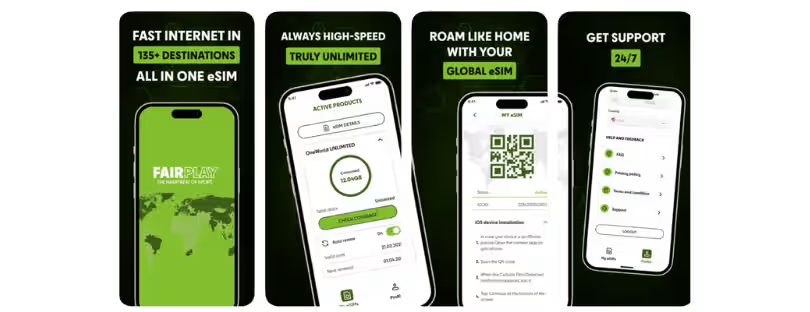
FairPlay’s product philosophy — whether it’s unlimited day passes, monthly Flex subscriptions, or global roaming setup — makes clear it’s targeting users who are frustrated by the hidden costs and limitations of cheap plans. Its website emphasizes a single eSIM covering 135+ destinations, “no unused data waste,” and a tiered plan structure that starts modestly but unlocks truly unlimited data as usage grows.
This isn’t an accident. It’s a response to a real gap in the market: premium travellers and remote professionals want predictable bills, consistent performance and global convenience.
“Chasing the lowest price usually means cutting corners somewhere — coverage, speed, transparency. We chose the opposite approach.”
said Davor Horvat, Footballerista.
In other words, they don’t want the cheapest option — they want the least annoying option.
One eSIM, One Plan, Global Footprint
One of the most tangible ways FairPlay sets itself apart is the simplicity of its footprint. Instead of buying a different profile for every country or region — a common pain with lowcost, segmented eSIM plans — FairPlay pitches “One eSIM. OneWorld.” with seamless connectivity across borders.
This design is strategic. The closer integration of global coverage means FairPlay users don’t have to worry about fiddly installations or buying new data packages mid-trip — a convenience that isn’t trivial for users who travel frequently or live nomadic lifestyles. While cheaper providers might undercut prices for specific regions, they often trade off convenience and simplicity.
It’s also worth noting that FairPlay’s pricing model, particularly its flex plans starting around €25 per month, isn’t at the bottom of the market — but once a user exceeds moderate usage, the cost doesn’t spiral out of control. That gives it a distinct appeal for those who use data for intensive tasks — video calls, cloud backups, video streaming — where throttled plans can quickly become frustrating and expensive when topped up.
In a Sea of Cheap, What Is Premium?
Comparing FairPlay with other travel eSIM brands — such as Truely or Holafly — highlights different strategic priorities in the industry. Some players, like Airalo and Nomad, are often lauded for affordable, flexible region-based offers with plans that can start at just a few dollars or euros. These services are excellent for occasional travellers or data-light users, and their simplicity has helped them amass millions of users.
Others, like Holafly, are pushing global data plans with added voice or SMS features in a bid to simplify connectivity while adding locally relevant capabilities — again, often at prices tailored to heavy use rather than bargain hunting.
FairPlay’s approach sits closer to this latter group: it’s less about undercutting every competitor and more about offering a consistent, no-nonsense experience that eliminates many of the hassles price-centric travellers tolerate. In this context, its higher price tag isn’t a drawback — it’s a feature for a specific set of users who value predictability and performance over every last cent.
“FairPlay isn’t for someone hunting the cheapest gigabyte. It’s for people who travel often and just want connectivity to work.”
Davor Horvat added.
Trends Shaping eSIM Value Perception
Seen through the lens of broader market trends, FairPlay’s strategy aligns with analysts’ expectations for the industry’s evolution. The global eSIM market is expanding rapidly — projected to grow at double-digit rates over the next decade — driven by travel demand, IoT, connected vehicles and enterprise use cases.
As the market matures, price competition remains fierce, but there’s a growing recognition that consumers are willing to pay a premium for better service and fewer surprises. Telecom operators themselves are reportedly pivoting toward personalized and value-added connectivity services rather than simple commoditized data packages.
In other words, we’re seeing a bifurcation: ultra-low-cost, flexible plans for budget travellers, and higher-tier offerings for users whose needs go beyond pure data volume. FairPlay’s pricing and positioning put it squarely in that second category.
What FairPlay’s Strategy Means for Travellers
For travellers and digital nomads accustomed to juggling multiple eSIMs, unpredictable bills and throttled speeds, FairPlay’s model answers a specific pain point: what if connectivity just worked — everywhere — without drama?
It’s not trying to be the cheapest eSIM — it’s trying to be the least frustrating. And that difference in mindset is critical. For frequent flyers, professionals who work on the road, families on long holidays, or even sports fans who simply want reliable streaming abroad, a premium, truly global plan can actually be more cost-effective in the real world, once you factor in convenience and reliability.
That’s why the “price” of a travel eSIM is increasingly about more than euros per gigabyte or dollars per day. It’s about peace of mind, predictable billing, easy activation and usage that “just works” across borders without constant plan juggling. In a market where many choices can overwhelm, FairPlay’s focus on value over lowest price is a sign of both maturity and confidence.
Conclusion
FairPlay’s refusal to chase the lowest price tag reflects a broader shift in the eSIM market: as competition squeezes commoditized offerings, segments of travellers are willing to trade pure price for a better overall experience. Compared to ultra-budget players that compete on cents per megabyte, FairPlay targets users who value seamless global coverage, transparent plans and genuinely unlimited data without the invisible throttling that defines many “cheap” plans.
With a rapidly expanding global eSIM market forecast to grow strongly over the next decade, many brands will continue fighting for the bottom end of the price spectrum. But FairPlay’s strategy — to own the premium, hassle-free niche — could prove prescient as mobility demand continues to rise and users increasingly prioritize simplicity and reliability over the lowest possible cost. For connected travellers, that’s not just smart product positioning — it’s a reflection of real, evolving user needs in a world where digital connectivity is as essential as luggage and a passport.