eSIM in Japan: Can Networks Handle Sakura Surge?
Japan’s cherry blossom season is many things — breathtaking, fleeting, deeply cultural — and, from a network perspective, a genuine stress test. Every spring, thousands of trees burst into bloom across Tokyo, drawing massive crowds to parks and riversides for hanami parties and picnics. And every one of those visitors has a phone. Most of them are uploading. Some are livestreaming. All of them need a connection.
So the obvious question — one that somehow still doesn’t get answered enough — is: what does mobile connectivity actually look like on the ground during Japan’s most chaotic tourist season?
Connectivity Lab set out to find out. Their field tests, conducted at three of Tokyo’s best-known sakura destinations — Ueno Park, Meguro River, and Shinjuku Gyoen National Garden — used a local travel 5G eSIM connected directly to KDDI’s au network. The methodology is clean and the timing deliberate: tests were run ahead of the peak bloom surge, with monitoring set to continue as crowds build.
The short version: the results are good.
The Numbers from the Ground
Idle latency stayed below 40 milliseconds across all three locations — a meaningful benchmark for anyone trying to navigate Google Maps in real time, load a translation app at a restaurant, or video call someone back home. That’s responsive performance, not theoretical maximum performance, which makes it more useful as a real-world indicator than headline speeds alone.
The standout number came from Meguro River, where the device clocked a maximum download of 272 Mbps. That’s well beyond what any traveler needs for the usual mix of Instagram uploads, TikTok clips, and the occasional FaceTime. For context, a typical 4K video upload might demand 20–50 Mbps under optimal conditions. At 272, you have headroom to spare.
The key qualifier in all of this: the eSIM was running on a local 5G unlimited plan, connecting natively to Japan’s domestic infrastructure rather than routing through international roaming channels. That architectural difference isn’t a marketing footnote. It’s why the latency numbers look the way they do.
Why Network Architecture Actually Matters Here
International roaming has a dirty secret most travelers don’t think about: your data often leaves Japan, bounces through your home carrier’s infrastructure somewhere overseas, and then comes back. That round trip adds latency, and in crowded environments where every millisecond of responsiveness matters, it shows.
A local travel eSIM skips all of that. Traffic goes directly onto Japan’s domestic network — in this case, KDDI’s au network, which holds around 31% market share and is recognized for its femtocell technology, particularly in mountain areas, with urban speeds in Tokyo and Osaka competitive with Docomo.
That native connection is what makes the latency numbers believable. You’re not fighting network geography on top of network congestion.
The Scale of the Seasonal Challenge
It’s worth appreciating how unusual the cherry blossom season is as a connectivity scenario. Due to higher-than-usual temperatures across Japan in February 2026, the Japan Meteorological Corporation forecasts that cherry blossoms in Tokyo would begin around March 20 — earlier than a typical year, which compresses the visitor surge into an even tighter window.
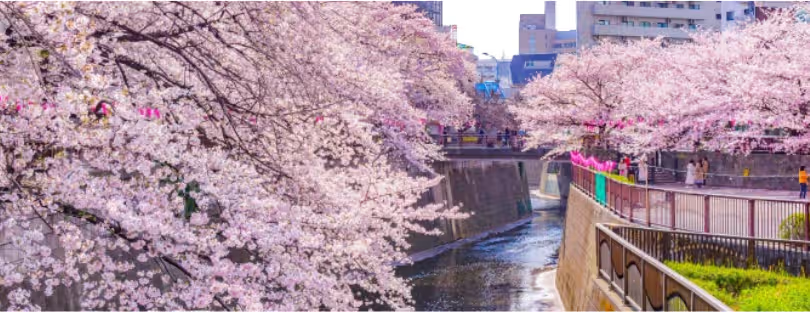
Japan welcomed over 42 million visitors in recent years, putting significant pressure on popular destinations. Ueno Park alone hosts hundreds of thousands of people during the sakura season on a single weekend. Shinjuku Gyoen — officially a national garden — enforces entry caps but still draws enormous crowds. Meguro River, lined with cafés and trendy restaurants, turns into one of Tokyo’s most photographed corridors every March and April.
The upshot is that any network test conducted at these locations under peak conditions is asking a lot. Towers get hammered. Spectrum is shared across thousands of simultaneous connections. That KDDI’s au held up with sub-40ms latency in this environment is worth noting. best eSIM for Japan cherry blossom season
Connectivity Lab Plans to Keep Watching
One pre-peak test is a data point, not a verdict. Connectivity Lab said it plans to continue monitoring mobile network performance at major sakura viewing sites as crowds increase during the peak travel period — which is the right approach. The numbers that matter most are the ones recorded on a Saturday afternoon in late March when Ueno is shoulder-to-shoulder and every tourist within 500 meters is posting a Reel.
Japan Sakura Connectivity Snapshot
Across all locations, early measurements showed strong and stable mobile performance.
What This Tells Us — and What the Market Is Still Figuring Out
Here’s the bigger picture. Field-testing eSIM performance at real-world tourist flashpoints is exactly the kind of content the travel connectivity market has been underproducing. Speed tests in hotel rooms or airport lounges are essentially useless as consumer guidance. Testing at Meguro River during hanami season is actually useful.
On the network side, the KDDI au result confirms what operators and MVNOs building Japan products already know: au is a strong second choice behind Docomo for tourists, with competitive urban speeds and that femtocell advantage in areas other networks struggle with. For providers like Holafly — which uses KDDI for its unlimited Japan plans — and Airalo, which splits between KDDI and SoftBank, independent tests have shown Airalo averaging 100–140 Mbps in urban areas on those networks. The 272 Mbps peak recorded here on a 5G plan suggests maximum throughput headroom is considerably higher when conditions align — though averages, not peaks, are what travelers actually experience.
What’s interesting from a market standpoint is the divergence in how providers are positioning around Japan. Holafly leads on unlimited, branding peace of mind as the core value prop. Ubigi goes the other direction — offering a wider plan range than any competitor, including a 60GB annual plan at roughly $6.67 per month for frequent Japan visitors, which signals a push toward the repeat traveler and digital nomad segment rather than one-time sakura tourists. Airalo dominates on brand recognition. Japan Wireless, a local Tokyo-based operator, plays the country specialist card. None of them is particularly strong on field-tested performance data published transparently, which is a gap this kind of Connectivity Lab report, done consistently, could actually fill.
The broader trend worth watching: as Japan continues posting record inbound numbers — with early 2026 arrivals showing continued growth despite some market-specific fluctuations — and as international tourists grow more eSIM-native, real-world network performance at high-traffic events will become a genuine differentiator. Not just between carriers, but between eSIM providers who can credibly prove their product holds up when it’s needed most and those who can’t. The brands that invest in transparent, location-specific performance data — rather than relying solely on carrier partnership logos — are the ones that will earn trust in an increasingly crowded distribution market.