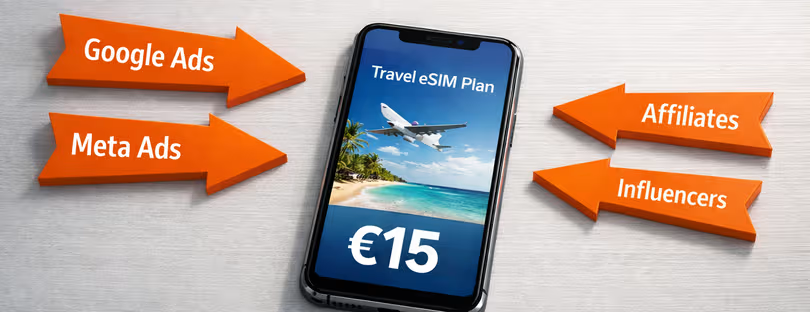
Cheap Data, Expensive Customers: The Travel eSIM Paradox
Scroll through travel apps, airport Wi-Fi landing pages, or travel blogs today and you will see the same promise repeated everywhere: global data for €10, €12, maybe €15. Activate instantly. No roaming shock. No physical SIM cards.
At first glance, the travel eSIM business looks like one of the most elegant digital products ever created.
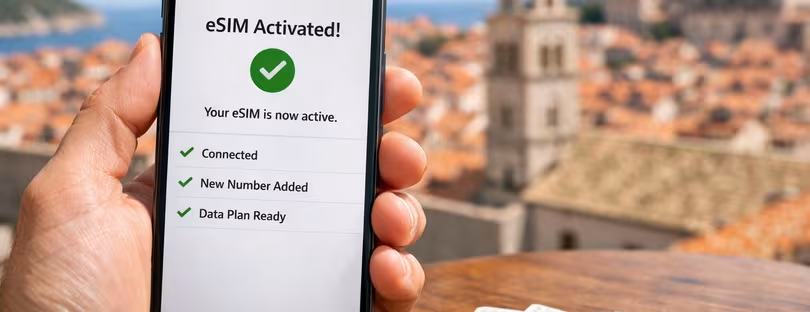
There is no plastic SIM to manufacture, no shipping, no retail store, no staff selling plans at airports. A traveler scans a QR code and suddenly their phone connects to a local network. travel eSIM customer acquisition cost
Just software.
But behind that €10–€15 plan sits one of the most expensive marketing battles in the telecom world today.
In reality, selling a €15 travel eSIM plan can easily cost a provider €30 or even €40 in marketing and distribution before the traveler ever uses a single megabyte of data.
This uncomfortable math is becoming one of the defining economic pressures in the travel connectivity industry. And if you spoke to founders, platform operators, and connectivity providers during MWC Barcelona this year, the same concern kept appearing in conversations.
The market is growing.
But acquiring travelers is getting brutally expensive.
The metric quietly shaping the industry
To understand the economics behind travel eSIMs, you have to look at one number that dominates every digital business: Customer Acquisition Cost, usually called CAC.
CAC measures how much a company spends on marketing and sales to acquire a single paying customer.
The formula is straightforward. Take the total cost of advertising, partnerships, affiliate payouts, influencer campaigns, and marketing operations. Divide it by the number of customers acquired.
What emerges often tells a very uncomfortable story.
In healthy digital businesses, investors usually look for a ratio of roughly three to one between customer lifetime value and acquisition cost. In simple terms, the revenue generated by a customer should be about three times higher than the cost of acquiring them.
Travel eSIM providers often fail that test on the very first transaction.
And that first purchase is usually where the illusion of cheap connectivity starts to break.
What a €15 eSIM sale actually looks like
Let’s take a realistic example.
A traveler planning a trip to Japan searches Google for “best eSIM Japan.” They click a paid advertisement, download an app, and buy a 10GB plan for €15.
Behind that simple purchase is a chain of costs that many users never see.
Paid search competition
Travel connectivity keywords are highly competitive. eSIM apps, telecom brands, comparison websites, and travel platforms all compete for the same search terms.
Clicks for keywords such as “eSIM Europe” or “data plan Japan” can easily cost €2–€4.
If ten users click an ad and only one ends up purchasing, the acquisition cost for that single customer is already €20–€40.
App install campaigns
Many providers focus heavily on app installs. The strategy is simple: if the traveler installs the app, the company can convert them later.
But installs are not free.
Global mobile marketing benchmarks show app installs often cost between €1.50 and €4, depending on the platform and region.
If a company spends €3 per install and only one out of four users purchases a plan, that channel alone represents a €12 acquisition cost.
Affiliate distribution
Affiliate marketing has become one of the most powerful distribution engines in the travel eSIM ecosystem.
Travel bloggers, comparison platforms, and connectivity marketplaces often earn commissions for sending customers to providers.
Typical commissions range between roughly 20 and 40 percent of the plan value.
On a €15 plan, that means €3–€6 can immediately go to the affiliate partner.
For many providers, affiliate networks represent one of the largest marketing expenses.
Influencer marketing
Travel creators on YouTube, TikTok, and Instagram have become powerful promotion channels for eSIM brands.
These partnerships help reach audiences planning trips, but they add another layer of cost.
A sponsored video or campaign might cost thousands of euros. When that investment is spread across conversions, the effective acquisition cost rises again. travel eSIM customer acquisition cost
Brand marketing and content
Even organic traffic has a price.
SEO content, comparison pages, newsletters, PR campaigns, and editorial partnerships require teams, tools, and time.
Over time, these channels can reduce dependence on paid ads. But in the early stages, they still represent a significant investment.
When all these channels are combined, a €30–€40 acquisition cost per customer is not unusual in the travel connectivity space.
And that is before the provider even pays for the data itself.

The wholesale side of connectivity
Travel eSIM providers usually do not own the networks delivering the data.
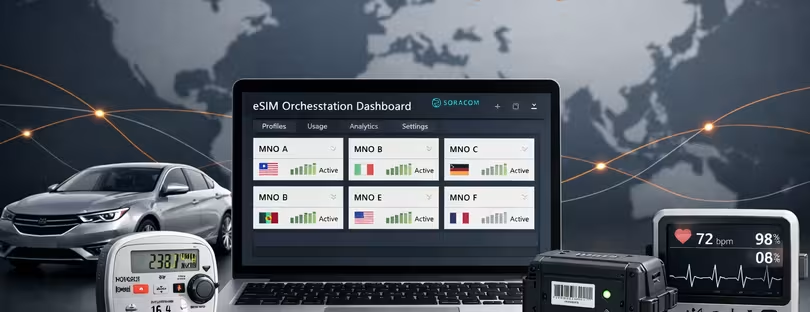
Instead, they purchase wholesale connectivity from mobile network operators or global connectivity platforms that aggregate network capacity across many countries.
Wholesale pricing depends heavily on traffic volume, regions, and negotiated agreements. But industry estimates suggest digital connectivity providers often operate with gross margins between roughly 35 and 60 percent before marketing costs.
If a provider sells a €15 plan, the wholesale connectivity itself may cost around €6–€9.
That means the economic structure can look something like this:
Plan price: €15
Possible cost stack
Marketing acquisition: €30–€40
Affiliate commission: €3–€6
Wholesale connectivity: €6–€9
In other words, the first transaction can easily lose money.
Surprisingly, that is not necessarily a problem.
Why the first sale is often a loss leader
Many digital platforms intentionally accept losses on the first transaction.
The real objective is not selling a single plan.
The real objective is acquiring the traveler.
Once a user installs an app and successfully activates an eSIM, several new revenue opportunities appear.
Travelers who trust a provider often return when they visit new countries. A frequent traveler might buy several plans per year, generating €100 or €200 in revenue over time.
Providers can also upsell larger data bundles, regional packages, or longer-duration plans.
Some companies are experimenting with subscription connectivity models, offering always-available global data rather than single-trip plans.
Others add services such as VPN protection, travel insurance, or travel rewards programs.
Each additional service increases the lifetime value of the traveler.
The first eSIM purchase is therefore less a profit event and more an entry point into a relationship.

The second SIM slot strategy
Retention has become one of the most important strategic battles in the industry.
If a traveler deletes the app after the first trip, the provider must spend another €30 or €40 to reacquire them for the next journey.
This is why many companies now focus intensely on staying installed on the device.
Some industry insiders describe this strategy as the race for the “second SIM slot.”
Most smartphones today support multiple eSIM profiles. The traveler’s primary SIM typically remains their home operator.
But the second slot becomes the travel connectivity provider.
If that slot remains active, the provider effectively becomes the traveler’s default data partner for every future trip.
Once that relationship exists, each new journey can generate another purchase without repeating the expensive acquisition process.
Why distribution is becoming the real battlefield
The early travel eSIM market focused heavily on technology.
Providers competed on coverage maps, supported countries, activation speed, and price.
But those differences are shrinking quickly. Many providers now offer similar global coverage and comparable pricing.
What increasingly separates companies is not connectivity.
It is a distribution.
Companies that already control large digital ecosystems hold a powerful advantage. Fintech apps, airlines, travel platforms, and device manufacturers can introduce connectivity directly to millions of existing users.
These companies do not need to spend €30 or €40 acquiring each traveler through advertising.
Meanwhile, standalone eSIM apps must compete in one of the most expensive digital advertising environments in travel.
This is why partnerships, embedded connectivity, and bundled travel services are becoming central strategies across the industry.
Conclusion: the travel eSIM market is becoming a distribution war
The biggest misconception about the travel eSIM market is that it is primarily a telecom business.
Technically, it is.
Economically, it looks far closer to a consumer internet market.
Connectivity itself is rapidly becoming commoditized. Coverage is similar across providers. Activation processes are nearly identical. Even pricing differences are narrowing.
What really separates companies now is how they reach the traveler.
The companies that win the next phase of the market will not necessarily be the ones selling the cheapest gigabyte of data.
They will be the companies that control distribution.
Airlines, fintech platforms, smartphone ecosystems, and global travel apps all have the potential to integrate connectivity directly into their services, dramatically lowering acquisition costs.
Meanwhile, standalone providers must find ways to retain users, build brand loyalty, and turn a single €15 purchase into a long-term relationship. travel eSIM customer acquisition cost
Because the hardest challenge in the travel eSIM business is no longer delivering data.
It is reaching the traveler without spending €40 to sell a €15 plan.