Aruba.it enters travel eSIM market with Simyousoon service
Aruba.it, best known for cloud services, hosting, and digital infrastructure, has officially entered the travel eSIM space with a new service called Simyousoon. On paper, it looks like a straightforward consumer launch. In reality, it signals something bigger: traditional digital infrastructure companies are now stepping directly into the global mobility game.
Simyousoon offers data bundles from 1 GB up to 20 GB, plus unlimited plans, valid for 7 to 30 days, starting at EUR 1.35. Coverage spans 200+ destinations, and activation is handled instantly through a dedicated mobile app.
If you have been following the evolution of travel connectivity, you know this is not just another “cheap data abroad” story.
This is infrastructure meeting mobility.
From cloud infrastructure to travel connectivity
Aruba.it is not a startup experimenting with roaming arbitrage. It is one of Italy’s largest cloud and data center operators, with deep roots in digital trust services and enterprise infrastructure.
So why move into travel eSIMs?
Because the eSIM layer is increasingly becoming a natural extension of digital identity, cloud infrastructure and app-based service ecosystems. The logic is simple: if you already manage servers, domains and digital services for millions of users, offering mobile data connectivity is no longer a stretch. It becomes another digital utility.
Simyousoon positions itself as:
- Travel-ready eSIM for fast and reliable data
- Instant activation
- Transparent data costs
- 24/7 chat customer support
That positioning aligns closely with what today’s travelers expect: no queues, no plastic SIM cards, no surprise roaming invoices.
What Simyousoon is offering
The commercial structure is relatively familiar for anyone in the travel eSIM ecosystem.
Flexible bundles
Users can choose between 1 GB and 20 GB packages or unlimited data options. Validity ranges from 7 to 30 days. That covers short city breaks, business trips, and longer remote work stays.
Competitive launch pricing
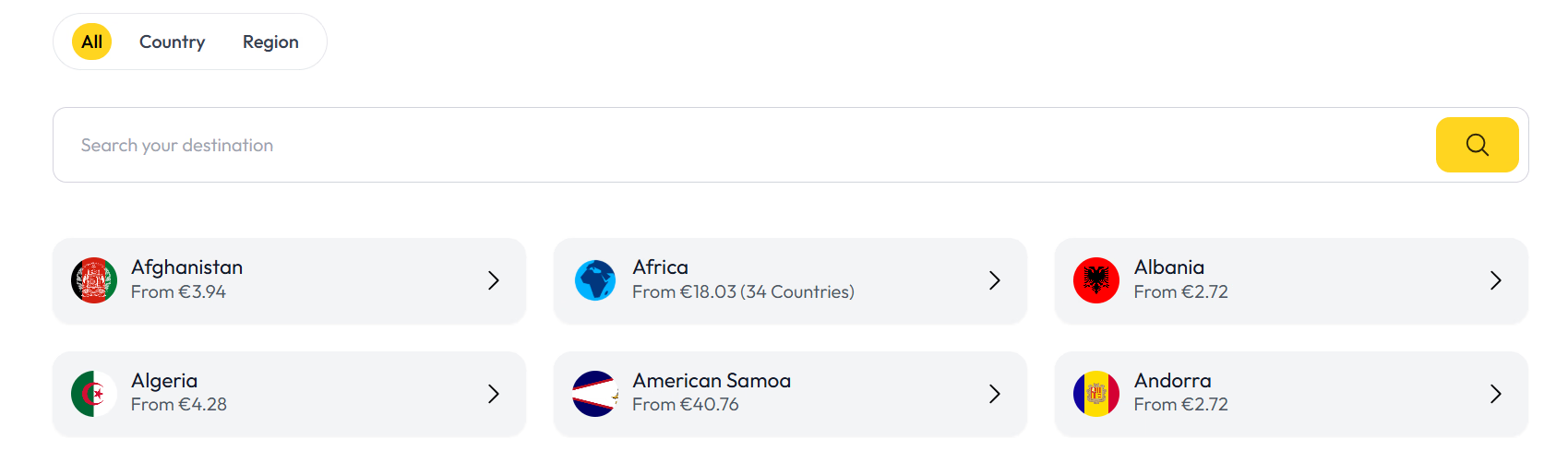
Launch promotions advertise up to 30 percent discounts on selected plans. Example starting prices include:
- United States from €2.72
- United Kingdom from €3.05
- Thailand from €2.03
- Japan from €2.72
- UAE from €2.72
These entry-level price points place Simyousoon firmly within the competitive range of established travel eSIM providers.
App-centric management
Everything runs through the Simyousoon app, available on iOS and Android. Users can install the eSIM, monitor data usage in real time, and top up if needed.
Transparent cost positioning
“No roaming fees” and “no surprises” messaging dominate the product page. Costs are shown upfront, remaining data can be tracked anytime, and activation happens instantly via QR code or in-app setup.
The user journey is simple:
- Choose a destination and data plan
- Download the app and activate
- The plan automatically activates upon arrival
It is a clean, consumer-friendly flow.
The broader market context
The travel eSIM segment has been growing rapidly. According to data from GSMA, global eSIM adoption continues to accelerate, with smartphone manufacturers embedding eSIM capability as a default feature rather than a premium add-on.
Research firms such as IDC have highlighted how digital SIM provisioning is reshaping roaming economics, particularly by enabling over-the-top providers to bypass traditional roaming agreements and sell local-rate data directly to end users.
What makes Aruba.it’s move interesting is not the pricing or bundle size. It is the profile of the company entering.
Until recently, the travel eSIM space was dominated by:
- Travel-focused digital brands
- Telecom aggregators
- MVNO-backed platforms
- API-based connectivity providers
Now, infrastructure players are stepping in.
This reflects a larger structural shift: connectivity is no longer just telecom territory. It is becoming a digital service layer embedded into apps, ecosystems and platforms.
The eSIM evolution from plastic to platform
Simyousoon’s messaging leans heavily into simplicity:
- No physical SIM cards
- No waiting times
- No replacements
- Keep your eSIM forever
That last point is particularly interesting. The concept of keeping a single embedded SIM profile and simply switching plans or operators digitally represents the true promise of eSIM technology.
The device becomes permanent. The network becomes flexible.
For frequent travelers, that means:
- Real-time maps anywhere
- Digital payments without interruption
- Booking confirmations on arrival
- Continuous WhatsApp and messaging access
It is no longer about avoiding roaming fees. It is about preserving digital continuity.
And that is the key difference between first-generation travel SIM cards and modern eSIM services.

Where Simyousoon fits in the competitive landscape
Let’s be realistic. The travel eSIM market is crowded.
Major global players already offer:
- Multi-country regional plans
- Unlimited daily passes
- Enterprise travel solutions
- Crypto payments
- Lounge perks or bundled travel services
Simyousoon does not attempt to differentiate with exotic add-ons. Instead, it competes on:
- Simplicity
- Transparent pricing
- Strong brand trust from Aruba.it
- App-based ease of use
This is a conservative but potentially effective strategy.
Unlike aggressive startup competitors, Aruba.it does not need to build brand trust from zero. It already operates in regulated digital infrastructure environments. That credibility may resonate with users who value reliability over marketing hype.
However, long-term differentiation will require more than price promotions.
Competitors increasingly focus on:
- Multi-network intelligent switching
- Enterprise oversight dashboards
- Subscription-based global data models
- API-driven integrations for travel platforms
If Simyousoon remains purely a consumer data bundle product, it will compete in a price-sensitive segment. If it leverages Aruba.it’s infrastructure DNA, it could evolve into something more integrated.
The infrastructure angle matters
One underappreciated aspect of eSIM growth is the backend architecture.
Provisioning, profile management, remote SIM provisioning standards, and secure subscription management are governed by frameworks developed by the GSMA. As these standards mature, the barrier to entry for digital players lowers.
Cloud-native companies are naturally well-positioned to operate in that environment.
Aruba.it understands data centers, security, uptime guarantees and digital compliance. Applying that expertise to travel connectivity could allow Simyousoon to emphasize performance stability rather than just affordability.
For business travelers in particular, reliability matters more than saving two euros.
A market that is consolidating and expanding
The travel eSIM space is simultaneously fragmenting and consolidating.
On one side, hundreds of niche brands are emerging, often white-labeling the same wholesale connectivity infrastructure. On the other side, larger digital ecosystems are integrating connectivity as a feature rather than a standalone product.
Airlines, fintech apps, super apps and even hardware manufacturers are embedding eSIM options directly into their flows.
Aruba.it’s move suggests another path: digital infrastructure providers expanding horizontally into consumer mobility.
This reflects a broader industry insight.
Connectivity is no longer a standalone telecom service. It is becoming a digital utility embedded into user journeys.
What this means for travelers
For end users, more competition usually means:
- Lower entry prices
- Clearer pricing transparency
- Improved user experience
- Better customer support
Simyousoon promises 24/7 chat support and Aruba-backed assistance channels. If delivered consistently, that could become a strong differentiator in a market where support quality varies significantly.
The promise of “always online, wherever you are, no surprises” is simple. The real test will be network performance consistency across those 200+ destinations.
Conclusion: infrastructure players are the next wave
Aruba.it entering the travel eSIM market is not just another product launch. It is a signal.
The eSIM market is maturing.
First came travel startups solving roaming pain points. Then came aggregators scaling distribution through APIs. Now, established infrastructure providers are stepping in, recognizing that connectivity is simply another digital service layer.
According to projections from IDC and industry data shared by GSMA, eSIM-enabled connections will dominate new smartphone activations within the next few years. As that happens, brand trust and ecosystem integration will matter more than temporary launch discounts.
Simyousoon enters a competitive field, but it does so with institutional backing, infrastructure credibility and a clean consumer proposition.
If Aruba.it leverages its core strengths in cloud architecture, security and service reliability, Simyousoon could evolve beyond being “just another travel eSIM” and become part of a broader digital service ecosystem.
The real question is not whether Aruba.it can sell data bundles.
It is whether infrastructure companies will redefine the next phase of travel connectivity.
And based on this launch, that evolution is already underway.