Airalo Expands with Melon Mobile in South Africa
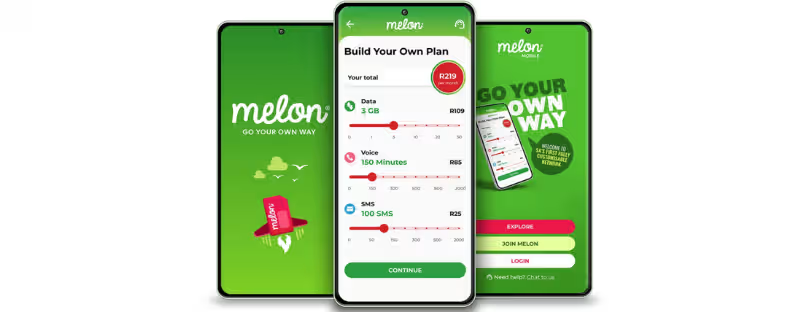
South Africa’s connectivity landscape just got a meaningful upgrade. Melon Mobile has partnered with Airalo to bring frictionless eSIM access to both international visitors and local users.
On paper, this looks like another distribution partnership. In reality, it reflects something bigger: how global eSIM platforms are increasingly relying on strong local network integrations to deliver a better on-the-ground experience.
For travellers heading to South Africa, the value is immediate. You can now install an eSIM before departure and land with connectivity already active, powered locally by Melon Mobile’s infrastructure.
What actually changes for travellers
If you’ve used Airalo before, the flow stays familiar. Open the app, choose a plan, install the eSIM, and connect upon arrival. What changes is the underlying network layer.
Instead of relying on indirect roaming agreements, Airalo users in South Africa will now connect via Melon Mobile’s local setup. That typically means stronger coverage, more stable speeds, and fewer of the inconsistencies that sometimes come with global roaming-based eSIMs.
For users, it’s simple. For the industry, it’s a quiet but important shift toward deeper local partnerships.
Why South Africa matters in this equation
South Africa is not just another destination. It’s one of Africa’s most visited markets, with millions of inbound travellers every year and tourism acting as a key economic driver.
That creates a very specific demand pattern: short-term, high-usage connectivity from users who expect things to “just work” the moment they land.
This is exactly where eSIM has an advantage over traditional roaming and physical SIM cards. No queues at the airport, no paperwork, no uncertainty. Just instant activation.
By plugging into a local operator like Melon Mobile, Airalo is effectively strengthening its position in a market where reliability matters as much as price.

The model behind the partnership
This collaboration follows a model we’re seeing more often across the eSIM ecosystem:
Global distribution + local network control
Airalo brings scale, brand recognition, and a massive global user base. Melon Mobile brings local network relationships and execution.
Pre-installed connectivity
Users install before travel, removing one of the biggest friction points in international connectivity.
Multi-service positioning
Beyond data, the partnership also opens the door for voice and SMS services, something many travel eSIM providers still struggle to offer consistently.
Better cost-performance balance
Local integration often improves margins and performance at the same time, which is rare in telecom.
What Melon Mobile is really doing here
From Melon’s perspective, this is less about tourism alone and more about positioning.
By integrating with a global platform like Airalo, the company is effectively extending its reach beyond domestic users and into international traffic flows. It becomes part of the global connectivity supply chain, not just a local player.
CEO Calvin Collett framed it as a move toward “seamless digital connectivity that works instantly,” but the strategic layer is clear. This is about owning the local access layer in a world where distribution is increasingly global.
Where this fits in the broader eSIM market
The timing is not random.
According to the Trusted Connectivity Alliance, consumer eSIM adoption continues to accelerate, with hundreds of millions of profiles downloaded annually. At the same time, platforms like Airalo have already crossed 20 million users globally, pushing eSIM from a niche travel tool into a mainstream connectivity option.
What we’re seeing now is the next phase:
Global eSIM brands are no longer just aggregators. They are becoming orchestrators of local network partnerships.
This is also where competition is heating up.
Players like Holafly focus on simplicity and unlimited plans. Nomad eSIM leans on flexible pricing and infrastructure backing. Meanwhile, Airalo is doubling down on global coverage combined with localized execution.
Each model solves a different piece of the puzzle. The winners will be those who can combine distribution, pricing, and network quality into one seamless experience.
What this means for travellers and the industry
For travellers, this partnership is straightforward. Better connectivity, less friction, and more confidence that things will work as expected.
For the industry, it signals something more important.
The eSIM market is moving away from simple “resell global data” models toward deeper integration with local telecom ecosystems. That’s where performance improves, margins stabilize, and real differentiation starts to emerge.
Conclusion
This Melon Mobile and Airalo partnership is not just about South Africa. It’s a clear example of how the travel eSIM market is evolving.
The early phase of eSIM was about convenience. Buy, install, connect. That layer is now mature.
The next phase is about quality, control, and infrastructure alignment. Who owns the network experience, not just the customer interface.
And that’s where this deal matters. It shows that the future of travel connectivity will not be built by global platforms alone or local operators alone, but by how well they integrate.
If anything, expect more of these partnerships. Because in a market where users don’t care who provides the signal, only that it works, the strongest combinations will quietly take the lead.