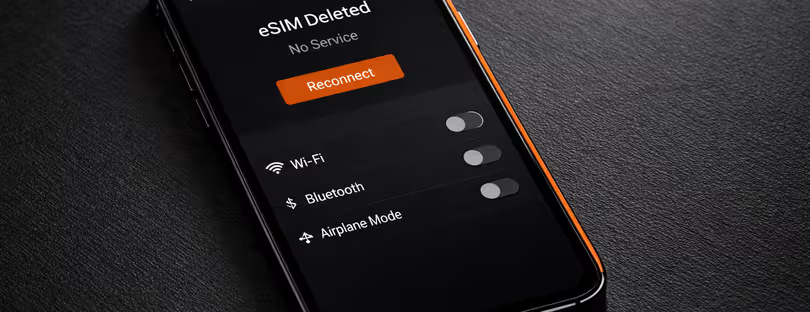
Accidentally Deleted eSIM? Here’s What Really Happens
You don’t plan to delete your eSIM.
It usually happens mid-trip, mid-settings scroll, or mid-panic. You’re switching networks, cleaning up old plans, or just tapping too fast. One wrong click and suddenly:
No signal.
No data.
No fallback.
And unlike a physical SIM, there’s nothing to “put back in.”
This is one of those quiet eSIM realities no one really talks about. Not in onboarding flows. Not in marketing pages. But it’s happening more often than the industry admits.
Let’s unpack what actually happens when you accidentally delete an eSIM, and why this small mistake reveals something much bigger about how the market is evolving.
What actually happens when you delete an eSIM
Deleting an eSIM isn’t like turning off mobile data.
It’s closer to uninstalling your identity from the network.
Technically, what you’re removing is the carrier profile stored on your device’s embedded SIM chip. Once it’s gone, your phone no longer has credentials to connect to that network.
The result is immediate:
- No signal from that carrier
- No calls or SMS
- No mobile data
From your side, it feels like the network disappeared. The profile is removed from your device, and its usability depends on the provider’s provisioning rules.
And here’s the key detail most users don’t realize:
You usually can’t restore it locally — recovery depends on your provider.
There’s no recycle bin for eSIMs.
Behind the scenes, eSIM profiles aren’t stored on your phone in the traditional sense. They’re delivered by a system called SM-DP+ (Subscription Manager Data Preparation), defined by the GSMA. This is the infrastructure that generates, stores, and securely pushes your eSIM profile to your device. When you delete an eSIM, you’re not deleting it from that system — you’re removing your device’s access to it. That’s why recovery isn’t something your phone can handle locally. It has to come from the provider’s side.
Can you recover a deleted eSIM?
Short answer: yes, but not in the way you think.
You’re not restoring the same eSIM. You’re getting a new one.
In most cases, recovery means:
- contacting your provider
- verifying your identity
- receiving a new QR code or activation link
- installing a fresh eSIM profile
That’s it.
There is no local recovery on the device. The logic is entirely network-side.
If you’re lucky, and you saved the original QR code, you might be able to reuse it. But many providers invalidate codes after first use, which means you’re back to support anyway.
This is why almost every official answer, across carriers and support forums, comes down to the same sentence:
Contact your carrier and request a new eSIM.
Not exactly the seamless experience eSIM promises.

The real problem appears when you’re traveling
Deleting your eSIM at home is annoying.
Deleting it abroad is a different story.
Because now you’re dealing with:
- no mobile data
- no SMS (which often breaks login or verification)
- no easy way to contact support
- potential roaming restrictions on replacement activation
Some carriers even require activation on their home network, which can make recovery impossible until you return (applies mainly to legacy carriers, not modern travel eSIM apps).
This is where eSIM’s biggest advantage flips into its biggest weakness.
With a physical SIM, you could walk into a store, swap it, and move on.
With eSIM, you’re dependent on:
- WiFi access
- backend systems
- customer support responsiveness
That’s not frictionless. That’s infrastructure-dependent.
Why this keeps happening
If you look at forums and user reports, accidental deletion isn’t rare.
It’s a design issue.
Modern phones allow multiple eSIM profiles, temporary travel plans, and easy switching (eSIM profiles are governed by GSMA standards (SGP.22 / SGP.32)). That’s great. But it also creates confusion:
- users don’t always know which plan is active
- naming is inconsistent
- deletion is often just one tap away
And the system doesn’t warn you properly about consequences.
There’s no “this will fully disconnect your number” moment.
Just a confirmation button.
That’s a UX problem, not a user problem.

How different providers handle it
This is where the market starts to split.
Not all eSIM providers behave the same when things go wrong.
Consumer travel eSIM players
Most travel eSIM providers (Airalo, Holafly, Yesim, Nomad) operate on a prepaid model.
If you delete the eSIM:
- some allow reinstallation via app
- others require reissuing
- some may charge for replacement
The experience depends heavily on how tightly they control their provisioning systems.
Infrastructure-driven players
Providers with stronger backend control (think API-first platforms or MVNEs) can often:
- reissue instantly
- push profiles directly
- automate recovery flows
This is where you start to see the difference between:
→ selling data
→ owning connectivity infrastructure
And it matters more than most users realize.
Enterprise-focused solutions
Companies like SureSIM or 1GLOBAL approach this differently.
For them, eSIM isn’t just a product. It’s a managed asset.
That means:
- centralized control
- remote provisioning
- policy-based recovery
Accidental deletion becomes an operational event, not a user problem.
That’s a completely different level of maturity.

What you should actually do if it happens
No fluff. Just what works.
Immediate steps
- Connect to WiFi
- Log into your carrier or eSIM provider account
- Check if you can reinstall via app or dashboard
If that fails
- Contact support
- Request a new eSIM profile
- Be ready with IMEI and account verification
If you’re traveling
- Use hotel or public WiFi
- Avoid deleting any secondary backup eSIM
- If possible, install a temporary eSIM to stay connected
And one important lesson:
Always keep a backup connectivity option.
Because eSIM is not immune to failure. It just fails differently.
The bigger picture
This is not just about accidentally deleting an eSIM.
It’s about how digital connectivity is being redefined.
eSIM promised simplicity. And in many ways, it delivered:
- no physical cards
- instant activation
- global access
But it also introduced a new dependency layer:
You no longer control your connectivity physically.
You rely on:
- platforms
- provisioning systems
- APIs
- carrier infrastructure
And when something breaks, you feel it immediately.
This is why the market is shifting.
The real competition is no longer about:
→ who has the cheapest data
→ or the most countries
It’s about:
→ who controls the experience when things go wrong
Because that’s where trust is built.
Conclusion
Accidentally deleting an eSIM feels like a small mistake.
But it exposes something fundamental about the industry.
The difference between providers is no longer visible in marketing pages. It shows up in edge cases like this.
Some providers leave you stuck in support loops.
Others rebuild your connection in seconds.
That gap is widening.
And it’s why the eSIM market is quietly splitting into two categories:
- providers selling access
- providers building systems
As adoption grows, users won’t remember who had the cheapest plan.
They’ll remember who got them back online when it mattered.
And that’s where the real winners will emerge.