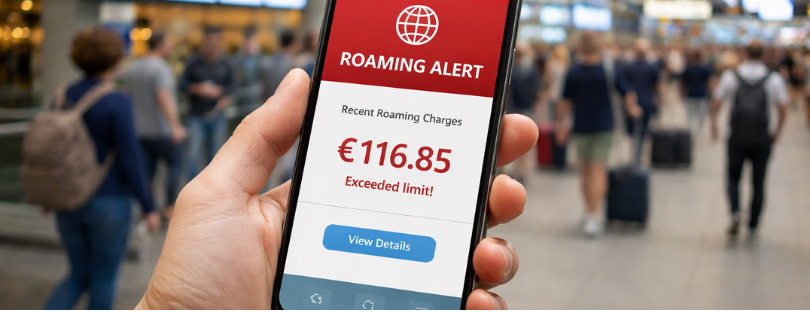
Why Roaming Charges Still Surprise Travellers in 2026
It is 2026. You can tap-to-pay on a mountain, board a plane with a digital boarding pass, and download an eSIM in the time it takes to find your gate.
And yet roaming charges still catch travellers off guard.
Not always in the dramatic “€400 for two days” way. More often it is the quiet version: a couple of euros here, a “small” daily pass you did not realise you activated, a few megabytes billed at a rate that looks like it belongs in 2009, and suddenly your post-trip phone bill feels like a gotcha.
The tricky part is that roaming has genuinely improved in some places. If you travel inside the EU/EEA, “Roam Like at Home” is still doing what it promised: domestic-like pricing, more transparency, and extra protections around things like premium services and non-terrestrial networks.
So why are travellers still getting burned?
Because the way we travel and the way our phones behave has changed faster than the mental model most people have for roaming.
The biggest trap is thinking roaming is one problem
Most travellers still treat roaming like a single on/off switch.
In reality, it is three different worlds:
EU/EEA roaming (mostly predictable)
If you are an EU/EEA customer travelling within the EU/EEA, the rules are fairly consumer-friendly and widely understood by now.
Non-EU roaming (where the old chaos still lives)
Step outside that zone and pricing can jump sharply. Regulators have flagged that “rest of world” roaming prices remain far higher than domestic levels, and that some of the worst surprises happen outside the EU/EEA.
Non-terrestrial networks (the cruise ship and plane problem)
This is the one people forget exists until their phone connects to a maritime or airborne network, and the “normal rules” do not apply. EU policy discussions explicitly call these out because unexpected surcharges can happen fast.
If you keep those three buckets in your head, a lot of 2026 roaming confusion suddenly makes sense.
“I barely used my phone” is no longer a defence
Here is what changed: you can be “not using your phone” and still be using data.
Background behaviour is the new bill shock engine:
- Cloud photo backups kicking in the moment you hit 4G
- App updates auto-downloading because the hotel Wi-Fi is slow
- Maps preloading an entire city because you opened it once
- Messaging apps restoring media and voice notes
- Laptop tethering that eats 1GB before you even open your email
And travellers do not notice because it feels invisible. Your phone is doing what it was designed to do: stay synced, stay current, stay helpful.
Roaming billing is doing what it was designed to do: charge per unit (sometimes brutally) when you are outside your home tariff protections.

 Borders still bite, even when you swear you did not cross one
 Borders still bite, even when you swear you did not cross one
One of the most underestimated roaming triggers is accidental network switching near borders.
Regulators have noted complaints about inadvertent roaming when people travel near EU/EEA borders with neighbouring non-EU/EEA countries, and also when devices latch onto non-terrestrial networks.
This is how you get the classic story:
“I was in Croatia / Greece / Finland / Spain the whole time.”
Sure.
But your phone briefly connected to a network across the water or across the border, and your billing system did not care that it was accidental.
In 2026, with travellers doing road trips, ferry hops, island itineraries, and cross-border train rides, this happens more than people think.
The welcome SMS arrives late, and your cost limit can be hit before it lands
Everyone expects the “Welcome to X, here are your roaming rates” message to protect them.
But it is not a shield. It is a notification.
BEREC has flagged complaints where users were billed surcharges before receiving the welcome SMS, and because “rest of world” rates can be so high, some people hit the cut-off limit before the message even arrived.
That is why relying on the welcome message as your moment to “decide what to do” is risky. By the time you are informed, you may already have consumed chargeable data in the background.
UK travellers are living a different roaming reality now
If you are a UK customer travelling in the EU, the post-Brexit shift still matters in 2026.
The UK is not under an obligation to guarantee surcharge-free roaming across the EEA, and some protections that used to exist have expired.
So two travellers can stand next to each other in Paris:
- One EU customer, happily roaming like at home.
- One UK customer, paying daily fees or per-MB rates depending on their operator and plan.
Same destination. Completely different bill outcome.
And this is exactly how travellers get caught: they assume the rules are universal, because their friend’s rules were.
The “roaming pass” era created a new kind of confusion
Operators got smarter. Instead of shocking per-MB bills, many push daily passes, weekly bundles, and “travel add-ons.”
This is better for most people, but it comes with fine print pitfalls:
- Passes that activate automatically the moment you use data abroad
- Passes that cover some countries but not the one you are connecting to
- “Unlimited” passes with fair use throttling or speed caps
- Bundles that do not include tethering, hotspot, or premium services
Regulators have even pointed to problems with automatic non-EU roaming bundles, arguing that consumers should deliberately opt in rather than be defaulted into packages they did not want.
So yes, roaming passes reduced the classic horror stories, but they also introduced a subtler issue: people think they are “safe” because they have “a pass,” when the pass might not apply in the moment that matters.

Why eSIM did not magically solve this (yet)
Travel eSIMs are one of the strongest counters to roaming bill shock, but two realities keep roaming surprises alive:
Awareness is still not universal
GSMA Intelligence has reported that in a multi-country consumer sample, fewer than 30% of consumers were aware of eSIM (at least at the time of that study), which is still a real adoption barrier.
Behaviour lags behind capability
Even travellers who know eSIM exists often do not set it up before departure. Then they land, their primary SIM roams, background data kicks in, and the damage is done before they remember the eSIM plan they meant to buy.
Also, eSIM does not automatically stop your primary line from roaming. Dual SIM is powerful, but it is also a “two knobs” system that many people never fully configure.
What is changing in 2026 (and what is not)
Here is the trend line I would bet on:
- Inside the EU/EEA, the trajectory is still toward more predictable roaming, better transparency, and fewer loopholes, with the Commission continuing to monitor the market and strengthen consumer information around tricky areas like premium services and non-terrestrial networks.
- The EU is also moving toward extending the “Roam Like at Home” area to additional countries, with Ukraine and Moldova highlighted as progressing on that path. That will reduce surprises for travellers who move across those borders.
- Outside those frameworks, roaming remains a commercial jungle. Prices can still be high, bundles can still be confusing, and “I did not mean to use data” is still not a billing category.
So the situation is improving, but unevenly. And travellers mostly experience the uneven part.
The conclusion
Roaming charges still catch travellers off guard in 2026 because the problem is no longer just “expensive rates.” It is mismatched expectations.
We travel across regulatory zones without noticing. Our phones consume data without asking. Operators sell passes that feel simple but behave like products with edge cases. And the biggest gotcha of all is psychological: people assume connectivity is a utility now, priced like water and electricity, when roaming outside protected regimes is still priced like a premium service.
Compared with the market alternatives, the pattern is clear. Operator roaming add-ons are convenient but can be opaque across borders and zones. Travel eSIMs are usually the cleanest way to control cost, but adoption is still held back by awareness and setup habits. Wi-Fi-only is cheaper, but unreliable for modern travel workflows. “Do nothing and hope” is the one strategy that keeps producing the same headline every year.
The real 2026 move is not just “buy an eSIM.” It is building a new default: treat cross-border connectivity like you treat travel insurance. You do not wait for the emergency to start thinking about it.
Because the roaming bill shock is not really about roaming anymore. It is about how often your phone makes decisions faster than you do.