Why Mobile Operators Must Rethink Latency in the Age of Travel eSIMs
We don’t talk enough about latency. It’s one of those tech terms that often gets brushed aside in the consumer conversation because, well, it doesn’t sound as sexy as “5G” or “unlimited data.” But latency—the delay before data starts moving—is quietly becoming one of the biggest competitive battlegrounds for mobile operators, especially now that travel eSIMs are stepping into the spotlight. travel eSIM latency
If you’re a mobile operator still thinking of latency as a niche concern only relevant for hardcore gamers, it’s time for a reality check. In the age of borderless connectivity and instant switching between carriers via eSIM, latency is no longer a technical footnote. It’s a customer experience dealbreaker.
Let’s unpack why.
Latency: The Invisible Friction Point
When most people think about network quality, they go straight to speed tests—download and upload rates. And sure, nobody wants to wait 15 minutes for a Netflix download at the airport. But speed is only half the story.
Latency is the subtle culprit behind so many of those everyday frustrations: the lag when you open Google Maps abroad, the delay on a WhatsApp call, or that awkward pause on a video meeting when you’re checking in from a hotel Wi-Fi fallback that’s secretly tethered to a local SIM.
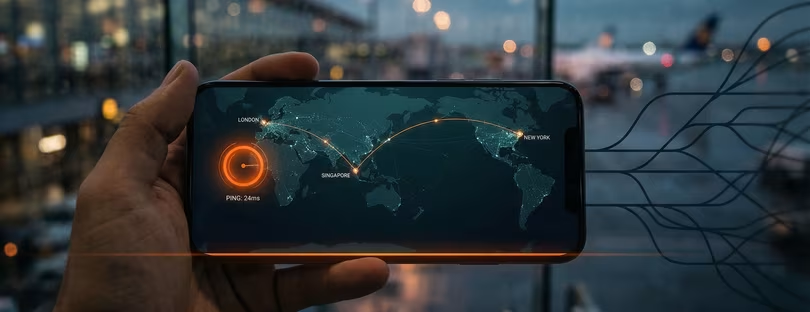
For travelers, latency is amplified because of distance and routing. If your eSIM provider is routing your data traffic through a home base in Singapore while you’re standing in Madrid, you’re going to feel it—no matter how many gigabytes you bought.
The eSIM Effect: Zero Loyalty Switching
Here’s where it gets interesting for operators: eSIM has made switching networks frictionless. In the old days, swapping to a different SIM card abroad was a hassle—you had to find a shop, fiddle with a paperclip, and hope you didn’t lose your original SIM. Latency was just one of those things you tolerated if you wanted to avoid paying €15 for a single MB of roaming.
But with eSIM? A traveler can literally try out three different providers in an afternoon, and they don’t even need to leave their hotel room to do it. If latency is poor, the uninstall button is just as easy to hit as “install.”
In other words, latency isn’t just a performance metric anymore. It’s a competitive differentiator in a market where loyalty is paper-thin.
Business Travelers Feel It First
Let’s zoom in on one particular group: business travelers. They’re the ones dialing into Teams calls from airports, uploading large decks from taxis, or handling sensitive transactions on the move. For them, a split-second delay can make or break productivity.
If you’re an operator and your latency adds an extra half-second to every round-trip data request, it doesn’t sound like much on paper. But in a 45-minute video call? That’s a whole layer of friction that translates into frustration. And frustrated business travelers don’t just churn quietly—they complain loudly. On LinkedIn. To their companies. To their travel managers, who then switch corporate contracts.
 Latency and the Rise of AI-Driven Travel
 Latency and the Rise of AI-Driven Travel
Another reason operators can’t afford to treat latency as a backroom metric: AI. Travelers today rely heavily on real-time, AI-powered tools—think live translation apps, instant itinerary updates, or augmented reality guides layered over a foreign city street.
These applications are hyper-sensitive to latency. If the AR arrow lags behind you by two seconds while you’re walking in Tokyo, it’s useless. If your real-time translation app stutters mid-sentence in a negotiation, you lose credibility.
And the kicker? These apps are exactly the kind of services travelers are willing to pay extra for, which means they’re also the kind of services that expose poor latency like a flashing neon sign.
The Routing Problem Nobody Talks About
One of the quirks of travel eSIMs is that many providers don’t actually connect you to a local operator’s core network. Instead, they tunnel your traffic through their own infrastructure—often backhauled halfway across the world.
That’s why you’ll see reviews that say something like: “The data worked fine, but Google Maps was super laggy.” It’s not that the local network was weak—it’s that your data took the long way around.
For operators, this is both a challenge and an opportunity. If you can localize traffic and keep latency low, you stand out in a crowded eSIM marketplace. If you don’t, you’re just another “good on paper, disappointing in practice” option.
Why Operators Need to Rethink Their Priorities
Traditionally, operators marketed themselves on coverage and gigabyte bundles. That made sense in a SIM card world where customers were locked in for the duration of their trip. But with travel eSIMs, customers are buying performance, not just data buckets.
And performance isn’t just about raw speed. It’s about:
- Where the traffic is routed (local vs. international backhaul)
- How consistent the latency is (not just average numbers)
- Whether the network prioritizes real-time apps like voice, video, and translation
If you’re still selling data like it’s 2010, you’re missing the story.

The New Traveler’s Hierarchy of Needs
Let’s put this in human terms. A modern traveler doesn’t care if their connection is technically “fast” if it feels slow. Here’s the hierarchy:
- Does my app open instantly?
- Does my call sound natural?
- Does my map keep up with me?
- Then—and only then—do I check how many gigabytes I’ve got left.
Notice where latency fits in? Right at the top.
The Call to Action for Operators
So what should operators actually do about latency in the age of travel eSIMs?
- Invest in localized breakouts. Stop routing European travelers’ data through Asia just because your infrastructure is centralized there.
- Market latency, not just speed. Publish transparent metrics. Show travelers that you’ve optimized for real-world use.
- Partner smarter. Work with eSIM aggregators that prioritize low-latency connections, not just the cheapest wholesale deals.
- Educate consumers. If you can explain why your connection feels smoother, you’ll build trust and loyalty that gigabyte numbers alone can’t buy.
A Final Thought about travel eSIM latency
We’ve entered an era where connectivity is judged not by what’s promised on the box but by what’s felt in the moment. Travelers don’t care about latency as a number—they care about whether their translation app stutters while ordering dinner in Rome.
For mobile operators, this is a wake-up call. Latency is no longer an invisible metric hidden in the background. It’s front and center in the eSIM battle for traveler loyalty.
If operators don’t rethink latency now, they’ll lose to those who do—because in the age of instant switching, travelers won’t wait around for a better experience. They’ll just download it.