Why eSIM Is Becoming Essential for Business Travel in 2026
In 2026, business travel is not roaring back blindly. It is recalibrating.
After the sharp rebound of 2025, companies are entering a more deliberate phase of mobility. Fewer vanity trips, fewer rushed itineraries, more purpose. Travel is no longer about clocking miles or filling calendars. It is about being in the right place, at the right time, for the right reason, so deals close naturally and work actually moves forward.
That shift is quietly transforming one overlooked layer of corporate travel: connectivity. And it is why eSIMs have moved from a nice-to-have to a foundational tool for modern business travel.
Business travel without borders
Holafly’s latest global insights revealed a couple of months ago that eight in ten professionals expect to travel internationally in 2026, while only a small minority plan to stay fully domestic. The implication is hard to ignore: business has no barriers anymore.
What has changed is not where people work, but how seamlessly they expect to work. Global teams now assume that Slack, Zoom, cloud tools, CRM systems, and security protocols will function the moment they land. There is no patience for airport SIM hunts, roaming bill anxiety, or patchy hotel Wi-Fi.
This is where eSIM technology has quietly become one of the most practical upgrades in corporate mobility.
Why eSIM fits the new business travel logic
An eSIM removes friction at exactly the moments that matter most. It is activated before departure or upon landing, works across multiple countries, and eliminates physical SIM swaps entirely.
For business travelers, that means no downtime between landing and the first call. For finance teams, it means predictable costs instead of post-trip roaming surprises. For IT and security teams, it means centralized control, easier provisioning, and fewer unknown variables.
As travel becomes more intentional, connectivity needs to be invisible. eSIMs deliver that invisibility better than any alternative currently on the market.
Business hubs are consolidating, not expanding
In 2026, corporate mobility is gravitating toward a familiar yet powerful set of cities. These are places where deals are signed, partnerships are formed, and decisions move faster because the ecosystem is already there.
Holafly asked more than 10,000 respondents in its Global eSIM & Travel Report 2025–2026, and the business hubs for 2026 appeared clearly.
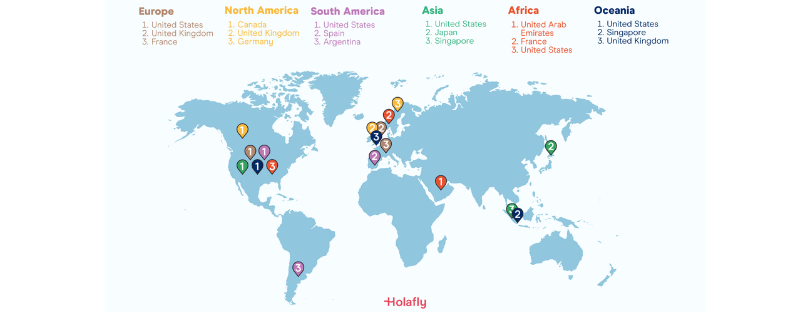
Top business hubs by region
Europe: United States, United Kingdom, France
North America: Canada, the United Kingdom, Germany
South America: United States, Spain, Argentina
Asia: United States, Japan, Singapore
Africa: United Arab Emirates, France, United States
Oceania: United States, Singapore, United Kingdom
Business travelers are not chasing novelty. They are reinforcing the routes that already work and the hubs that historically deliver results. Trust is established, infrastructure is mature, and time on the ground produces measurable outcomes.
Connectivity in these hubs is not optional. It is assumed.
Connectivity as a performance tool
“At the end of the day, all the signals point in the same direction,” says Alex Bryszkowski, VP of Holafly for Business. “In 2026, business travel isn’t about how often teams fly, but about what happens when they land. The strongest hubs are the ones that allow people to focus on building relationships, moving projects forward and making decisions that actually matter, and where staying connected, secure and at ease is never a concern.”
That statement captures a growing consensus across corporate travel managers. Connectivity is no longer an IT line item. It is a performance enabler.
Arriving connected means meetings start on time, navigation works instantly, authentication flows do not break, and teams can focus on outcomes rather than logistics.
Holafly for Business and the managed eSIM model
For global companies, solutions like Holafly for Business play a central role in this transition. The appeal is not just coverage, but management.
Corporate eSIM platforms increasingly offer centralized dashboards, employee provisioning, flexible data plans, and customer support designed for scale. This aligns well with companies that want consistency across regions without negotiating dozens of local SIM contracts.
Holafly’s business-focused approach reflects a broader market trend: eSIM providers are no longer selling data. They are selling predictability.
Strong contenders reshaping business eSIMs
Holafly is not alone. A new generation of eSIM providers is actively targeting business travelers with more specialized offerings.
Fairplay Mobile has positioned itself as a pragmatic choice for heavy travelers through its Flex Unlimited model. For professionals moving frequently across borders, unlimited-style plans remove mental overhead. No data tracking, no unexpected throttling discussions mid-trip, just stable connectivity that mirrors the way business actually happens.
Yesim leans into flexibility and user experience. Its global coverage, app-based management, and transparent pricing resonate with teams that blend corporate travel with remote work. For hybrid professionals, Yesim’s model reflects how work and travel increasingly overlap.
Airhub operates closer to the enterprise layer. Its strength lies in bulk provisioning, API integrations, and enterprise-grade controls. This makes it attractive for organizations managing large, distributed teams where connectivity needs to scale without adding operational complexity.
Together, these players illustrate where the business eSIM market is heading: fewer gimmicks, more infrastructure thinking.

Cost control without compromise
One of the quiet benefits of eSIM adoption in business travel is financial clarity. Traditional roaming models were built for occasional travel, not constant cross-border movement. They break down quickly at scale.
eSIM platforms replace variable roaming charges with fixed, pre-approved plans. This simplifies expense reporting, reduces disputes, and gives finance teams visibility before trips happen, not weeks later.
In a climate where CFOs scrutinize travel ROI more closely than ever, that predictability matters.
Security, compliance, and control
Beyond cost and convenience, eSIMs offer subtle security advantages. Centralized provisioning allows companies to disable plans, limit exposure, and standardize connectivity behavior across regions.
As regulatory environments grow more complex, especially around data handling and cross-border work, having a consistent connectivity layer reduces risk. This is particularly relevant for industries operating under strict compliance frameworks.
eSIM as a baseline, not a perk
The broader trend is clear. eSIMs are no longer a perk for frequent flyers. They are becoming baseline infrastructure for any company operating internationally.
This mirrors earlier shifts in business travel. Wi-Fi went from luxury to expectation. Mobile device management became standard. Cloud access became assumed. eSIMs are following the same path, faster.
Conclusion: the invisible advantage
In 2026, the most successful business trips will not be defined by the flight taken or the hotel booked, but by how little friction exists once work begins.
eSIM technology sits quietly in the background of that success. It removes barriers without demanding attention. It supports focus rather than distracting from it.
Compared with traditional roaming, local SIM logistics, or unreliable Wi-Fi dependency, business-focused eSIM providers offer a cleaner, more scalable model. Holafly for Business, Fairplay Mobile, Yesim, and Airhub represent different interpretations of the same truth: global work needs global-ready connectivity.
As business travel becomes more intentional and outcomes-driven, the tools that survive will be the ones that disappear into the workflow. In that sense, eSIMs may be one of the most important upgrades corporate travel has made in years, not because they are flashy, but because they finally let professionals land ready to work.
Sources referenced include Holafly Global eSIM & Travel Report 2025–2026, corporate mobility trend analyses from GSMA, and ongoing enterprise connectivity reporting across the travel tech sector.