Vodafone Partners With Netcompany to Scale Global Travel eSIM Connectivity
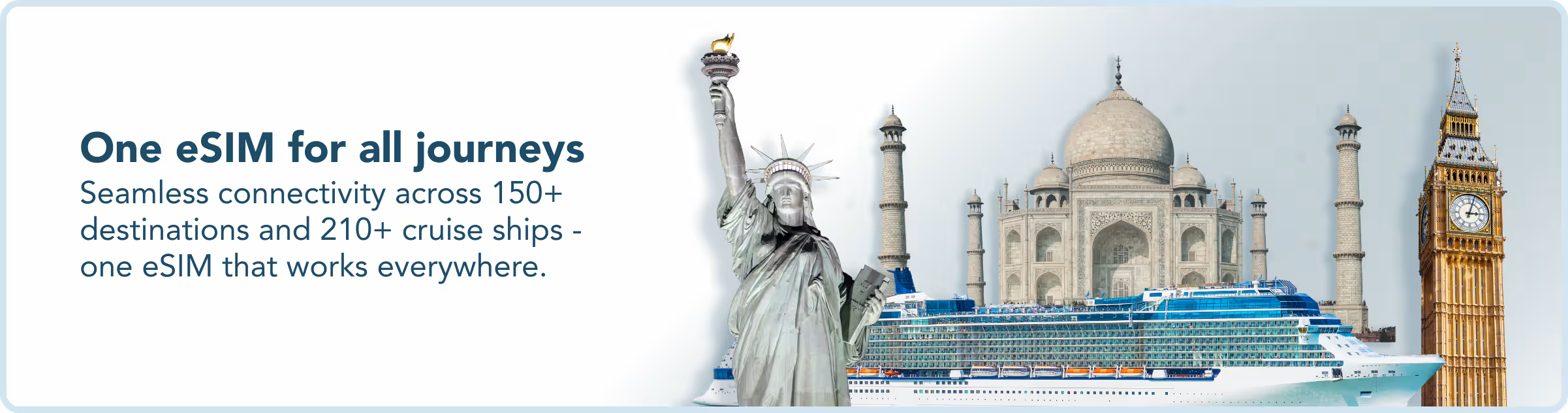
Vodafone has quietly but decisively stepped deeper into the global travel connectivity market. Together with Netcompany, the operator has launched a new Travel eSIM platform designed to give travellers instant access to mobile data in more than 200 destinations worldwide.
At its core, the proposition is simple. Data-only connectivity that activates in seconds, works across 700 partner networks, and removes the need for roaming add-ons, public Wi-Fi hunting, or buying local SIM cards at the airport. But behind that simplicity sits a carefully timed move into one of the fastest-growing segments of the telecom and travel tech ecosystem.
The platform is available not only to Vodafone customers but also to anyone with a compatible smartphone. Users keep their existing phone number, download an eSIM profile through an app, and get online almost immediately. For frequent travellers, that alone solves a long list of familiar pain points.
What the Travel eSIM actually offers
This is a data-only product. There are no voice minutes or SMS bundles, and that is very much by design. Vodafone and Netcompany are leaning into how travellers actually use their phones abroad in 2026. Messaging apps, navigation, cloud services, work tools, social media, banking, and ride-hailing all depend on stable mobile data, not traditional calls.
The Travel eSIM uses embedded SIM technology, allowing users to install a digital SIM profile directly onto their device. No physical SIM swapping. No risk of losing a home SIM. No compatibility guessing games once you land.
Coverage spans more than 200 destinations across continents, supported by Vodafone’s wholesale and partner network relationships. The companies say the service activates in seconds via the app, a detail that matters far more than it sounds. Speed of activation is one of the biggest friction points in today’s eSIM market, and also one of the easiest places to lose user trust.
Who this is built for
Vodafone and Netcompany position the platform for a wide range of traveller profiles, from digital nomads and business professionals to leisure tourists. That broad positioning reflects how the travel eSIM market itself has evolved.
What started as a niche solution for tech-savvy travellers has gone mainstream. Business travellers want predictable costs and reliable coverage across multiple countries. Digital nomads want flexibility and multi-country plans. Leisure travellers simply want their phone to work when they arrive, without surprises on their bill.
By making the platform available to non-Vodafone customers, Vodafone is clearly treating this as a standalone global product, not just a value-added service for its existing base.

Why Vodafone is doing this now
For European operators, roaming within the EU has been largely commoditised. Prices are regulated, margins are thin, and differentiation is limited. The real complexity and opportunity begin once travellers leave the EU, where roaming pricing, policies, and user expectations diverge sharply.
The Travel eSIM platform gives Vodafone a cleaner, more scalable way to serve outbound travellers without forcing them into traditional roaming models. It also sidesteps a key behavioural shift. Many travellers actively avoid roaming today, even when it is technically available, because of fear of bill shock, unclear pricing, or bad past experiences.
By offering a separate, app-based eSIM product, Vodafone meets users where they already are in the app economy.
Netcompany’s role behind the scenes
Netcompany developed the Travel eSIM platform for Vodafone, covering mobile and web applications as well as deep integration with telecom systems. That includes provisioning, network access, user authentication, and the operational plumbing that most users never see but immediately notice if it fails.
Founded in Copenhagen, Netcompany operates as an IT services provider across public and private sectors and employs more than 9,400 professionals. The project fits into a broader trend where telecom operators increasingly rely on external development partners to deliver consumer-facing digital services quickly and at scale.
Time to market matters here. So does the ability to deploy across dozens or hundreds of countries without breaking the user experience.
“Through the Travel eSIM platform, developed for our client Vodafone Group, we offer a solution that connects the world in a simple, secure, and seamless way. This is a project that leverages our know-how and proves that technology can make our lives easier, regardless of location”,
said Christos Kontellis, Country Managing Partner Netcompany SEE.
Speed, experience, and reliability as priorities
Vodafone says the platform moved quickly from initial concept to broad launch, a detail that signals internal urgency rather than experimentation. User experience and reliability were highlighted as key design goals, which again speaks to lessons learned from earlier generations of roaming apps and travel connectivity tools.
“Launching the Travel eSIM platform has been a major step forward in delivering seamless, borderless connectivity to our customers. Working with Netcompany allowed us to move from concept to global rollout at speed, without compromising on user experience or reliability”,
commented Nick Dutch, Business Owner of Vodafone Travel eSIM.
That emphasis is telling. In today’s eSIM market, coverage claims are easy. Reliability is harder. Support is harder still. Operators entering this space cannot afford the instability that has plagued some early eSIM-only players.
How does this fit into the wider eSIM market?
The travel eSIM segment has exploded over the past three years. Specialist providers like Airalo, Nomad eSIM, and GigSky have built global audiences by offering flexible data plans outside traditional operator ecosystems.
At the same time, airlines, fintech apps, and travel platforms are increasingly bundling connectivity into broader services. Think flight booking plus data. Travel insurance plus data. Banking apps with built-in roaming alternatives.
Vodafone’s move is different because it brings operator-grade infrastructure, brand trust, and wholesale relationships into a space that has so far been dominated by digital-first challengers. That does not automatically guarantee success, but it does change the competitive dynamics.
What does this signal mean for operators
This launch reflects a wider shift in how telecom operators think about travel connectivity. Rather than forcing roaming into legacy billing systems, many are now treating travel eSIMs as separate digital products with their own pricing, UX, and go-to-market strategies.
It also shows growing acceptance that travellers are willing to buy connectivity from brands other than their home operator, as long as the experience is simple and transparent. Vodafone’s entering this space suggests operators no longer see travel eSIMs as a threat to roaming revenue, but as a necessary evolution.
Conclusion: where this leaves the travel eSIM market
A market maturing, not peaking
Vodafone’s Travel eSIM platform is not just another product launch. It is a sign that the travel eSIM market has moved from early adopter territory into a more mature, competitive phase. When tier-one operators invest in global eSIM platforms built for non-customers, it signals long-term commitment, not experimentation.
Compared with pure-play eSIM providers, Vodafone brings scale, network depth, and operational resilience. Compared with traditional roaming, the platform offers clarity, speed, and user control. The real test will be pricing transparency, customer support, and how well Vodafone communicates this product without confusing it with roaming.
From a market perspective, this launch aligns with broader trends highlighted by sources such as GSMA Intelligence and industry analysts tracking embedded connectivity adoption across travel and IoT. eSIM is no longer a feature. It is a distribution model.
For travellers, that is good news. More competition tends to mean better pricing, clearer offers, and fewer nasty surprises after landing. For the industry, it confirms that travel connectivity is now a strategic battleground, not a side product.
Vodafone’s entry raises the bar. The next question is how quickly others will follow.