Uber Buys Blacklane: A Shift Toward Luxury Mobility
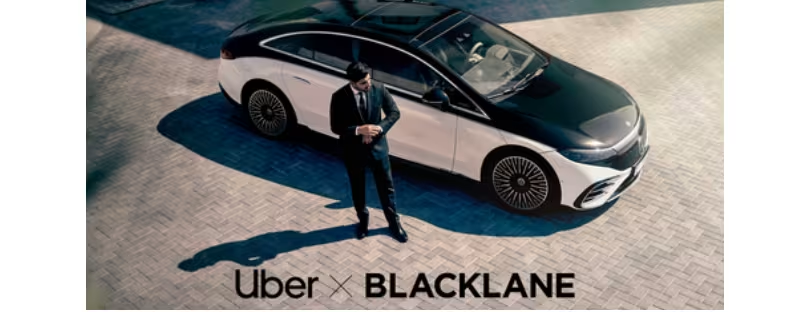
Uber is making another calculated move upmarket. The company has announced plans to acquire Blacklane, the Berlin-founded global chauffeur platform, in a deal that signals something bigger than just expansion. This is Uber doubling down on premium, pre-booked, and executive travel. Uber Blacklane acquisition
If you’ve been watching the mobility space closely, this move feels less like a surprise and more like a confirmation of where the market is heading.
Why Blacklane matters
Blacklane is not just another ride-hailing competitor. Since its launch in 2011, it has built a very specific kind of reputation. Think consistency, reliability, and a service layer that feels closer to hospitality than transport.
Operating in more than 500 cities across 60+ countries, Blacklane connects travelers with professional chauffeurs through a structured booking system. It has become a go-to for corporate travel managers, executives, and high-value customers who care less about price and more about predictability.
That distinction is key.
Uber dominates on-demand mobility. Blacklane dominates planned, high-quality journeys.
Put those two together, and you start to see the strategic logic.
Uber’s premium push is accelerating
Uber has been quietly reshaping its positioning over the past few years. It is no longer just about getting from A to B as cheaply as possible. The company is building layers:
- UberX for everyday rides
- Uber Comfort and Business for mid-tier users
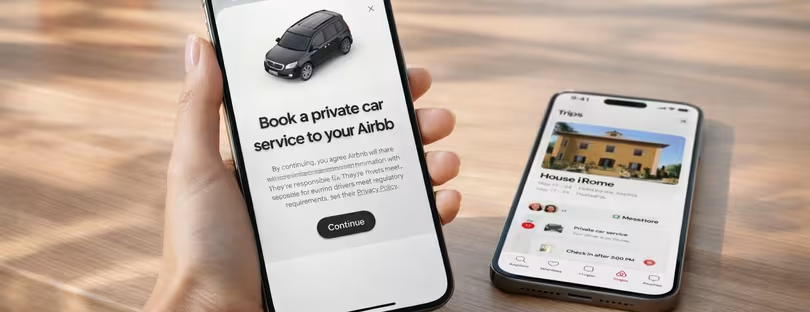
- Uber Reserve for scheduled trips
- Uber Elite for high-end experiences
The fastest growth is happening in the pre-booked category. Uber Reserve, in particular, is seeing strong traction because it solves a very real problem: uncertainty.
Airports, early meetings, tight schedules. These are moments where users are willing to pay more for reliability.
That is exactly where Blacklane excels.
By acquiring Blacklane, Uber is not just adding a premium product. It is importing a service philosophy that has been missing from traditional ride-hailing.
What Uber actually gains
This is not just about luxury cars or higher prices. The real value sits deeper.
Blacklane brings three things Uber has historically struggled to fully own:
First, service standardization at the premium level. Blacklane’s model is built on vetted chauffeur partners and consistent global service delivery. That is very different from Uber’s marketplace model.
Second, corporate travel credibility. Blacklane is deeply embedded in enterprise travel programs. Uber has been trying to break into this space for years with Uber for Business, but this accelerates that effort significantly.
Third, global chauffeur infrastructure. Instead of building this from scratch, Uber is effectively plugging into an existing premium network.
This is faster, cleaner, and strategically smarter.
What Blacklane gets in return
For Blacklane, the upside is scale.
Uber brings distribution, data, and demand at a level that no chauffeur platform can match on its own. The ability to tap into Uber’s user base instantly expands Blacklane’s reach beyond its traditional corporate and luxury audience.
It also opens new markets faster.
Blacklane has grown steadily, but carefully. Uber operates at a completely different speed. That combination could turn a niche premium service into something much more mainstream.
There is also a brand shift here. Blacklane moves from being a standalone premium option to becoming part of a broader mobility ecosystem.
That comes with both opportunity and risk.
|
The bigger trend: mobility is segmenting
This deal is not happening in isolation. It reflects a wider shift across travel and mobility.
The market is splitting into two clear directions:
On one side, low-cost, high-volume, on-demand transport. Think price-sensitive users, quick rides, and minimal expectations.
On the other hand, premium, predictable, and experience-driven mobility. This is where users are willing to pay more for certainty, comfort, and control.
We are seeing similar patterns elsewhere:
- Airlines are separating economy and premium experiences more aggressively
- Hotels doubling down on boutique and luxury segments
- Travel tech platforms focusing on curated, high-value users
Even within mobility, competitors are moving.
Companies like Bolt are strengthening their core affordability play. Meanwhile, players like Wheely and Blacklane have been building premium-first models focused on service quality.
Uber is now trying to sit across both worlds.
That is not easy to execute, but if done right, it creates a powerful advantage.
Where this could go next
The interesting question is not whether this deal makes sense. It does.
The real question is how far Uber takes this.
If Blacklane remains a standalone premium layer inside Uber, the impact will be incremental.
If Uber fully integrates Blacklane’s service model, we could see a shift in how premium mobility is delivered globally.
That could mean:
- More structured, hospitality-like experiences inside Uber
- Stronger integration with airports, airlines, and hotels
- Subscription or membership models for premium users
- Deeper expansion into corporate travel ecosystems
There is also a technology angle.
Pre-booked mobility, combined with data, opens the door to predictive travel services. Knowing when and where a user will need a ride before they even request it.
That is where mobility starts to look more like infrastructure.
Conclusion
This acquisition is less about luxury cars and more about control over a higher-value segment of the travel journey.
Uber is not chasing premium for branding reasons. It follows the economics. Higher margins, more predictable demand, and stronger customer loyalty all sit in the premium layer.
Competitors like Wheely have shown that there is real demand for chauffeur-level service in urban markets. At the same time, data from sources like McKinsey and Deloitte continues to highlight the growth of premium travel segments, especially among business travelers and high-frequency users.
What Uber is doing here is simple in theory but complex in execution. It is trying to combine scale with service quality.
That combination has historically been very difficult to achieve.
If Uber manages to preserve Blacklane’s service standards while scaling it globally, this could redefine what premium mobility looks like.
If not, it risks turning a high-quality service into just another tier in a crowded app.
Either way, one thing is clear.
Mobility is no longer just about getting somewhere.
It is about how predictably, comfortably, and seamlessly you get there.
|
RIDE
Uber rides 60% off
First 5 rides · up to €6 off
|
CONNECTIVITY
Get eSIM before landing
Avoid roaming · instant data
|
AIRPORT TIP
Skip airport SIM queues
Activate before arrival
|