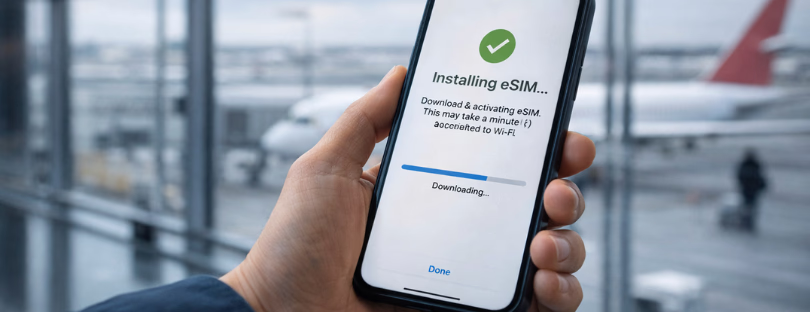
There’s a specific point in every roaming story where the debate stops being theoretical. It’s when you land, switch airplane mode off, and your phone does that innocent little “Welcome to…” message.
And then, a few days later, your bank app does its own welcome message.
If you’ve ever rolled your eyes at travel eSIMs as “internet hype,” I get it. eSIM marketing can be loud. Some brands promise magic. Some plans are genuinely confusing. Some “unlimited” offers are unlimited in the same way a hotel’s “ocean view” is ocean view.
But roaming bills are not hype. They are the most honest documents in mobile.
This is your friendly Alertify reminder: your phone does not become cheaper abroad just because you “barely used it.” Roaming cost is not a reflection of your intent. It’s a reflection of pricing architecture.
And that’s why eSIM is not overhyped. Roaming is simply under-explained.
Roaming is not “expensive,” it’s structurally unpredictable
Let’s say you travel with a domestic SIM (or eSIM) plan you love. At home, it behaves. You know the rules. You know the carrier. You know the usual speeds.
Then you cross a border, and suddenly you are in a different commercial universe.
Roaming is a wholesale product wearing a retail costume. Your home operator buys access from a foreign operator, adds margins, adds “passes,” adds fairness policies, adds exceptions, then hands you a menu that looks simple but is full of invisible conditions.
That’s how people end up shocked, even when they are careful:
A single background app update can trigger real usage.
A hotel Wi-Fi dropout can push your phone back to cellular without asking nicely.
Video calls do not feel like “data” until the bill arrives.
“Roaming pass” pricing can be reasonable in one country and outrageous in the next.
Europe tried to fix part of this for travellers inside the EU with “Roam Like at Home,” and earlier with bill-shock safeguards like an automatic data roaming cut-off (famously around €50, excluding VAT, unless you opt out).
But the moment you travel outside those protected zones, the old roaming logic comes back fast.
The bill-shock problem never really died
People assume bill shock is a 2010s problem that regulators solved.
It was solved in specific places, under specific rules, for specific geographies.
BEREC’s roaming work still tracks transparency and comparability, and it is very clear that roaming is a living system, not a closed chapter. Their benchmark report covering October 2023 to September 2024 is literally about how roaming pricing and transparency behave in the real world.
And if you look at what European regulators discuss about “Rest of World” roaming, you can see the tension: consumers want predictable pricing, while some commercial models still pull toward automatic bundles and confusing defaults. BEREC has even argued against certain automatic RoW roaming package behaviors because of how they collide with the idea of safeguards and transparency.
In the UK, post-Brexit roaming became a perfect real-world experiment: protections changed, roaming charges reappeared for many travellers, and regulators leaned into clearer alerts and spend cap options to reduce surprise charges.
So no, bill shock did not disappear. It just moved to the edges of where protections apply.
And most people travel at the edges.
eSIM is not a miracle. It’s a pricing reset button
Here’s the part that gets missed in most “eSIM vs roaming” conversations.
The killer feature is not the QR code. It’s not even the tech. The killer feature is that travel eSIMs turn roaming into a prepaid decision.
Roaming is usually a postpaid risk:
You use it first.
You find out later.
You dispute, negotiate, regret, or pay.
Travel eSIM is usually prepaid control:
You choose a plan up front.
You see the allowance and validity.
You spend within a box you agreed to.
That is why eSIM feels “overhyped” only to people who have never had a roaming bill slap their confidence.
Also, the market has matured. Even GSMA Intelligence has pointed out that travel eSIM is becoming a growth driver and a strategic focus, including mobile network operators launching travel eSIM offers to compete with specialist providers.
So the trend is not “random startups shouting about eSIM.” The trend is “everyone who enjoys roaming margin is being forced to respond.”
When roaming still makes sense
Yes, I’m going to say it: sometimes roaming is fine.
If you are travelling inside the EU/EEA with a plan that genuinely includes roaming, the experience can be frictionless, and that’s the point of the regulation.
Roaming can also make sense when:
Your company plan includes predictable international allowances.
You have a travel add-on that is actually transparent and fairly priced for the specific country.
You need voice and SMS continuity tied to your primary number and you cannot risk any workflow changes.
You are on a short trip and you have already verified the exact costs.
The problem is that most travellers assume they are in one of these safe cases. They are not.
The common roaming “gotchas” that keep filling bills
You are outside the protected roaming zone (EU/EEA rules do not follow you everywhere).
You bought a pass, but it covers “some usage” and then falls back to pay-as-you-go rates.
Your phone burns data silently (cloud sync, app updates, photo backups).
“Unlimited” exists as a label, not as a performance promise.
You trust the welcome SMS as pricing information. It is often not enough.
The market is moving from “roaming” to “connectivity stacks”
Another reason the “overhyped” take is fading is simple: travel connectivity is becoming a product category, not a carrier side-feature.
Specialist travel eSIM providers scaled quickly, and that forced three moves across the industry:
Mobile operators building or partnering on travel eSIM offers to defend roaming revenue.
Travel brands and platforms are adding connectivity as an add-on (because it increases conversion and reduces travel stress).
Consumers are learning that connectivity is not a single purchase, but a stack: data plan, network access, support, refund policy, and reliability.
Even mainstream coverage has been tracking this shift, tying eSIM adoption growth to travel usage and broader device support.
This is where the conversation gets more adult.
It’s no longer “eSIM vs SIM.” It’s “predictable connectivity vs surprise pricing.”
Conclusion: eSIM isn’t overhyped, roaming is under-accountable
If you think eSIM is overhyped, I’m not going to argue with your feed. Some of the marketing deserves skepticism.
The direction of travel is clear: roaming margins are being squeezed by consumer behavior (people refusing surprise bills), by regulation in protected zones (EU/EEA rules changed expectations), and by competition (specialist travel eSIM brands and now MNO travel eSIM offers).
So here’s the real conclusion: eSIM is not a trendy upgrade. It is the consumer side of a market correction.
Roaming will not vanish. It will evolve into clearer bundles, better alerts, and more “travel mode” pricing, because it has to. Regulators keep pushing transparency and safeguards, and the market keeps rewarding whoever makes costs predictable.
If you want the simplest test of whether eSIM is “overhyped,” don’t read another hot take.
Check your last roaming bill. travel eSIM vs international roaming charges
Then ask yourself one question: Did you pay for connectivity, or did you pay for uncertainty?
Driven by wanderlust and a passion for tech, Sandra is the creative force behind Alertify. Love for exploration and discovery is what sparked the idea for Alertify, a product that likely combines Sandra’s technological expertise with the desire to simplify or enhance travel experiences in some way.