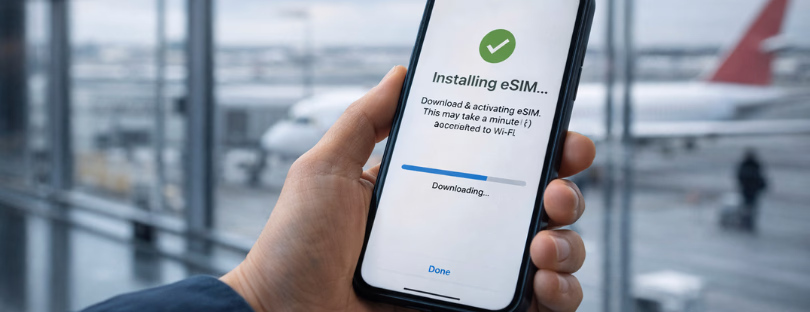
Travel eSIMs: One-Night Stand or Real Relationship?
There is a quiet moment that happens with travel eSIMs, usually right after landing. The phone reconnects. Data starts flowing. Maps load. Messages send. And instead of relief, something else shows up. Suspicion.
For many travelers, that moment feels oddly similar to waking up after a one-night stand. Everything seems fine, almost too fine. No awkward conversation, no small print surfacing, no immediate consequences. And that is precisely what makes people uneasy.
Domestic mobile plans come with history. Contracts. Paperwork. Monthly bills that arrive like clockwork. Sometimes, even mild resentment. Users trust them not because they are good, but because they are familiar. Years of suffering create a strange sense of safety. You know exactly how they will disappoint you.
A travel eSIM does not offer that emotional build-up. You install it, it activates, it works. End of story. No onboarding drama. No lengthy identity checks. No confirmation calls asking if you are really sure. The silence feels unnatural, so the brain fills it with anxiety.
Trust built on shared pain
Psychologically, trust is often built through shared friction. People trust banks they have argued with, airlines they have been delayed by, and operators that have overcharged them at least once. There is a perverse comfort in knowing the shape of the pain.
Travel eSIMs skip that phase entirely. They show up, do their job, and disappear when the trip ends. There is no shared past. No time to form expectations. No scars.
That lack of history makes users hyper-vigilant. Signal bars get checked compulsively. Speed tests run for no real reason. People wait for the betrayal, as if connectivity owes them a plot twist.
This behavior shows up even among experienced travelers and industry professionals. Rationally, they understand how eSIM provisioning works, how profiles authenticate to networks, and how local partners are selected. Emotionally, they still expect something to go wrong because nothing has yet.
Familiar chaos felt safer than quiet efficiency
The irony is hard to ignore. Traditional roaming, which objectively deserves distrust, never triggered this level of second-guessing. Roaming bills were unpredictable, support was slow, and pricing models were borderline hostile. And yet, users accepted it.
They accepted it because it was familiar chaos. They knew roaming would hurt, but they knew how. The pain had a pattern. It was expensive, but emotionally predictable.
Travel eSIMs inverted that experience. Lower costs. Instant setup. Transparent pricing. No bill shock weeks later. From a rational perspective, they solved the exact problems roaming created. From an emotional perspective, they broke the script.
When something behaves better than expected, people assume it is temporary.
The “is it worth it?” question was never technical
On the surface, the question most users ask sounds rational. Is it worth it? Is the coverage good? Are speeds reliable? Will it work in multiple countries?
But underneath, the real question is different. Can this be trusted?
If the doubt were truly about technology, the conversation would have ended years ago. eSIM standards are mature. Carrier partnerships are well established. Multi-network routing is not experimental. The infrastructure is there.
What lingers is the discomfort of a product that does not demand loyalty, paperwork, or long-term commitment. It feels transactional in a way telecom has never been. And that makes people suspicious.
In many ways, travel eSIMs feel like dating in a world raised on arranged marriages.
How leading players normalized the “quiet experience.”
Several providers have worked intentionally to make this quiet reliability feel less unsettling. Travel eSIMs may start as a one-night stand, but players like Airhub, Fairplay, Yesim, and Ubigi are clearly positioning themselves as the kind of partners you’d actually consider a long-term relationship with.
Brands like Airalo, Nomad eSIM, and GigSky invested heavily in transparency rather than persuasion.
Instead of aggressive promises, all of them are focused on clarity. Coverage maps that actually match reality. Pricing that does not hide behind fair use footnotes. Set up flows that assume the user is capable, not confused.
Interestingly, the brands that gained the most trust were not the loudest. They were the ones that stayed boring after purchase. No surprise emails. No sudden upsells. No mysterious throttling. Just consistent performance.
Over time, repeat usage started to create something that travel eSIMs initially lacked. Memory.
From a disposable tool to a repeat companion
The shift happens subtly. The first trip feels like a fling. The second feels like a coincidence. By the third or fourth, the pattern becomes clear. It always works.
At that point, trust stops being theoretical. It becomes experiential.
Industry data from GSMA and OECD-backed telecom reports consistently show that repeat eSIM users report significantly lower anxiety around connectivity compared to first-time users. Not because the tech changes, but because expectations finally align with reality.
What once felt suspicious starts to feel refreshing. Quiet becomes a feature, not a warning sign.
Telecom culture was built on captivity
Traditional mobile operators built trust through captivity. Long contracts. Penalties for leaving. SIM locks. Complex plan structures that discouraged comparison. Trust was less about belief and more about lack of alternatives.
Travel eSIMs flipped that model. No contracts. No lock-in. No penalty for switching providers between trips. Trust had to be earned through performance alone.
That shift mirrors broader consumer trends across fintech, travel, and SaaS. Users are increasingly comfortable with short-term relationships as long as the experience is consistently good. Loyalty is no longer contractual. It is conditional.
The relationship potential is real
The uncomfortable truth for many travelers is that the eSIM did not betray them. It did not suddenly stop working. It did not produce a shocking bill. It quietly did exactly what it promised.
And that forces a mental adjustment.
If something works quietly, without demanding commitment, maybe the problem is not the product. Maybe the discomfort comes from years of being trained to expect worse.
Conclusion
Travel eSIMs sit at an interesting crossroads. They are no longer experimental, but they are still emotionally unfamiliar. Compared to established roaming services and legacy operators, they behave better than users are conditioned to expect. That gap between expectation and reality creates distrust, not because the product fails, but because it refuses to misbehave.
As competition increases among major players and smaller niche providers, reliability is becoming table stakes rather than a differentiator. The real evolution is happening in trust cycles. Repeat usage, transparent coverage disclosures, and alignment with GSMA standards are slowly turning one-night stands into repeat relationships.
The data already supports it. Industry reports from GSMA Intelligence, OECD telecom studies, and operator disclosures consistently show higher satisfaction and lower churn among frequent travel eSIM users. Not because they fell in love on the first trip, but because the relationship proved stable over time.
The future of travel connectivity is not about convincing users that eSIMs are better. It is about giving them enough quiet experiences to realize that better does not have to be loud.