TCS and Amadeus Rethink Airline Retailing with AI
Here’s the thing about airline “digital transformation.” It’s been talked about for years, but most of it has lived in slide decks, not in real customer experience.
This new partnership between Tata Consultancy Services (TCS) and Amadeus feels different. Not because it’s another announcement, but because of where it’s focused: the actual interface where airline retailing happens.
And that’s where things get interesting.
A shift from systems to experience
Tata Consultancy Services (TCS) has entered a global strategic partnership with Amadeus to co-develop next-generation airline retailing solutions. On paper, that means combining TCS’s capabilities in AI, cloud, and data analytics with Amadeus’s travel technology infrastructure.
But if you look closer, this is really about fixing a very specific problem the industry still hasn’t solved properly.
Airlines have modernized booking engines, distribution, even pricing logic. But the service layer, especially contact centres, still feels stuck somewhere between legacy systems and partial upgrades.
This partnership targets exactly that gap.
Instead of building yet another backend capability, TCS is designing a Service Centre User Interface for Amadeus Nevio. That’s important because Nevio itself is Amadeus’s big bet on offer and order-based retailing, moving away from traditional PNR-based systems.
What TCS is building sits right on top of that shift.
A cloud-native, SaaS-based interface, fully integrated into Nevio, designed for the people actually handling customer interactions.
And finally, that’s where transformation becomes visible.
What airlines actually get out of this
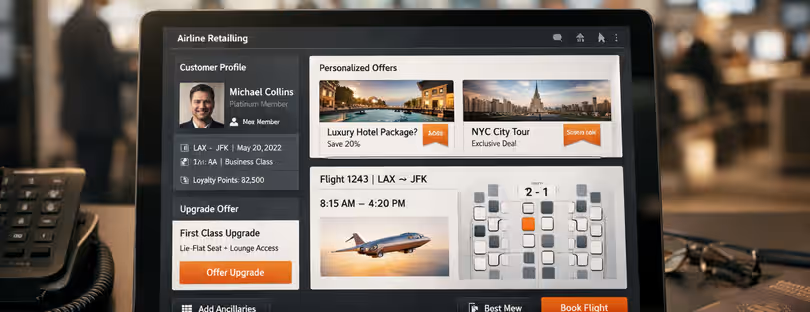
At a practical level, the new interface is expected to give airline agents AI-driven insights in real time.
That sounds like a buzzword, but it translates into something very concrete:
Instead of agents navigating multiple disconnected systems, they get a unified view of the customer, their journey, their preferences, and available offers.
The goal is simple. Faster decisions, more relevant offers, and fewer friction points.
From an airline perspective, that means:
Smarter workflows
AI-guided processes that reduce manual handling and speed up resolution times.
Better retailing
Context-aware upselling based on real-time data, not static rules.
More consistent service
A standardized interface across different customer touchpoints.
Arun Pradeep Surendra Mohan, business head for Travel, Transportation & Hospitality at TCS for the EMEA and APAC regions, framed it clearly:
“Our global strategic partnership with Amadeus marks an important step in reshaping the future of travel technology. By combining Amadeus’s powerful platform capabilities with TCS’s deep expertise in AI, cloud, and large-scale transformation, we are moving beyond traditional integration towards true co-innovation.”
That last part matters more than it sounds.
Because airlines don’t need more integrations. They need systems that actually work together by design.

Why Nevio is central to all of this
If you’ve been following Amadeus, you’ve probably seen Nevio mentioned more and more.
It’s their answer to a long-standing industry problem: how to move from legacy booking logic to true retailing logic.
Instead of tickets, you have offers.
Instead of records, you have orders.
Instead of static pricing, you have dynamic, personalized bundles.
But here’s the catch.
That model only works if the operational layer can keep up.
And that’s exactly where most transformations break.
Airlines might adopt offer and order systems, but if their service agents still operate on outdated tools, the experience collapses at the moment it matters most.
TCS’s role here is to make Nevio usable at scale.
Not just technically deployed, but operationally embedded.
That includes integrating it deeply into airline contact centres and ensuring faster rollouts across carriers.
In other words, turning a platform into something airlines can actually run their day-to-day operations on.
Beyond contact centres
The partnership doesn’t stop at the service interface.
TCS is also expected to support broader implementation of Amadeus Nevio across airlines, helping accelerate adoption and integration into existing ecosystems.
And over time, this could extend into:
Airport operations
Connecting retailing logic with on-the-ground experiences.
End-to-end travel platforms
Linking airlines more tightly with the wider travel ecosystem.
This is where the bigger ambition starts to show.
Not just improving airline systems, but rethinking how different parts of the travel journey connect.
The AI race is already happening
At the same time, this move doesn’t happen in isolation.
The travel industry is entering a phase where AI is no longer an add-on. It’s becoming the core layer.
Companies like Anthropic, through AI plugins and agent-based systems, are pushing toward a future where planning, booking, and even customer service could be partially automated.
That creates a very different competitive dynamic.
On one side, you have infrastructure players like Amadeus building deeper, more integrated systems.
On the other, you have AI-native players trying to bypass traditional layers altogether.
And then there’s everyone else trying to catch up.
Amadeus has already signaled its direction through multi-year growth targets and moves like the acquisition of SkyLink, aimed at strengthening its conversational AI capabilities.
So this partnership with TCS is not just about improving existing systems.
It’s about staying relevant in a market that is being redefined in real time.
What this means for the travel ecosystem
If you zoom out, this partnership reflects a broader shift happening across travel.
The industry is moving from fragmented systems to connected platforms.
From transactions to relationships.
From products to experiences.
And increasingly, from human-led processes to AI-assisted decisions.
But here’s the nuance that often gets missed.
Transformation in travel doesn’t happen where you expect it.
It doesn’t start with flashy consumer apps.
It starts in the operational layers. In the tools agents use. In the systems that decide what offer a customer even sees.
That’s where TCS and Amadeus are focusing.
And that’s why this matters more than it looks at first glance.
Final thoughts
Let’s be clear. Amadeus is not alone in this.
Sabre is pushing its own retailing transformation through SabreMosaic.
Travelport continues to evolve its platform with AI-driven capabilities.
Airlines themselves, especially larger groups, are investing heavily in in-house digital infrastructure.
At the same time, reports from organizations like McKinsey and Phocuswright consistently point to the same trend: airlines that successfully adopt offer and order-based models can unlock significant revenue uplift and operational efficiency.
But execution remains the bottleneck.
That’s where most initiatives slow down.
So the real question is not whether the industry is moving in this direction.
It already is.
The question is who can operationalize it fastest.
This is where the TCS–Amadeus partnership has a real shot at impact.
Not because it introduces something radically new, but because it focuses on making something complex actually usable.
And in this industry, that’s often the hardest part.
If they get this right, it won’t just improve airline retailing.
It will quietly redefine how the entire travel experience is delivered.