Starlink Launches in the UAE: What It Means for Connectivity in the Gulf
SpaceX’s Starlink officially launched in the United Arab Emirates on March 18, 2026. The UAE now appears on Starlink’s official availability map, with subscriptions open to both residents and businesses. It sounds like a straightforward market expansion, but in a region where satellite internet has historically been treated with regulatory caution, this is anything but routine.
The path here was deliberate. The UAE’s Telecommunications and Digital Government Regulatory Authority (TDRA) licensed Starlink Satellite Communications Services LLC back in June 2024 — a license valid for ten years through June 2034. Then came the aviation partnerships: in November 2025, Emirates announced it would begin deploying Starlink Wi-Fi across its entire in-service fleet, starting with Boeing 777 aircraft and aiming to complete the rollout by mid-2027. Around the same time, flydubai announced Starlink as its in-flight connectivity partner for its Boeing 737 fleet, with installation on 100 aircraft set to begin in 2026. The residential launch was essentially the last domino to fall.
What It Actually Costs
Residential users can subscribe to the “Residential Lite” package for Dh230 per month, while the standard Residential plan is priced at Dh300. Roaming options are also on the table — a 100GB roaming plan starts at Dh190 per month, with unlimited roaming at Dh370. Business plans start from around Dh248 per month.
Starlink UAE Plans — March 2026
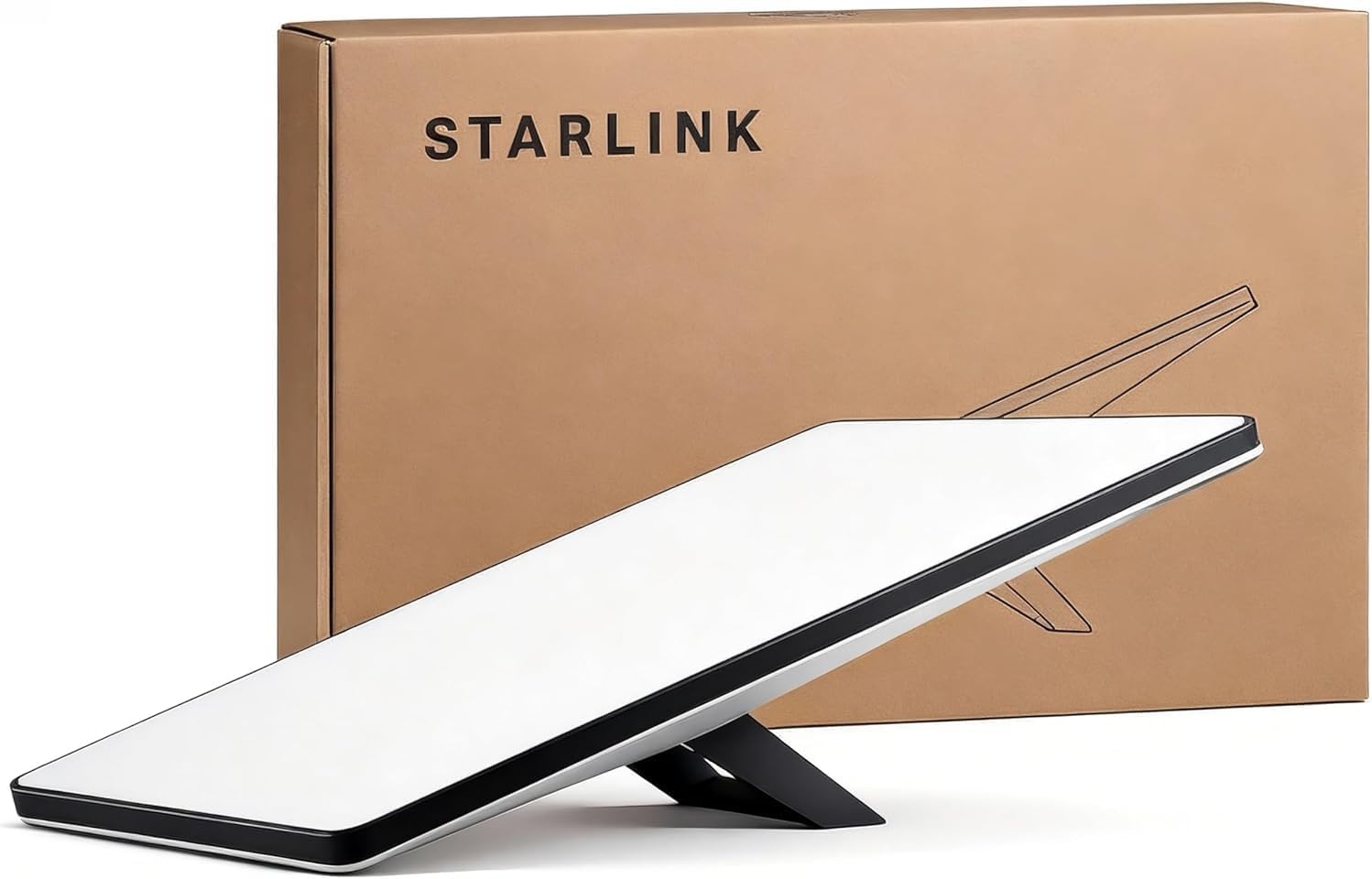
Hardware is where the upfront hit lands. The Standard Kit is priced at Dh1,465, while the more portable Mini Kit costs AED 1,099 — both include the satellite dish, Wi-Fi router, and necessary cables. That’s a real barrier for residential adoption in a market where Etisalat and du routinely bundle routers at no extra cost and offer fibre plans at competitive prices. It’s also the trade-off that defines Starlink’s value proposition: you’re not paying for convenience, you’re paying for independence from fixed infrastructure.
Who This Is Really For
Analysts suggest early uptake is likely to come from niche users who prioritize flexibility, mobility, or redundancy over cost. That’s a fair read. The UAE’s urban centers — Dubai, Abu Dhabi, Sharjah — are already wired. Etisalat’s fibre penetration is among the highest in the world, and 5G coverage in these cities is deep and reliable. Starlink isn’t going to displace that.
Where the satellite model genuinely wins is at the edges: offshore platforms, desert operations, temporary construction sites, remote tourism infrastructure, maritime routes. In the Gulf, the most relevant use cases are less about rural inclusion and more about mission-critical uptime — from offshore rigs and desert operations to smart city backup systems and large-scale events where uninterrupted bandwidth is essential.
The Mini Kit adds another dimension. It’s backpack-portable, supports over 200 Mbps download speeds, and can be used across Starlink’s 150+ country footprint. For the kind of high-mobility professional that the UAE has in abundance — consultants, executives, project managers moving between Gulf states — that’s a genuinely compelling tool.
The Regulatory Angle
Getting a 10-year license in the UAE is not something that happens quietly. Licensing frameworks in the UAE typically require compliance with strict operational, data protection, and content regulations. Starlink’s approval indicates alignment with these requirements, though the long-term regulatory approach to satellite-based providers remains under close observation.
There’s also a sovereignty dimension worth noting. Contrary to traditional land-based internet networks, which are generally owned and operated at the national level, Starlink maintains full control over its constellation of satellites, making access to its internet services subject to its owner’s desires. GCC governments are aware of this dynamic, which is partly why the UAE and Saudi Arabia are simultaneously investing in homegrown tech capabilities and alternative satellite ventures. A 10-year license isn’t unconditional trust; it’s a calculated bet.
The Bigger Picture: LEO Connectivity and the Travel-Tech Intersection
Starlink’s Gulf rollout — Oman in March 2025, Bahrain in May 2025, Kuwait in March 2026, UAE now — is a coherent regional strategy, not a patchwork of market entries. SpaceX is building distribution density across high-income, infrastructure-forward markets where enterprise and government spending power is significant.
For the travel connectivity space, this matters in a specific way. Starlink’s Roam plans — unlimited global data, pausable subscriptions, hardware that travels — are a different category of product than what eSIM providers like Holafly, Airalo, or Ubigi offer. They’re not competing directly, but they are competing for the same mental real estate: what do I use to stay connected when I leave home?
eSIM still wins on simplicity, device-nativity, and price for most travelers. You don’t carry a dish. But Starlink’s portability hardware is narrowing the gap for a particular segment: long-stay remote workers, expedition travelers, and anyone running operations in places where a local SIM or roaming plan simply doesn’t reach.
The more interesting competitive pressure is on telecom operators. Starlink’s entry introduces a performance-driven benchmark that could push incumbent operators to differentiate further on speed, service guarantees, and bundled digital offerings. Etisalat and du have every reason to watch this closely. As LEO constellations mature — and with Starlink’s Gen 3 satellites targeting fiber-grade speeds — the gap between satellite and terrestrial performance keeps shrinking.
The UAE launch is a signal, not just a service rollout. Satellite connectivity is no longer a fallback for places without infrastructure. It’s becoming a parallel layer — and in a region already obsessed with redundancy, resilience, and Vision 2030-style digital ambition, that layer is going to get a lot of investment in the years ahead.