For years, RCS was the future that never quite arrived. Too fragmented. Too limited in reach. Too dependent on Android. Too complicated for brands to justify moving budgets away from SMS. RCS for Business
A new study by global tech strategists Juniper Research forecasts that operators will generate $3.1 billion globally from RCS for Business traffic in 2027, up from $1.2 billion in 2025. The whitepaper makes one thing clear: RCS is no longer an experimental channel. It is becoming core infrastructure.
And the reason is simple: scale has finally caught up with ambition.
From Limited Reach to 80% Penetration
Historically, RCS for Business struggled with a single, painful bottleneck: reach.
As Molly Gatford, Senior Research Analyst at Juniper Research, explains:
“Historically, the biggest challenge with RCS for Business was cultivating demand for a channel with limited reach. Now, with RCS penetration surpassing 80% in markets such as the US and France, operators face a new challenge: establishing effective pricing models for conversational use cases to unlock new revenue”
Apple’s rollout of RCS support changed the equation. In North America alone, RCS-capable subscribers jumped from 40.3% in 2024 to 86.5% in 2025. That is not incremental growth. That is structural transformation.
And when scale arrives, monetisation follows.
The Migration from SMS Is Accelerating
The first major revenue driver is predictable: migration from A2P SMS.
Banks are moving OTPs to verified RCS to reduce spoofing. Logistics companies are replacing plain-text notifications with branded, authenticated conversations. Retailers are shifting marketing traffic toward rich cards, carousels, and embedded CTAs.
RCS offers something SMS never could:
Brand verification
Rich media
Interactive messaging
Read receipts
Built-in analytics
Vendors are being urged to simplify SMS-to-RCS uplift by enabling brands to convert existing workflows into rich RCS templates with minimal redevelopment. Lower friction equals faster migration.
But this isn’t just about richer messages. It’s about economics.
RCS vs WhatsApp: A Pricing Reality Check
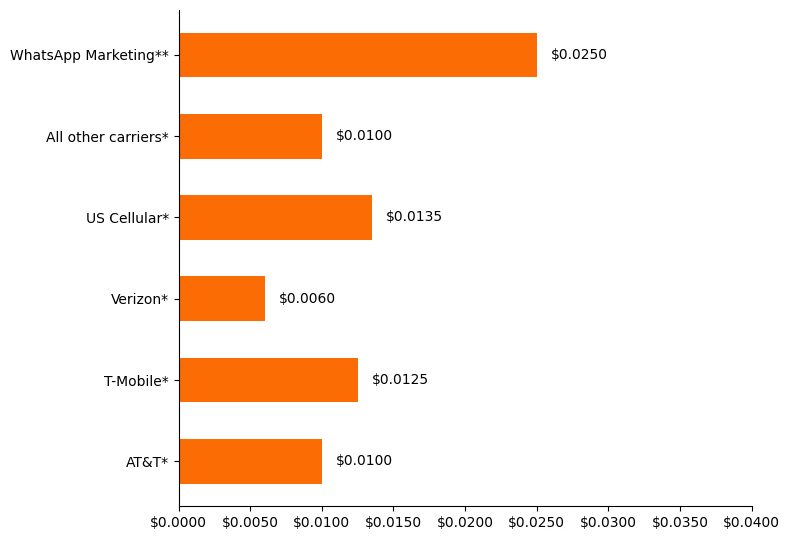
One of the most revealing insights from the research compares US carrier fees for RCS Rich Media against WhatsApp marketing pricing.
The result?
RCS Rich Media messages are priced significantly lower than WhatsApp marketing messages in the US.
That pricing delta changes ROI math for brands.
Add to that the temporary pause of WhatsApp marketing messages to US numbers in 2025, and suddenly RCS is not just a technical alternative. It becomes a strategic one.
For authentication and utility use cases, WhatsApp may sometimes appear cheaper. But reach matters. In the US market, especially, RCS has native inbox access and broader operator alignment.
The takeaway is not that RCS “beats” WhatsApp. It is that RCS is no longer the expensive, underdeveloped option. It is competitive.
And in some cases, structurally advantaged.
Source Twilio *RCS Rich Media US Carrier Fees as of January 2026
The Real Growth Engine: Conversational P2A
If SMS migration is phase one, Person-to-Application messaging is phase two.
The new capability to initiate an RCS conversation directly from Google Search represents a fundamental shift in messaging dynamics. Instead of brands pushing messages, users initiate conversations.
This is discovery-driven messaging.
As noted in the research:
“The new capability to initiate an RCS conversation from Google Search is expected to drive major growth in Person-to-Application (P2A) messaging as customers can more easily discover and engage with brands.”
But there is a catch.
Operators must gain visibility into conversational traffic if they want to monetise it effectively. That means understanding:
Conversation duration
Message volume
Entry points
Engagement type
And that brings us to the next strategic inflection point: pricing models.
Pricing Conversations Is Harder Than Pricing Messages
SMS was easy. Per message. Fixed rate. Predictable billing.
Conversational RCS is different.
Do you charge per message? Per session? Per minute? Per resolution?
As Molly Gatford notes:
“As more brands use RCS as a conversational channel, mobile operators must partner with providers offering transparency into conversational traffic, specifically conversation duration, message volume, and how the conversation was initiated. This data will be key as mobile operators must develop differentiated conversational pricing models for RCS in the future ”
In other words, the monetisation challenge has moved up the value chain.
Operators are no longer selling message pipes. They are selling interaction infrastructure.
India: Growth With Guardrails
The Indian Subcontinent offers a different lens.
India has experienced strong RCS growth following Apple’s partnership with Jio and Airtel’s collaboration with Google. Subscriber numbers are projected to continue rising sharply in 2026.
But India has introduced strict traffic controls.
Google now limits promotional RCS traffic based on agent reputation. High-reputation brands can reach up to 300 million unique users within 28 days. Low-reputation agents are capped at 1 million.
This is not accidental.
India is trying to prevent the spam cycle that damaged SMS marketing credibility in the past.
That governance model may become a blueprint for other high-growth markets.
Verification Becomes Infrastructure
Another under-discussed development is the emergence of third-party verification bodies.
Independent verification authorities are expected to expand across markets, streamlining brand approval and reducing onboarding friction.
This matters.
Because verified branding is not just a feature. It is the trust anchor that allows RCS to carry authentication, banking alerts, and high-value customer interactions.
If verification scales efficiently, adoption accelerates.
If it remains slow and manual, friction slows enterprise onboarding.
The Bigger Picture: Messaging as Native Commerce
Step back from the datapoints.
What is actually happening?
RCS is becoming a native commerce layer inside the default messaging inbox.
Not an app. Not a download. Not an external redirect.
A built-in, IP-based channel with rich functionality.
The research forecasts operator revenue exceeding $7 billion by 2030. That trajectory is not about marketing blasts. It is about conversational engagement, authentication security, and transactional depth.
The competitive field includes:
WhatsApp Business
Apple Business Chat
In-app messaging ecosystems
Super apps in Asia
But RCS holds one structural advantage: it is operator-native and device-native.
No additional install required.
That matters in markets like the US and parts of Europe, where messaging fragmentation has historically limited alternative platform dominance.
Conclusion
RCS has moved from potential to platform.
The revenue projections are impressive. The subscriber penetration is transformative. The pricing comparisons are competitive. The governance frameworks are evolving.
But the real story is subtler.
The challenge is no longer convincing brands to experiment with RCS.
The challenge is designing sustainable conversational pricing models before commoditisation sets in.
If operators treat RCS like upgraded SMS, they will miss the opportunity.
If they treat it like conversational infrastructure, integrated with AI agents, commerce workflows, and verified trust layers, they will unlock long-term growth.
Scale is already here.
The next phase will not be about adoption.
It will be about monetisation discipline.
And in telecom, discipline is what separates temporary spikes from structural revenue streams.
Lara is a digital marketing expert with unstoppable energy and a passion for all things travel and beauty. She’s endlessly curious about how technology is transforming the way we explore the world — and the way we take care of ourselves while doing it. From smart skincare gadgets to travel-ready beauty tech, Lara loves discovering innovations that make life on the go smarter, easier, and a little more glamorous. Based in Zagreb, she brings a vibrant mix of creativity, curiosity, and style to the Alertify team — always chasing the next trend where tech meets beauty. Also she is an Apple fan!