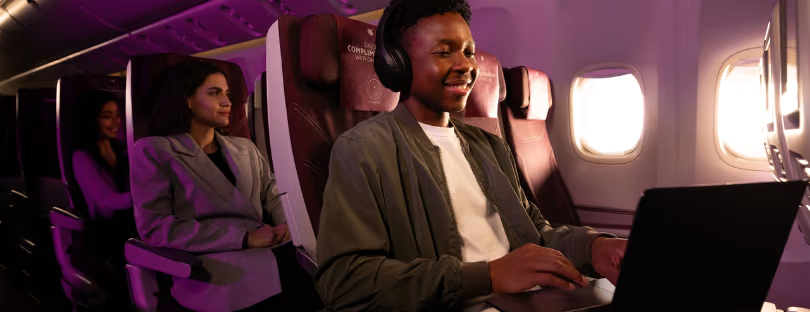
Qatar Airways Sets New Standard With Starlink Wi-Fi
When airlines talk about “fast Wi-Fi,” it is often marketing shorthand for something that still struggles to load an email attachment at 35,000 feet. Qatar Airways is playing a very different game. With the first-ever Starlink installation on a Boeing 787-8 now complete, the airline is not just improving connectivity. It is redefining what passengers should expect from long-haul in-flight internet.
The move makes Qatar Airways the first carrier globally to operate Boeing 787-8 Dreamliners with Starlink, adding another milestone to what is already the most ambitious connectivity rollout in commercial aviation. Three Dreamliners are already flying with the system live, pushing the airline’s total Starlink-equipped widebody aircraft to nearly 120.
For passengers, that translates into free, gate-to-gate connectivity that feels closer to home broadband than traditional satellite Wi-Fi. For the industry, it raises uncomfortable questions about how quickly others can realistically catch up.
From Boeing 777 to Dreamliner in record time
Qatar Airways’ Starlink journey did not start with the Dreamliner. The airline first rolled out the technology across its Boeing 777 fleet, then made aviation history again by completing the world’s first Airbus A350 Starlink installation.
That A350 programme alone would have been headline-worthy. Completing a full-fleet retrofit in just eight months is almost unheard of in widebody operations. By December 2025, every Airbus A350 in the Qatar Airways fleet was Starlink-enabled, creating the largest connected A350 fleet anywhere in the world.
Within just 14 months, the airline had started and completed Starlink installations on both the Boeing 777 and Airbus A350, before expanding to the Boeing 787 Dreamliner. In an industry where connectivity upgrades can take years to move from trial to fleet-wide deployment, this pace stands out.
First in the world with Starlink-certified Boeing 787-8
The Boeing 787-8 is not an easy aircraft to certify for new satellite systems. Composite airframes, power requirements, and antenna integration all add complexity. Qatar Airways is now the first airline globally to secure Starlink certification for this aircraft type.
For context, the 787-8 is a backbone aircraft for many long-haul networks, especially on thinner intercontinental routes. Bringing Starlink to this platform opens the door to consistently high-speed connectivity on sectors where airlines have historically struggled to justify premium inflight Wi-Fi investments.
It also signals that Qatar Airways is thinking beyond flagship routes. The goal is not selective connectivity but a network-wide experience that feels consistent, whether you are flying Doha to London or Doha to a secondary city across continents.
Nearly 120 widebodies and counting
With close to 120 widebody aircraft now equipped, more than 58 percent of Qatar Airways’ widebody fleet offers Starlink connectivity across Airbus A350s, Boeing 777s, and Boeing 787s.
Passengers can access speeds of up to 500 Mbps per aircraft, enabling video calls, streaming, cloud-based work, and real-time collaboration without the usual inflight compromises. Importantly, the service is free and available gate-to-gate, removing the familiar frustration of connectivity dropping during taxi, takeoff, or descent.
The coverage is equally notable. Starlink-powered flights are now operating across six continents, including long- and ultra-long-haul routes to the majority of destinations in the Americas and Australia, alongside key markets in Europe, Africa, Asia, and the Middle East.

Millions are already using it in the air
Since Qatar Airways launched Starlink onboard in October 2024, more than 11 million passengers have already used the service. That number carries extra weight when placed in a global context.
Across all airlines worldwide, Starlink connected around 21 million passengers in 2025. Qatar Airways alone accounts for nearly half of that total, with over 10 million travelers becoming the first in the world to experience complimentary Starlink Wi-Fi on widebody aircraft flying long-haul routes.
This is not a niche perk for premium cabins or select aircraft. It is a mass-market deployment that reaches economy passengers on some of the longest flights in the world.
Connectivity that changes airline operations
Starlink’s impact goes well beyond passenger screens. Inside Qatar Airways, the system is quietly transforming real-time operations.
Crew now receive flight and roster updates instantly on their devices, improving alignment and reducing last-minute confusion. Cabin crew can coordinate with ground teams in real time during medical or service-related situations, speeding up decision-making and potentially avoiding delays.
Engineering teams are also benefiting. In-flight entertainment systems can be monitored during flight, allowing engineers to prepare fixes before the aircraft even lands. That translates into faster turnarounds and fewer knock-on disruptions across the network.
This operational layer is often overlooked in passenger-facing announcements, but it is where high-speed, low-latency connectivity delivers some of its most tangible airline benefits.
Reinforcing a long-held reputation
Qatar Airways’ connectivity leadership aligns neatly with its broader brand positioning. Named the World’s Best Airline by Skytrax in 2025 for the ninth time, the airline has consistently leaned into premium experience, product innovation, and network reach.
Being the first in the MENA region to offer Starlink and now the world’s largest operator of Starlink-equipped widebody aircraft, strengthens that reputation in a way that passengers can feel directly. Wi-Fi is no longer an add-on. It is part of the core experience.

What this means for the rest of the industry
The competitive implications are significant. Other global carriers are moving toward next-generation connectivity, but few are matching Qatar Airways’ speed or scale.
Airlines like Delta Air Lines and United Airlines have announced Starlink partnerships, primarily focused on narrowbody fleets in North America. Meanwhile, European carriers continue to rely heavily on Viasat and Inmarsat solutions, which offer improvements over legacy systems but still struggle with latency and consistency on ultra-long-haul routes.
According to industry analysis from sources such as IATA, Aviation Week, and Ookla’s inflight connectivity reports, passenger expectations around inflight internet are converging rapidly with ground-based standards. Free, fast, and reliable connectivity is moving from differentiator to baseline.
Qatar Airways is acting as if that future has already arrived.
Conclusion: a new benchmark, not just a bold headline
What makes Qatar Airways’ Starlink rollout genuinely disruptive is not the technology itself but the way it has been deployed. This is not a pilot programme, a marketing experiment, or a premium upsell. It is a fleet-wide strategy executed at record speed.
Compared with peers, Qatar Airways has leapfrogged the industry curve, especially in the widebody segment, where connectivity challenges are hardest to solve. While competitors are still negotiating contracts, testing antennas, or limiting access to certain routes, Qatar Airways passengers are already video-calling, streaming, and working seamlessly across continents.
Reliable industry reporting from Aviation Week, Simple Flying, and IATA consistently highlights connectivity as one of the last major pain points in long-haul travel. Qatar Airways has turned that weakness into a strength.
For travelers, the message is simple. In-flight Wi-Fi no longer has to feel like a compromise. For the industry, the message is more uncomfortable. The bar has been raised, and catching up will not be easy.