When severe storms hit Portugal on January 28, 2026, they did more than flood roads and damage buildings. They knocked out critical telecom infrastructure, leaving more than 131,000 customers across operators without mobile service in early to mid February.
In response, Portugal’s major operators — Digi, MEO, NOS, and Vodafone Portugal — launched a coordinated emergency initiative: distributing 5,000 roaming-enabled eSIMs to residents in the hardest-hit areas.
It is a small number compared to the scale of disruption. But strategically, it signals something bigger.
This is no longer just about restoring towers. It is about restoring connectivity logic.
What Actually Happened
The storms caused widespread damage to network infrastructure, cutting off service in multiple regions. More than 131,000 customers were left without mobile access across operators.
In emergencies, connectivity becomes more than convenience. It becomes safety, coordination, and access to essential services. Calls, messages, and data are lifelines.
That urgency triggered a rare moment of alignment between competitors.
The initiative was a joint effort involving the Portuguese government, regulator ANACOM, and operators, under the leadership of Minister of Infrastructure and Housing Miguel Pinto Luz.
Instead of waiting for every damaged site to be repaired, operators enabled temporary cross-network roaming via emergency eSIM distribution.
How the Emergency eSIMs Work
The concept is simple but powerful.
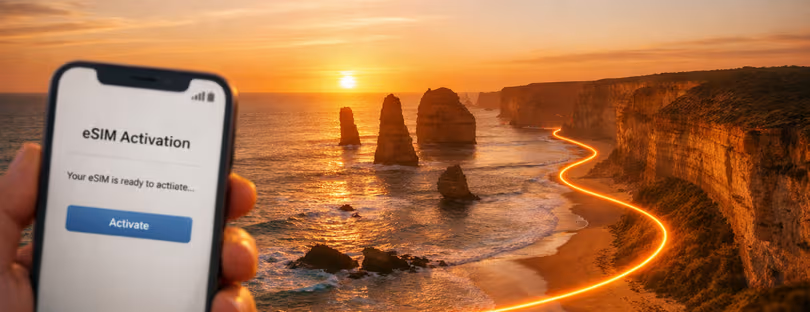
Residents in affected areas receive a temporary roaming-enabled eSIM profile. That profile allows their device to connect to any available network, not just their home operator.
If one network’s infrastructure is damaged but another’s is partially operational, users can still place calls, send messages, and access mobile data.
It is temporary. Full mobile service restoration is expected within 15 days, though structural repairs to infrastructure will likely take longer. But in crisis scenarios, 15 days without connectivity is not acceptable. So this stopgap matters.
This is not retail travel eSIM logic. It is regulated, coordinated domestic emergency roaming — and it demonstrates how flexible eSIM provisioning can be when policy allows it.
A Quiet Shift in Telecom Thinking
For years, roaming has been framed as a commercial product. International travel. Retail add-ons. Margin optimization.
But what Portugal just demonstrated is something different: roaming as resilience infrastructure.
This approach challenges the traditional “your SIM, your network” model. In extreme weather events, that rigidity becomes a weakness. Cross-network interoperability becomes a strength.
The technical foundation for this has existed for years through GSMA eSIM standards. What is different here is regulatory alignment and political will.
In many countries, domestic roaming between competitors remains sensitive. Commercial rivalries, wholesale agreements, and regulatory complexity often slow down cooperation. Portugal’s model shows that under pressure, operators can act collectively.
The question is whether this becomes a blueprint or remains a one-off.
5,000 eSIMs: Symbolic or Scalable?
On paper, 5,000 emergency eSIMs for 131,000 affected users may look modest.
But scale in emergency management often follows phased deployment. The initial distribution targets the most critical zones — areas with no service at all.
The real story is not the number. It is the precedent.
If eSIM can be rapidly provisioned to enable cross-network roaming in disaster scenarios, telecom resilience strategies may need to evolve.
Future storm responses might not just involve mobile generators and satellite backhaul. They may include pre-approved emergency roaming profiles, automatically triggered under defined outage conditions.
That is programmable connectivity applied to public safety.
Europe Is Watching
Across Europe, extreme weather events are increasing in frequency and severity. Floods in Germany. Wildfires in Greece. Storm damage in Spain and Portugal.
Telecom infrastructure remains physically vulnerable. But digital flexibility is improving.
Portugal’s move aligns with a broader European trend toward network resilience and digital sovereignty. Regulators are increasingly focused on ensuring continuity of service in crisis situations. Cross-operator collaboration is slowly becoming less taboo.
We have seen similar concepts in other markets, where temporary national roaming agreements are activated during outages. However, these are often ad hoc and commercially complex.
The Portuguese example stands out because it integrates regulator, government, and operators in a coordinated public response.
And crucially, it uses eSIM as the delivery mechanism.
Why This Matters Beyond Portugal
From an industry perspective, this initiative reinforces a larger truth: connectivity is no longer just a product. It is infrastructure in the same way electricity and water are infrastructure.
The difference is that connectivity can now be dynamically reprogrammed.
In traditional SIM logic, users are bound to one network identity. With eSIM, identity can be provisioned, replaced, or supplemented digitally. That flexibility creates opportunities not just for travel retail, but for crisis management, enterprise continuity, and public-sector resilience.
The Portuguese operators did not market this as an innovation. They framed it as an emergency response. But structurally, it is both.
Conclusion
Portugal’s emergency roaming eSIM initiative is more than a storm recovery measure. It is a glimpse into what modern telecom cooperation can look like under pressure.
Compared to more rigid markets where domestic roaming remains politically sensitive, Portugal demonstrated that competitors can collaborate when continuity of service becomes a public priority. Similar discussions are happening across Europe as regulators reassess resilience standards in light of climate-related disruptions.
If this model evolves into formalized emergency roaming frameworks — pre-authorized, technically standardized, and regulator-backed — it could redefine how national networks respond to disasters.
The telecom industry often debates margins, spectrum, and pricing models. But moments like this remind us of the core mission: keep people connected when it matters most.
In the coming years, resilience will not be measured only by tower density or 5G coverage maps. It will be measured by how quickly networks can adapt, interoperate, and recover.
Driven by wanderlust and a passion for tech, Sandra is the creative force behind Alertify. Love for exploration and discovery is what sparked the idea for Alertify, a product that likely combines Sandra’s technological expertise with the desire to simplify or enhance travel experiences in some way.