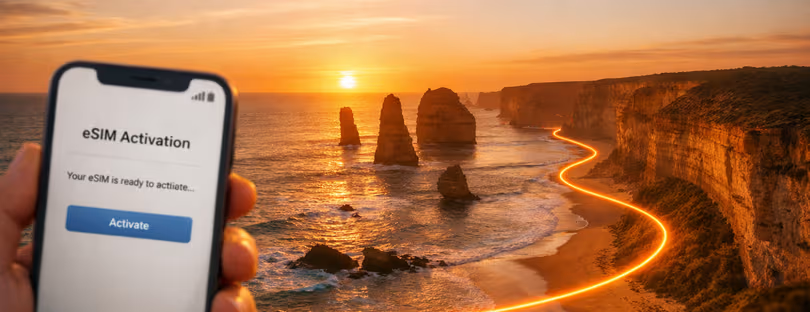
A New eSIM Player Targets the Hardest Connectivity Problem: The Sea. (and unlimited)
OneRoam has officially launched with a bold claim: a global traveleSIM that delivers ‘unlimited’ data, subject to fair-use policies and potential speed throttling
That positioning matters. Because while the travel eSIM market is crowded on land, connectivity at sea is still one of the least solved problems in globalroaming. Prices are high, coverage is inconsistent, and most travelers simply switch to airplane mode and wait for port Wi-Fi.
OneRoam is stepping directly into that gap.
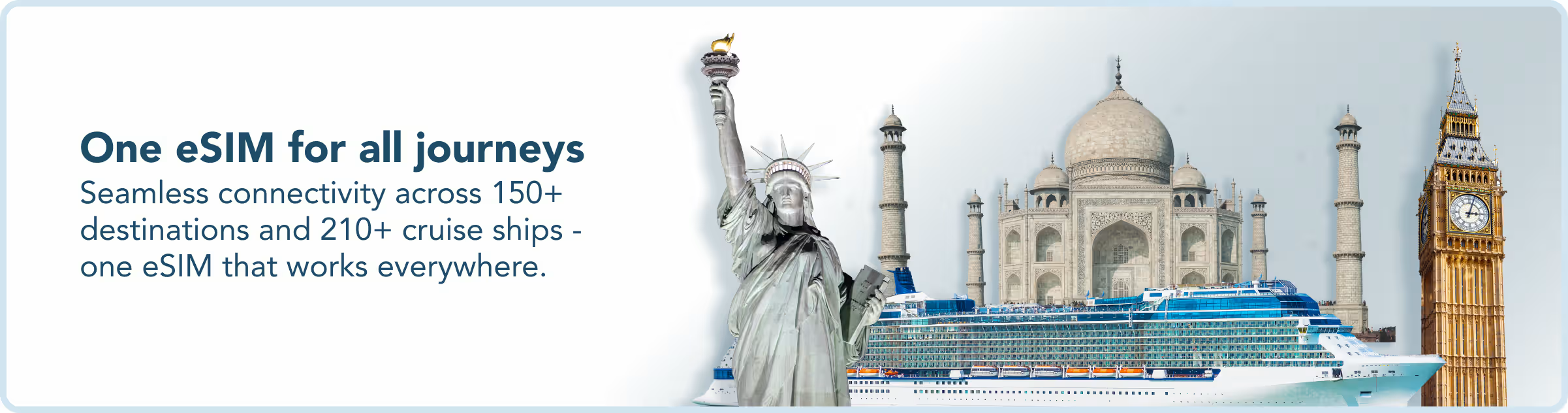
The company is introducing a day-based pricing model (prepaid plans priced per day) that works across more than 140 destinations and over 200 cruise ships. The promise is simple: one plan, predictable pricing, and no need to switch SIMs when moving between countries or maritime networks.
For an industry that still struggles with fragmentation, that’s an ambitious starting point.
What OneRoam Is Actually Offering
At its core, OneRoam is built around a familiar concept with a new twist: global coverage combined with daily pricing.
Instead of buying fixed data packages, users choose how many days they need. Plans start at around $3 per day for land-only usage and go significantly higher for cruise connectivity, starting at $19.99 per day.
The structure looks like this:
Land plans
3 days unlimited
from $14.99
7 days unlimited
from $31.99
30 days unlimited
from $89.99
Global + Cruise plans
1 day
from $19.99
7 days
from $89.99
30 days
from $259.99
The key differentiator is continuity. The same eSIM works across destinations and onboard ships, without requiring separate packages or manual switching.
That’s a real pain point today. Most travelers still juggle local eSIMs for land and expensive onboard Wi-Fi packages for cruises.
“OneRoam removes the complexity and unpredictability travelers often experience when trying to stay connected across multiple countries and maritime networks,” said Willie Moore, Executive Director, OneRoam. “Our goal is to provide a seamless connectivity experience that works wherever the journey takes them, whether at sea or land.”
That’s the vision. But the details matter.
The “Unlimited” Question
Like many providers in this space, OneRoam leans heavily on the word “unlimited.”
But in practice, it’s not truly unlimited in the way users might expect.
Buried in the terms is a standard fair-use policy. Once users cross a certain (undisclosed) threshold, speeds may be reduced for the rest of the validity period. High-bandwidth activities like streaming or large downloads can be impacted after that point.
In other words, this is “unlimited with throttling,” not unrestricted high-speed data.
That’s not unusual. In fact, this has become common among ‘unlimited’ travel eSIM providers.
But it does put OneRoam in the same category as providers that have built entire brands around this ambiguity. The difference is that OneRoam is applying it to a much more complex environment: maritime connectivity.
And that’s where expectations need to be managed carefully.
Where OneRoam Fits in the Market
If this feels familiar, it should.
OneRoam is effectively positioning itself as the closest comparable competitor in the cruise eSIM segment to Gigsky, one of the few established players offering eSIM connectivity for cruises.
GigSky takes a different approach. Instead of “unlimited,” it offers fixed data buckets like 25GB, 50GB, or 75GB per month for global plans, along with cruise-specific packages starting around $18.99.
Land plans
3 days unlimited
from $14.99
7 days unlimited
from $31.99
30 days unlimited
from $89.99
Global + Cruise plans
1 day
from $19.99
7 days
from $89.99
30 days
from $259.99
That creates a clear trade-off:
GigSky: predictable data limits, lower entry pricing, more transparency
On paper, OneRoam’s pricing is competitive for land usage. Around $3 per day for global data is aligned with what we’re seeing from providers like Holafly or Yesim’s day-based plans.
But at sea, pricing jumps significantly. A 30-day cruise plan at $259.99 brings the daily cost down, but still reflects the underlying reality of maritime networks: they are expensive to operate.
This is where OneRoam’s strategy becomes clear. It’s not trying to be the cheapest option. It’s trying to simplify a very fragmented experience.
Why Cruise Connectivity Is Still So Expensive
To understand OneRoam’s positioning, you need to understand the infrastructure behind it.
Connectivity at sea is not just roaming across terrestrial networks. It often relies on satellite backhaul, specialized maritime agreements, and limited bandwidth shared across thousands of passengers.
That’s why onboard Wi-Fi is notoriously expensive and unreliable.
eSIM providers like OneRoam and GigSky are essentially building alternative access layers on top of that infrastructure. They negotiate access, bundle it into consumer-friendly plans, and try to abstract away the complexity.
But they can’t fundamentally change the cost structure. At least not yet.
Which means pricing will always look high compared to land-based eSIM plans.
The Real Innovation: Distribution, Not Technology
What OneRoam is really doing is not reinventing connectivity. It’s packaging it differently.
The pay-by-day model is increasingly becoming the dominant logic in travel eSIMs. We’ve seen it with providers like Yesim, and even premium players like Fairplay are moving toward usage-based or adaptive pricing models.
Why?
Because travel behavior is unpredictable.
Some days you need almost no data. On other days, you need unlimited. Traditional fixed plans force users to guess upfront. Day-based or adaptive models remove that friction.
OneRoam extends that logic into a new territory: maritime.
That’s the real play here.
Who This Is Actually For
Despite the broad messaging, OneRoam is not for everyone.
For occasional travelers, especially those staying within one country, cheaper local or regional eSIMs will still make more sense.
Where OneRoam becomes relevant is in more complex travel patterns:
Ideal users
Cruise passengers moving across multiple regions
Digital nomads combining land and sea travel
Business travelers with unpredictable itineraries
Content creators who need always-on connectivity
For these users, the value is not just data. It’s continuity.
Not having to think about connectivity every time you change location is the real product.
What Comes Next for This Category
OneRoam’s launch is another signal that the travel eSIM market is evolving beyond simple data packages.
We are now seeing three distinct directions:
Price-driven players competing on GB and affordability
“Unlimited” providers competing on simplicity and marketing
Infrastructure-led models focusing on subscriptions, APIs, and embedded connectivity
OneRoam sits somewhere between the second and third categories.
It simplifies the user experience, but it also hints at a future where connectivity follows the traveler seamlessly across environments, without manual intervention.
That’s the bigger picture.
Conclusion
OneRoam is not introducing a completely new concept. But it is applying existing eSIM logic to one of the most underserved parts of the market.
That alone makes it worth paying attention to.
Compared to players like GigSky, it trades transparency for simplicity. Compared to land-focused providers like Holafly or Airalo, it expands the scope into maritime connectivity, where few competitors operate at scale.
The biggest question will be trust.
Because in today’s eSIM market, “unlimited” has become one of the most overused and misunderstood terms. Providers that are clear about limits, thresholds, and real-world performance are the ones that tend to win long-term credibility.
Industry data from sources like the Trusted Connectivity Alliance and Juniper Research already shows rapid growth in eSIM adoption, especially among frequent travelers. But as the market matures, differentiation is shifting away from coverage and into experience design.
That’s exactly where OneRoam is positioning itself.
If it can deliver a consistent experience across both land and sea, it has a real opportunity.
If not, it risks becoming just another “unlimited” promise in a market that is already full of them.
Driven by wanderlust and a passion for tech, Sandra is the creative force behind Alertify. Love for exploration and discovery is what sparked the idea for Alertify, a product that likely combines Sandra’s technological expertise with the desire to simplify or enhance travel experiences in some way.


 Who This Is Actually For