For years, enterprises treated cellular connectivity as a secondary link. A failover line. A temporary bridge. Something you plugged in when fiber was delayed or MPLS failed.
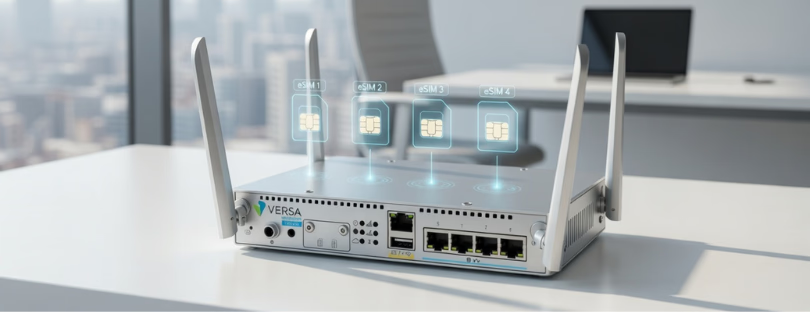
This week, Versa Networks announced an integration with 10T Solutions that brings native multicarrier cellular connectivity with eSIM support directly into Versa Secure SD-WAN appliances. On the surface, it is a technical integration. Underneath, it represents something bigger: the normalization of carrier-agnostic cellular as enterprise infrastructure.
And that shift deserves attention.
The problem with single-carrier cellular
Enterprises extending 4G and 5G into branches, pop-up retail sites, logistics fleets, industrial facilities, and IoT deployments face a structural constraint. Most cellular deployments still depend on a single carrier per device.
If that carrier underperforms, coverage drops, roaming restrictions apply, or congestion spikes, the enterprise absorbs the impact. Switching carriers often requires physical SIM swaps, contract renegotiations, or device-level intervention.
In distributed environments, this creates operational friction and risk.
Cellular was originally positioned as a redundancy. Today, in many deployments, it is the primary transport layer. That changes the risk profile entirely.
The Versa and 10T integration directly addresses that dependency.
What has actually changed
The integration enables Versa CSG and CSM appliances to support up to two active eSIMs. Each eSIM can host multiple carrier profiles, allowing enterprises to provision and switch between carriers without physical SIM management.
In practice, that means:
Multi-carrier eSIM support
Multiple carrier profiles can coexist on a single appliance, creating real carrier diversity at the device level.
Dynamic profile switching
Carrier selection can shift automatically without manual SIM swaps or site visits.
Intelligent path selection
Versa SD-WAN continuously monitors performance metrics and routes traffic across the optimal link.
Zero-touch provisioning
Centralized eSIM profile management removes the logistical overhead of distributing and replacing physical SIM cards.
These capabilities collectively transform cellular from static connectivity into programmable transport.
Why eSIM matters in SD-WAN environments
In the consumer world, eSIM has been marketed around convenience and travel flexibility. In enterprise networking, it becomes something far more strategic: control.
10T Solutions brings multicarrier eSIM technology with support for SGP.32, the GSMA specification for IoT remote SIM provisioning. SGP.32 enables remote lifecycle management of SIM profiles at scale. Profiles can be provisioned, modified, or retired without device recall.
When this capability is embedded directly into SD-WAN appliances, the connectivity layer becomes aligned with the orchestration layer.
SD-WAN already abstracts multiple WAN transports. But if the cellular layer underneath remains locked to a single carrier, that abstraction is incomplete. True path diversity requires carrier diversity.
This integration effectively embeds that diversity inside the appliance itself.
From backup link to strategic transport
The evolution of cellular inside enterprise networking is worth examining.
Phase one: backup link for wired outages. Phase two: rapid-deployment primary link for temporary sites. Phase three: permanent primary transport for distributed and mobile assets.
We are now entering phase four: programmable, multicarrier cellular embedded into the network fabric.
For retail chains launching new locations, logistics firms managing cross-border fleets, or industrial operators deploying remote sensors, uptime is mission-critical. Cellular must behave like infrastructure, not contingency.
The ability to run two active eSIMs with multiple carrier profiles changes the reliability equation. If one carrier degrades, traffic can shift automatically. If a device crosses into a new coverage zone, profiles can adapt dynamically.
This reduces downtime, accelerates deployments, and simplifies scaling.
Competitive context and market direction
Versa is widely recognized in the unified security and networking space. Its VersaONE Universal SASE Platform converges SD-WAN, SSE, and SD-LAN capabilities into a unified architecture. Integrating multicarrier eSIM strengthens its edge and mobility narrative.
Other SD-WAN vendors have introduced embedded LTE or 5G modules. Some support eSIM. But multicarrier orchestration at the appliance level remains uneven across the market.
On the connectivity side, 10T Solutions positions itself as an AI-enabled IoT connectivity provider with large-scale deployment expertise. By embedding its multicarrier stack inside Versa appliances, it moves beyond being a standalone connectivity provider and becomes part of the enterprise networking control plane.
This mirrors broader industry trends.
According to GSMA Intelligence, IoT connections continue to expand globally, with remote SIM provisioning becoming a default requirement in large-scale deployments. Kaleido Intelligence has also projected significant growth in eSIM provisioning transactions across IoT and enterprise use cases over the coming years.
The direction is clear: remote provisioning and carrier flexibility are becoming baseline expectations.
Operational impact for enterprises
From an IT perspective, the benefits are tangible.
Deployment speed increases. Appliances can be shipped with embedded eSIM capability and activated remotely. There is no need to manage physical SIM inventory.
For enterprises managing hundreds or thousands of distributed endpoints, these efficiencies compound quickly.
The larger architectural shift
Beyond operational benefits, this integration reflects a deeper architectural shift: connectivity is becoming programmable infrastructure.
Historically, the SIM card represented a static relationship with a single carrier. Physical logistics constrained flexibility. Carrier changes were slow and costly.
With eSIM and remote provisioning, connectivity becomes software-defined. When layered with SD-WAN intelligence, it becomes policy-driven.
In future iterations, enterprises will not simply fail over between carriers based on signal strength. They will optimize based on cost thresholds, geopolitical exposure, application sensitivity, and real-time analytics.
This is the convergence of SD-WAN, eSIM, and AI-driven network management.
It is subtle now. It will not remain subtle for long.
What this means for the market
The integration between Versa and 10T Solutions signals that multicarrier eSIM is moving into mainstream enterprise networking stacks, not remaining confined to niche IoT deployments.
Vendors that continue to treat cellular as a single-carrier add-on risk falling behind. Enterprises increasingly expect flexibility, resilience, and remote control.
Competitors will respond. Some will integrate their own multicarrier capabilities. Others may partner with connectivity aggregators. The differentiator will not simply be hardware support, but orchestration depth and policy intelligence.
The question is no longer whether enterprises will adopt multicarrier eSIM. The question is how deeply it will integrate into their network architecture.
Conclusion
This announcement is less about a feature and more about direction.
When SD-WAN appliances embed multicarrier eSIM capabilities, cellular connectivity stops being a backup path and becomes programmable infrastructure. The dependency on single carriers weakens. Operational complexity declines. Resilience improves.
In a world where branches are remote, fleets are mobile, and IoT endpoints multiply, single-carrier dependency is an unnecessary risk.
The enterprises that treat connectivity as software-defined infrastructure rather than static access will build networks that are not only more resilient but strategically more flexible.
And as enterprise 5G, IoT scale, and SASE adoption accelerate, integrations like this will likely move from competitive advantage to baseline expectation.
Driven by wanderlust and a passion for tech, Sandra is the creative force behind Alertify. Love for exploration and discovery is what sparked the idea for Alertify, a product that likely combines Sandra’s technological expertise with the desire to simplify or enhance travel experiences in some way.