LG Uplus Links Roaming, Flights, and Cashback
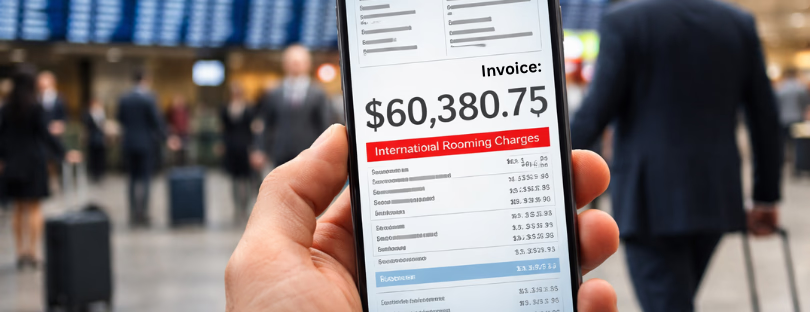
Lunar New Year travel is one of those moments when everything gets stress-tested at once. Airports are crowded, networks are congested, roaming bills can spiral, and even seasoned travelers start thinking about backup plans. This year, LG Uplus is leaning into that reality with a roaming promotion that feels unusually well thought out.
Instead of pushing vague discounts or “limited-time” data bundles, the Korean operator is tying roaming directly to how people actually travel during the holiday. Flights. Spending abroad. In-flight connectivity. It is a small but telling shift in how telecoms are trying to stay relevant when travelers already have plenty of alternatives.
The promotion runs through February 28 and targets customers traveling overseas during the Lunar New Year period. On the surface, it looks like a classic seasonal campaign. Look a little closer, and it says a lot about where roaming is headed.
Roaming Passes With Real Travel Context
At the center of the campaign is LG Uplus’ roaming pass. Customers who sign up for a plan priced at 44,000 won or higher get two immediate benefits: double roaming data and an in-flight Wi-Fi voucher for Korean Airlines.
That pairing is not accidental. For many travelers, the first real need for connectivity does not start after landing. It starts mid-flight. Messaging family. Checking hotel details. Preparing for immigration forms. In-flight Wi-Fi has quietly shifted from a luxury to a baseline expectation, especially on long-haul routes.
There is a practical catch, and LG Uplus is transparent about it. The Wi-Fi voucher is sent by text message only to customers boarding Korean Air Lines aircraft equipped with in-flight Wi-Fi. In other words, no vague promises. If the plane supports it, you get it. If not, you don’t.
To activate the benefit, customers subscribe to the roaming pass and then apply via the “Get benefits” section in the events menu of the Uplus official online store. It is not fully automatic, but it is clearly explained. That matters more than it sounds. One of the biggest pain points in roaming promotions is confusion around eligibility and redemption.
Cashback Tied to How People Spend Abroad
The second pillar of the promotion moves beyond connectivity and into spending behavior. Customers who spend 200,000 won or more at overseas merchants, both online and offline, using a Korean Air Lines card can receive up to 150,000 won in cashback.
This is where the campaign gets more interesting. LG Uplus is not just selling data. It is positioning roaming as part of a broader travel ecosystem that includes payments, airlines, and cards. Eligible cards and merchants, along with the cashback application process, are again handled through the benefits menu of the Uplus official online store.
For travelers, this feels closer to a travel bundle than a telecom upsell. For LG Uplus, it is a way to stay visible even when users might otherwise bypass operator roaming entirely in favor of eSIMs or local SIM cards.
Partnerships as a Competitive Weapon
Im Hye-gyeong, LG Uplus’ head of rate plans, framed the strategy clearly:
“We will continue to expand partnerships, including with Hyundai Card, and work to provide only the benefits customers truly need based on their experiences.”
That quote is worth pausing on. “Based on their experiences” is doing a lot of work here. Telecom operators have learned, sometimes the hard way, that travelers no longer respond to abstract promises of speed or coverage. They respond to tangible moments where connectivity either helps or fails them.
Airlines, card issuers, and roaming are converging around those moments. LG Uplus is not alone in this, but it is executing the idea with more clarity than many.
How This Compares to the Wider Roaming Market
Globally, roaming promotions tend to fall into two buckets. Either aggressive price cuts designed to slow down eSIM adoption, or vague “travel packs” that bundle services without much coherence.
What LG Uplus is doing sits somewhere in between. It is not trying to beat eSIM providers on price alone. Instead, it is stacking benefits that eSIM-only players usually cannot control, like airline Wi-Fi and card-based cashback.
Compare this with how many European operators approach roaming. The focus is still largely on data caps and destination lists, even as travelers increasingly expect seamless, multi-touchpoint experiences. Meanwhile, standalone travel eSIM brands compete on flexibility, instant activation, and transparent pricing, but rarely integrate with airlines or payment ecosystems.
The result is a fragmented experience for travelers. LG Uplus is clearly betting that tighter partnerships can reduce that fragmentation, at least for its own customers.
What This Signals About Roaming Trends
This promotion reflects a broader shift in the roaming market. Connectivity is no longer the product. It is the baseline. The differentiator is what surrounds it.
Airlines see Wi-Fi as a loyalty driver. Card issuers see international spend as a growth lever. Telecom operators are stuck in the middle, trying to stay relevant as travelers gain more choice. The only way forward is collaboration.
We are seeing similar signals elsewhere in the market. Airline-backed connectivity bundles. Card-linked travel perks. Operators experimenting with experience-based rewards rather than raw data volume. None of this is accidental. It is a response to a traveler who is more informed, more demanding, and far less patient with friction.
Conclusion
LG Uplus’ Lunar New Year roaming promotion is not revolutionary, but it is revealing. It shows an operator that understands roaming alone is no longer enough. By tying data to flights, spending, and partnerships, LG Uplus is moving closer to how travel actually works today.
Compared with traditional roaming offers that still rely on confusing caps or short-term discounts, this approach feels more grounded. And compared with pure eSIM players, it highlights where operators still have leverage: deep local partnerships and access to adjacent services.
The long-term question is whether this kind of bundled thinking becomes the norm or remains a seasonal experiment. If trends from airlines, card issuers, and travel tech continue in the same direction, the answer seems clear. Roaming will survive, but only when it stops acting like a standalone product and starts behaving like part of the journey.