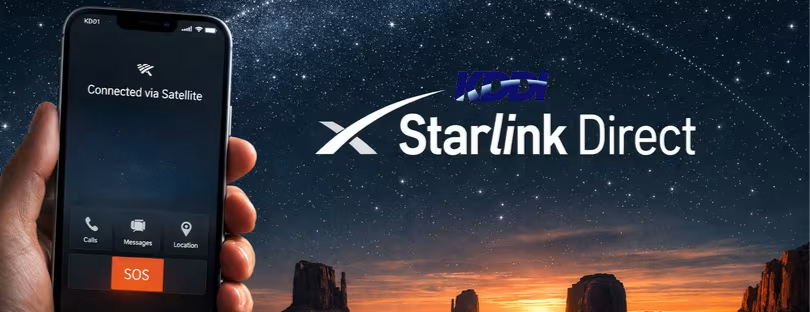
There’s a subtle shift happening in travel connectivity right now, and it’s coming from Japan. KDDI and Okinawa Cellular have expanded their au Starlink Direct service to support iPhones. On paper, this sounds like a routine device update. In reality, it’s a signal of where mobile connectivity is heading next.
For the first time, a wide range of iPhones can connect directly to satellites while roaming in the United States. No extra hardware. No special device. Just your phone and the sky.
What actually changed
Until now, satellite-to-smartphone connectivity has been limited by device compatibility. That’s no longer the case.
The updated service now supports 22 iPhone models, including:
iPhone 13 series
iPhone 14 series
iPhone 15 series
iPhone 16 series
iPhone 17 series
iPhone Air
That’s a meaningful jump. It essentially brings satellite roaming into the mainstream iPhone ecosystem.
And importantly, this isn’t just emergency messaging like what users may know from Apple’s built-in satellite SOS features. This is about ongoing connectivity while traveling, particularly in areas where traditional mobile networks simply don’t exist.
Why the U.S. matters here
The United States is the perfect testing ground for this kind of service.
It’s huge. Vast stretches of the country still lack consistent terrestrial coverage. National parks, highways, rural zones. These are exactly the places where travelers lose signal and where connectivity suddenly matters most.
KDDI’s move builds on its partnership with T-Mobile, announced in late 2025. Since March 2026, the au Starlink Direct service has been live for international roamers, offering connectivity even when there’s no traditional network available.
The key idea is simple: If your phone can see the sky, it can connect.
That changes the roaming experience in a very practical way. No more complete signal drops. No more “dead zones” in the middle of nowhere. Just a slower, but still functional, connection layer sitting above the traditional network.
How it works in practice
This is where things get interesting.
The service relies onStarlink, using low Earth orbit satellites to communicate directly with smartphones. No dish. No external receiver.
From a user perspective, the experience is meant to feel seamless:
When terrestrial coverage is available → your phone uses it
When it’s not → it switches to satellite connectivity
That’s the promise, at least.
In reality, there are still limitations. Satellite bandwidth is not comparable to 5G. Speeds are lower, latency is higher, and usage is more constrained. But for messaging, navigation, and basic connectivity, it’s more than enough.
And that’s the point. This isn’t about replacing networks. It’s about filling the gaps.
Why this matters for travelers
If you travel often, you already know the problem.
Roaming works great… until it doesn’t.
You land, your eSIM connects, and everything looks fine. Then you drive two hours out of a major city, and suddenly you’re offline. Maps stop updating. Messages fail. That familiar “No Service” appears.
What KDDI is doing here is removing that worst-case scenario.
You may not have perfect connectivity everywhere, but you won’t have zero connectivity anymore.
That’s a big psychological shift. And if you think about it, it directly tackles one of the biggest pain points in travel tech: connectivity uncertainty.
The bigger picture: telecom is going hybrid
Zoom out, and this isn’t just about KDDI or Japan.
This is part of a much larger shift in the telecom industry.
SpaceX is pushing direct-to-device through Starlink
AST SpaceMobile is testing direct satellite broadband to smartphones
Each of them is approaching the same problem from a different angle.
But the direction is clear: Connectivity is no longer just about networks on the ground.
Where eSIM fits into this
This is where things get especially relevant for the eSIM ecosystem.
eSIM already removed one layer of friction by making connectivity digital and flexible. You can switch providers, add plans, and stay connected globally without swapping SIM cards.
Now, satellite connectivity is removing another layer: coverage limitations.
Combine the two, and you get something much more powerful:
eSIM
flexibility and distribution
Satellite
coverage and resilience
Together, they start to look like a fully global connectivity layer.
And that has implications far beyond consumers. Think:
Travel platforms bundling connectivity by default
Airlines offering uninterrupted connectivity beyond Wi-Fi zones
This is exactly the kind of shift that infrastructure players, APIs, and enablers are already positioning for.
What to watch next
KDDI’s move is important, but it’s not the final form of this technology.
A few things to watch closely:
Will this expand beyond the U.S.?
Will pricing become transparent and predictable?
Will satellite fallback become standard in all premium plans?
How will performance improve with next-gen satellites?
And most importantly:
Will users even notice?
Because the real win here is invisible. If this works as intended, users won’t think about satellite connectivity at all. It will just quietly solve a problem that used to break the travel experience.
What this tells us about the future of roaming
For years, roaming has been about cost.
How much per GB? Which provider is cheaper? How to avoid bill shock?
That conversation is starting to change.
Now it’s about reliability.
Can you stay connected everywhere? Can you trust your connection when it actually matters?
KDDI’s au Starlink Direct update doesn’t solve everything. But it pushes the industry in a very clear direction.
Connectivity is no longer a binary state. It’s becoming layered, adaptive, and increasingly invisible.
Conclusion
What KDDI is doing with au Starlink Direct is not just a feature update. It’s a preview of a new connectivity model.
Compared to solutions from Apple or AST SpaceMobile, which still focus heavily on emergency or early-stage capabilities, this approach moves closer to everyday usability for travelers. At the same time, initiatives from SpaceX and T-Mobile are accelerating the commercial rollout, while chipset players like Qualcomm are embedding satellite readiness directly into devices.
According to industry bodies like GSMA, non-terrestrial networks are expected to become a core part of global connectivity standards over the next few years, not just a niche add-on.
So, where does this leave the market?
Simple. The future isn’t “terrestrial vs satellite.” It’s both.
And the providers that figure out how to combine them seamlessly will define the next phase of global connectivity.
For travelers, that means one thing: The idea of being completely offline while traveling is slowly becoming obsolete.
Driven by wanderlust and a passion for tech, Sandra is the creative force behind Alertify. Love for exploration and discovery is what sparked the idea for Alertify, a product that likely combines Sandra’s technological expertise with the desire to simplify or enhance travel experiences in some way.