Huawei Adds Curve Pay to Watches in Europe
Wrist-based payments have been a slow burn in Europe. The infrastructure was always there — NFC terminals are practically ubiquitous across the continent — but the software side, particularly for non-Apple, non-Samsung devices, has lagged. Huawei is now making a deliberate push to close that gap.
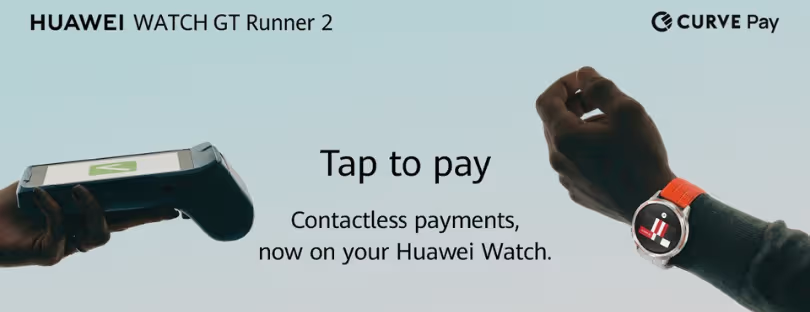
The company has confirmed Curve Pay integration across several of its smartwatch models in Europe: the HUAWEI WATCH Ultimate 2, WATCH GT 6, WATCH GT 5, and WATCH FIT 4. This follows an earlier rollout on the WATCH GT Runner 2, the brand’s GPS-focused device aimed at runners. That one launched with Curve Pay already baked in — which, in hindsight, looks like the quiet pilot before a broader expansion.
What Curve Pay Actually Adds
Curve Pay isn’t just another tap-to-pay layer. The core pitch is card consolidation — you load your existing cards into a single wallet interface, and the watch becomes your payment surface. That sounds simple, but the execution matters: the platform avoids hidden currency conversion fees (a genuine pain point for European travelers), lets you retroactively switch which card a payment was charged to, and stacks rewards on top of whatever your underlying card already offers.
For Huawei watch users specifically, a few features stand out:
Key capabilities at launch:
- Tap-to-pay at NFC terminals without a phone present
- One Smart Wallet — consolidates multiple cards into a single interface
- Off-wrist detection — triggers a passcode requirement the moment the device is removed, preventing unauthorized use
- Instant freeze — card management controls accessible directly from the watch
The off-wrist security feature is worth noting. It’s the kind of detail that separates a serious payment implementation from a checkbox feature. If you’re wearing a watch with contactless payment capability and it gets lifted off your wrist, you want it to lock immediately — not after a timer, not after a PIN timeout.
Huawei’s Ecosystem Logic
“The integration of Curve Pay into our wearable ecosystem marks a significant milestone in our mission to create a truly seamless digital life,” said Rong Tao, Huawei’s European Device Business President. “With this new addition to HUAWEI WATCH devices, we’re enabling our consumers to enjoy secure and convenient tap-to-pay functionality directly from their wrist, giving them greater independence and freedom of movement.”
The language is corporate, but the strategy underneath it is coherent. Huawei has been systematically rebuilding its consumer ecosystem in Europe post-2019 trade restrictions — AppGallery, HarmonyOS, its own health and fitness stack — and payments are a natural extension of that effort. A smartwatch that can’t pay is increasingly a hard sell in a market where the Apple Watch and Galaxy Watch have normalized the behavior.
Getting Curve Pay running across four watch models simultaneously, with availability on AppGallery, App Store, Google Play, and Galaxy Store, signals that Huawei isn’t trying to wall this off as an exclusive feature. The cross-platform app availability is pragmatic — it means Curve users who switch to a Huawei device don’t have to abandon their wallet setup.

The Bigger Picture: Wearable Payments Are Getting Competitive Fast
This move doesn’t happen in isolation. Google Wallet has been steadily expanding its wearable support. Garmin Pay has been quietly building out its banking partnerships across Europe. Fitbit Pay (now fully absorbed into the Google ecosystem) covers a decent range of banks in the UK and Western Europe. And Xiaomi, which competes directly with Huawei in the mid-range wearable segment, has been pushing NFC payment features into its Band and Watch S series.
What differentiates the Curve Pay approach is the meta-wallet angle. Most wearable payment solutions are single-card or bank-specific — you add a Visa, you tap to pay, that’s the loop. Curve sits across multiple cards and adds a financial management layer on top. For frequent travelers or people managing multiple accounts, that’s genuinely useful rather than a feature you forget exists.
The question is whether Huawei can drive meaningful adoption given its current position in the European market. Its watch hardware is well-regarded — WATCH Ultimate 2 in particular has received strong reviews for build quality and battery life — but its smartphone market share in Europe remains limited, which historically constrains ecosystem stickiness. Watches paired with non-Huawei phones are a thing, but it’s a harder sell.
What to watch going forward:
- Expansion to additional Huawei watch models (the company has indicated more are coming)
- Whether Curve Pay’s bank coverage keeps pace with user expectations across more European markets
- How this plays against Garmin’s expanding payment partnerships, particularly in the sports/outdoor segment, where both brands compete
The Takeaway Huawei Curve Pay smartwatch Europe
Huawei adding Curve Pay to its smartwatch lineup is a sensible, well-timed move — but it’s really a chapter in a longer story about how non-dominant players in the wearable space are trying to close the feature gap with Apple and Samsung. The hardware has been there for a while. The payment software layer has been the weak link.
What makes this interesting from a market perspective is Curve Pay’s positioning as a financial aggregator rather than a single-issuer wallet. That model — closer to what Revolut or Wise have done on the app side — is starting to show up in hardware integrations, and it makes more sense for a fragmented European banking landscape than trying to build direct bank partnerships from scratch. Analysts tracking open banking trends in Europe, including reports from Juniper Research and the European Payments Council, have consistently pointed to aggregation models as the growth vector in the wearable payments space through 2026 and beyond.
For Huawei, the win here isn’t just functional — it’s perceptual. Every feature that closes the gap with Apple Watch makes the choice slightly less asymmetric for European consumers. Whether that’s enough to move the needle on market share is a separate question. But in wearable payments, being present and working well is the table stakes. Huawei is now at the table.