GO UP
tech background
how to prevent roaming bill shock in enterprises

Enterprise Mobility After the Roaming Era

If you have ever asked, “How did we spend that much on mobile data this month?” you already know the dirty secret of corporate mobility: bill shock is rarely a carrier problem. It is a profile problem.
 

Most companies still treat mobile connectivity like a binary choice. Either give people “full internet” and hope they behave, or lock everything down so hard that employees start finding workarounds.

That second part matters because the fastest-growing cost in mobility is often the one finance never sees coming: shadow usage. Not just “Netflix on the company phone,” but employees quietly installing tethering apps, swapping SIMs, buying a travel eSIM on their own card, or routing work traffic through whatever connection is available because “IT is too slow.”

Meanwhile, travel eSIM revenue is surging because instant connectivity is becoming the default expectation. Juniper Research put travel eSIM package revenue at $1.8B in 2025, up sharply year over year.

So the question for IT is not “Should we allow eSIM?” It is “Which profiles do we allow, and how do we enforce them without breaking work?”

Business-only vs full internet is not a moral debate

A business-only profile is a connectivity rule set that answers one simple question: “What does this device need to do for work?”

A full internet profile answers a different question: “What can the internet do?”

Those are not the same thing.

Business-only profiles typically include things like:

  • Access to corporate apps (SSO, email, Teams, Slack)
  • VPN or secure access tools
  • Approved SaaS domains
  • Updates, security services, and device management traffic
  • Roaming rules that stop background drains

Full internet profiles include all of that, plus the entire open web, streaming, app stores, hotspot use, and the wild west of “I needed it for a meeting, okay?”

Neither is inherently “right.” The mistake is giving everyone full internet by default and then acting surprised when roaming bills look like a ransom note.

Where bill shock really comes from in 2026

Bill shock used to be mostly about the roaming price per MB. That still exists, but the modern version is sneakier.

Background data is the silent killer

Cloud sync, OS updates, photo backups, app refresh, and telemetry do not care that your employee is in Dubai for 48 hours. Your corporate policy might say “use Wi-Fi,” but the device will happily burn cellular while the user is asleep.

Hotspot turns one device into five

One tethered laptop update, one Zoom call, one file upload, and suddenly “the phone used 8GB today.”

“Unlimited” is often a pricing label, not a guarantee

Even when the plan is marketed as unlimited, fair-use and throttling rules can push users to switch networks or buy alternatives, which is where shadow usage starts.

The shadow eSIM is now the default workaround

If an employee can buy a travel eSIM in two minutes, they will. And if they do it outside IT visibility, you lose cost control, security posture, and auditability at the same time.

This is why travel eSIM growth is not just a consumer trend. It is a signal that frictionless connectivity is winning, and corporate policy has to adapt.

suresim

The real fix is policy profiles plus real-time control

Here is the uncomfortable truth: you cannot “expense policy” your way out of connectivity chaos.

What works is a combination of:

  • Profile design (business-only vs full internet)
  • Real-time visibility (what is happening right now)
  • Lifecycle controls (activate, pause, suspend, retire)
  • Enforcement (rules that actually stick)

This is exactly where enterprise eSIM plus mobility management platforms sit, and it is why SureSIM is worth paying attention to.

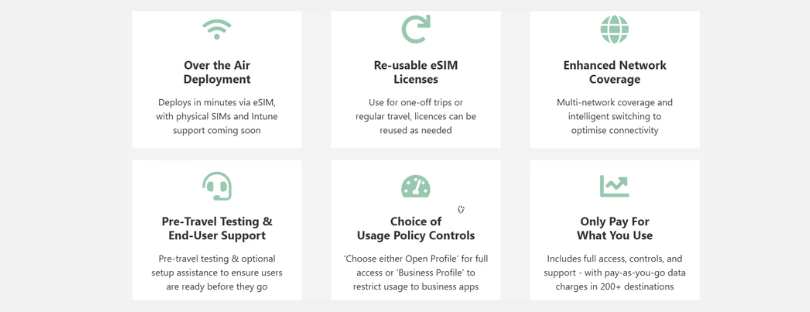
SureSIM positions itself as an enterprise eSIM plus mobility management built for IT teams and MSPs, with real-time control, policy-based management, and lifecycle management, not a consumer travel eSIM.

That distinction matters because consumer travel eSIMs optimize for the individual buyer. Enterprise mobility optimizes for governance, repeatability, and support load. how to prevent roaming bill shock in enterprises

What a good “business-only” profile actually looks like

This is where teams get stuck, so let’s make it practical. A business-only profile should feel invisible to the employee when they are doing work, and slightly annoying only when they are not.

Allowlist the work, not the whole internet

Start with the domains and services that matter. Identity providers, email, collaboration, your core SaaS stack, and your internal apps. Everything else is optional.

Control hotspots by role

Sales on the road might need tethering. A factory device probably does not. Hotspot is a profile switch, not a universal right.

Put hard rails on roaming behavior

Set thresholds, alerts, and automatic actions. “Notify at 80%, cap at 100%” is better than “Finance will notice next month.”

Make the “exception path” fast

If people need full internet for a real reason, give them a clean way to request a temporary profile upgrade. Shadow usage thrives when IT says no by default.

SureSIM explicitly leans into this idea of policy controls and real-time alerting to prevent roaming bill shock.

Full internet profiles still have a place, but only if they are managed

Some teams genuinely need open internet: execs, comms, journalists, field engineers, and anyone whose job involves unpredictable destinations and tools.

The difference between “managed full internet” and “free-for-all” is:

  • real-time usage visibility
  • clear guardrails on high-cost countries and networks
  • instant suspension or plan switching when anomalies appear
  • reporting that ties usage to users, trips, and business purposes

SureSIM’s messaging around a real-time control center and visibility is aimed directly at this operational reality.

Why is getting bigger, not smaller

Two market moves are colliding. how to prevent roaming bill shock in enterprises

First, eSIM is scaling fast across consumer travel and enterprise. Recent reporting highlights growing eSIM adoption and the industry shift toward more centralized provisioning approaches, especially in enterprise and IoT contexts.

Second, employee behavior has changed. People are no longer “loyal” to a carrier contract when they travel. They are loyal to not being inconvenienced. If corporate connectivity creates friction, shadow connectivity will replace it.

So the fight is not against eSIM. The fight is against unmanaged connectivity.

Enterprise eSIM | EMM Platform | SureSIM Mobility Management

What to look for when choosing an enterprise approach

If you are evaluating solutions, ask blunt questions:

Can we run multiple policy profiles per team?

Not just one global rule set.

Do we get real-time usage visibility and alerts?

Not “a report next week.” Real-time.

Can we suspend, reactivate, and retire cleanly?

Lifecycle matters when staff churn, devices get lost, or trips end early.

Is this built for IT and MSP workflows?

Dashboards, bulk actions, role-based controls, and support tooling.

Platforms that talk about dashboards, bulk management, data limits, and alerts are pointing at the right problem, even if their target segments differ.

Conclusion: The winning strategy is controlled freedom

The market is splitting into two lanes. how to prevent roaming bill shock in enterprises

Lane one is consumer travel eSIM: fast checkout, lots of plans, and a user solving their own problem. That lane is booming, and Juniper’s 2025 travel eSIM numbers underline how normal this behavior has become.

Lane two is enterprise connectivity: fewer surprises, fewer loopholes, and fewer tickets for IT. That lane is where policy profiles and lifecycle control become the product, not “cheap data.”

If you are trying to prevent bill shock and shadow usage, business-only vs full internet is the wrong framing if it ends in ideology. The right framing is controlled freedom: give employees the connectivity they need to do work instantly, then use profiles to remove the expensive and risky parts by default.

This is also why enterprise-first players like SureSIM are not competing with consumer travel eSIM brands on “Best plan for Thailand.” They are competing with chaos: unmanaged roaming, invisible spend, and security blind spots. And in 2026, with eSIM adoption accelerating and provisioning becoming more centralized across industries, that is a very real, very growing category.


Driven by wanderlust and a passion for tech, Sandra is the creative force behind Alertify. Love for exploration and discovery is what sparked the idea for Alertify, a product that likely combines Sandra’s technological expertise with the desire to simplify or enhance travel experiences in some way.