Yesim eSIM Japan Unlimited — Plans, Prices & What to Know
Japan’s tourism boom is well-documented at this point. Inbound visitor numbers have been shattering records since borders fully reopened, and for 2025, the Japan Tourism Agency was already forecasting over 35 million foreign arrivals. With that surge comes a predictable spike in eSIM searches — Japan consistently ranks as one of the top-five destinations for travel eSIM activations globally, sitting comfortably alongside Thailand, the UAE, and the US. It makes sense.
Narita, Haneda, and Kansai airports are often the first touchpoints for travelers realizing their home carrier’s roaming rate is embarrassing. Japan’s mobile infrastructure is exceptional — NTT Docomo, SoftBank, and KDDI collectively offer near-blanket 4G/5G coverage, including on the shinkansen — so the question isn’t really about network quality. It’s about who can give you access to it cheaply and cleanly.
What Yesim Is Offering
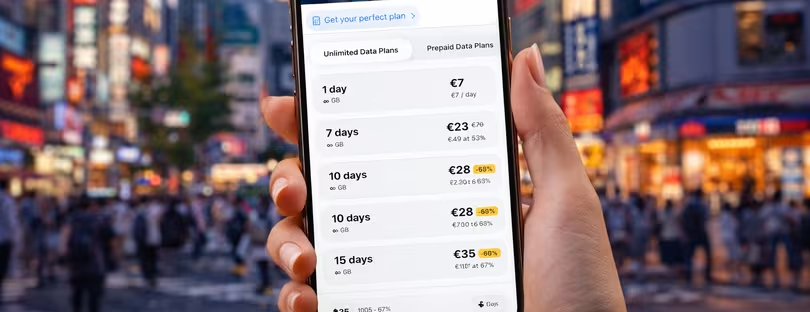
Yesim, the Swiss-registered eSIM platform backed by Genesis Group AG and part of the growing wave of operator-agnostic eSIM retailers, has put together a Japan lineup that’s worth looking at properly. The entry point is a 1-day unlimited plan at $8.40, which is essentially a day-pass format. From there, the pricing curve gets aggressive quickly.
The 7-day unlimited comes in at $27.60 — that’s $3.95/day, already a 53% drop per day compared to the entry rate. The 10-day plan is $33.60 ($3.36/day, -60%), the 15-day plan runs $42 ($2.81/day, -67%), and for longer stays, the 30-day unlimited plan lands at $66 — just $2.21/day, a 74% reduction from the day-one rate. For Japan, that 30-day figure is genuinely competitive, especially for digital nomads treating Tokyo or Osaka as a working base for a month.
There’s also a capped prepaid track if unlimited feels like overkill: 10GB/30 days at $20.40, scaling to 20GB for $31.20 and 30GB for $40.80. Per-GB rates land between $1.37 and $2.04, depending on volume.
The Day Pass Angle — and Why It Actually Matters
Beyond the Japan-specific plans, Yesim has a product called the Unlim Day Pass that deserves its own mention. It’s an annual-structure global plan covering 83 countries — Japan included — where you buy a bundle of unlimited-data days upfront and burn them down as you travel. Prices range from $58.80 for 10 days ($5.88/day) to $238.80 for 80 days ($2.99/day).
The logic here is aimed squarely at multi-destination travelers. If you’re doing Tokyo → Seoul → Bangkok in one trip, buying three separate country eSIMs is annoying and often more expensive than just pre-loading 20 or 30 days on a single profile. It’s not a new concept — Airalo’s regional and global passes work on a similar principle — but Yesim’s unlimited-per-day framing is slightly different from the GB-capped regional plans most competitors sell. You’re paying for time, not data volume. For heavy users, that distinction matters.
Reading Between the Lines on “Unlimited”
A word that needs context: unlimited. In Japan’s eSIM market, unlimited almost always means unlimited with network management policies — i.e., throttling after a daily threshold is hit. Yesim’s own FAQ acknowledges this, noting that once a daily usage ceiling is reached, speeds will be reduced to prevent network congestion.
This is standard practice across the board. Holafly, which built its brand almost entirely on unlimited plans, operates the same way. So does Nomad, and so do most others running on MVNO-type wholesale agreements. The practical ceiling for most travelers — streaming, navigation, video calls — won’t trigger throttling under normal use. But if you’re trying to upload 4K footage continuously, any unlimited eSIM plan is going to push back.
What Sets Yesim Apart in the Japanese Context
A few things worth flagging. First, the SwitchLess Networks feature: Yesim claims the eSIM will automatically shift to whichever local carrier offers the best available connection, including 5G where available. Whether this holds up across rural Japan — think Hakone, Yakushima, parts of Hokkaido — is harder to verify independently, but urban coverage is not a concern.
Second, Yesim offers hotspot/tethering support on Japan plans. Not all providers do, or they bury it in fine print. For anyone sharing data with a travel companion or connecting a laptop, this is relevant.
Third, and this one matters operationally: Yesim runs a Pay & Fly option as a fallback — a pay-as-you-go balance covering 170+ countries from $1.10/GB. If you arrive in Japan and realize your plan doesn’t suit your usage pattern, there’s an exit.
The Bigger Picture: Unlimited Plans Are Now Table Stakes
Japan eSIM is a crowded shelf. Airalo offers Japan unlimited starting at around $17 for 7 days. Holafly’s Japan Unlimited is positioned similarly. Nomad and Ubigi lean more toward capped GB plans for Japan. What Yesim is doing with its 30-day unlimited at $66 ($2.21/day) is competitive at the longer-stay end of the market, where most providers’ pricing gets soft.
The more interesting signal is structural. The proliferation of unlimited plans — from Yesim, Holafly, Airalo, and others — reflects a market maturation point. Per-GB pricing is becoming a commodity race nobody wins. The next battlefield is product architecture: day-pass models, annual plans, loyalty mechanics (Yesim has Ycoins, a cashback and referral system), and seamless multi-destination coverage. That’s where differentiation is being built now. Yesim’s Unlim Day Pass is a direct play at the frequent-traveler segment that Airalo has been courting with its subscription product. Both are betting that once a traveler is in their ecosystem with a pre-loaded plan, rebooking is automatic.
According to GSMA Intelligence data and industry analysts tracking the travel eSIM segment, the global travel eSIM market is expected to grow significantly through 2027, driven primarily by Asia-Pacific destinations — Japan chief among them. The infrastructure is there. The device compatibility is accelerating. The only question is who locks in the retention layer first. Yesim’s Day Pass model, combined with OneBalance on the B2B side and a loyalty program for consumers, suggests they’re thinking beyond single-trip transactions. That’s the right frame. In travel eSIM, the margin is thin. The money is in repeat.