From 8GB to 50+GB: Smarter Data for Nomads
If you are a digital nomad, you already know the most annoying truth about mobile data. Your usage is not consistent. It is moody. It swings.
One month, you are disciplined, living off café Wi-Fi, running maps, messages, and a few calls. You finish the month at 8GB and feel proud.
Next month, you land in a new city, your apartment Wi-Fi is “being installed tomorrow” for five tomorrows in a row, you hotspot your laptop, you push a couple of big uploads, you stream a lot more at night because you are tired, and suddenly you are at 50+GB without doing anything dramatic.
This is the gap most travel eSIM plans still do not respect. They assume travel is a short trip and data use is predictable. Nomad life is neither.
And that is why the next wave of travel connectivity is not really about bigger bundles. It is about plans designed for volatility.
Why nomad data is volatile by default
Volatility is not you being irresponsible. It is the environment.
Nomads sit on top of a stack of uncertainty:
Airbnb Wi-Fi that looks fast, then collapses when everyone wakes up. Co-working that is great until a thunderstorm cuts power. A new SIM or eSIM every border that changes how you behave. A new routine every city.
The work itself adds spikes:
Video calls are heavy. Cloud sync is heavy. Large attachments are heavy. Background app updates are sneaky. If you create content, the spikes get bigger.
This is why “average monthly usage” is a misleading metric for nomads. The average hides the problem. The problem is the swing between low months and high months.
If your plan cannot flex with you, you either overbuy (and waste money) or underbuy (and live in top-up mode). Both are exhausting.
Fixed bundles vs time-based unlimited
Most travel eSIMs still live in one of two worlds.
Fixed bundles are the classic model: buy 10GB, 20GB, 50GB, and pray you guessed right. It works well for normal trips because you can approximate. For nomads, fixed bundles cause constant micro-decisions. Should I stream or not? Should I upload now or later? Do I save the hotspot for emergencies?
Time-based unlimited is the newer promise: pay for X days, stop thinking. That is why it sells.
But the fine print matters. Many unlimited plans rely on fair use policies, speed reductions, or network management thresholds. HoIafly’s own FAQ explains that with unlimited plans, you may experience slower speeds if you exceed the fair usage policy limit set by the local operator.
For some travelers, this is fine. For nomads doing real work, it can be the worst of both worlds. You paid for “unlimited,” and you still end up managing your behavior, just in a different way.
So the market is starting to search for a third logic.
The third logic: responsive tiers with a cost ceiling
This is where FairPlay’s model becomes genuinely interesting. It is built around a simple nomadic truth:
Your usage will vary.
Your bill should not.
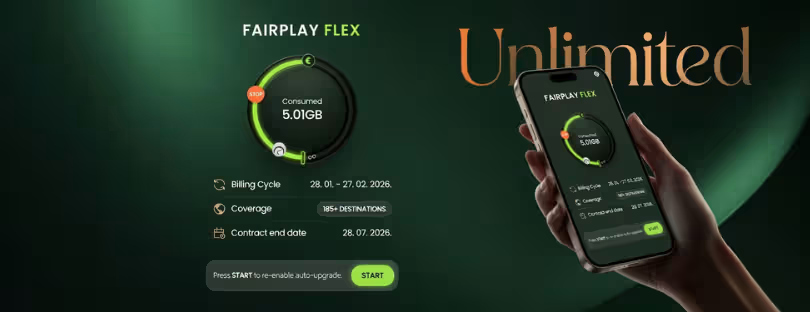
FairPlay FLEX starts with a baseline of 5GB of high-speed data. From there, the plan scales in clearly defined steps as your consumption increases. Instead of forcing you to pre-predict your needs, it responds to how you actually use data in real time.
Crucially, you remain in control. Through the app, you can stop further upgrades if you want to contain spending. That alone shifts the psychology from passive billing to active control.
But the defining feature is the monthly cost cap.
No matter how volatile your month becomes, your bill stops at a predefined ceiling — typically between €85 and €95 depending on contract duration. Once you reach it, you are protected. No runaway charges. No roaming-style shock.
That combination is the philosophy.
Not infinite data.
Predictable outcomes.
For a nomad, that is what actually matters. You do not want to calculate gigabytes during a deadline week. You do not want to switch behavioral modes halfway through a project because you guessed wrong on a bundle. You want a plan that absorbs volatility without punishing you for it.

What “volatile” looks like in real nomad weeks
This is the part the industry rarely illustrates, so let’s make it tangible.
Typical low month triggers
Maps, rides, messages, basic calls, email, browsing, occasional streaming, Wi-Fi covers the heavy lifting.
Typical high month triggers
Hotspotting a laptop for work, repeated video calls, cloud backups, large file uploads, long-form streaming, multiple devices, travel days with no stable Wi-Fi.
The problem is that you cannot predict which month you are about to have. You only notice the high month when you are already in it.
And this is why responsive models are more than pricing. They are stress reduction.
Bigger picture: the travel eSIM market is growing up
The timing here matters.
Travel eSIM is not niche anymore. Juniper Research estimates global travel eSIM revenue at $1.8 billion in 2025, projecting $8.7 billion by 2030, which is a major expansion of the category.
At the same time, digital nomadism is not a tiny subculture. MBO Partners’ 2025 report estimates 18.5 million American workers are digital nomads, and highlights long-term growth since 2019.
Put these together and you get a clear signal. The market is moving from “cheap travel data” to “connectivity as a lifestyle service.” That shift forces new plan design.
GSMA has also been pushing the narrative that eSIM-only is becoming real, and that operator support and device availability are rising globally.
As eSIM becomes normal, the product advantage moves away from “we have an eSIM” and toward “our pricing logic matches how people actually live.”
Nomads are the stress test for that.
Where FairPlay fits among the “unlimited” players
If you want a clean competitive framing, it is not about who is best. It is about which philosophy matches your use case.
Time-based unlimited providers like HoIafly win on immediacy and simplicity for short stays. You buy days, you stop thinking, unless fair use slowdowns appear.
Other brands lean into unlimited day plans too, including Yesim, which has built strong familiarity around daily unlimited logic for travelers.
FairPlay is trying to build a different habit:
A subscription that tracks real-world volatility, step-by-step, with a defined ceiling.
That is closer to how software subscriptions work. You start at a baseline, scale when you need more, but you do not get punished by surprise charges.
If nomads are moving from “travel mode” to “living internationally mode”, subscription logic makes more sense than bundle logic.
Conclusion
The travel eSIM market has spent years selling two ideas: fixed bundles for planners, unlimited days for people who hate planning.
Nomads are forcing a third idea into the spotlight: volatility-aware connectivity.
Because the real nomad problem is not running out of data. It is not even speed. It is the constant mental overhead of managing uncertainty, Wi-Fi, borders, top-ups, and the fear that the “unlimited” plan will suddenly behave differently when you need it most.
The bigger trend is clear in the numbers. Travel eSIM is scaling fast, and connectivity is becoming a mainstream travel product category. At the same time, nomadism is becoming mainstream, not fringe.
In that environment, “unlimited” as a marketing word will keep losing power. What will replace it is not a new slogan. It is better plan design.
FairPlay’s model is one of the more direct attempts to design for volatility, not just sell around it, by combining responsive tiers with a hard monthly cost ceiling.
And if the market keeps maturing the way GSMA and Juniper’s signals suggest, the winning providers will be the ones that make nomads feel one thing above all else.
Not impressed.
Not hyped.
Just calmly connected