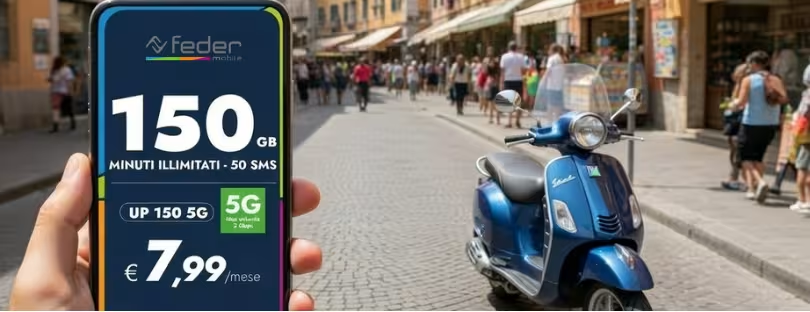
Italy’s telecom market just gained another digital connectivity option. Italian MVNO Feder Mobile has officially launched its eSIMservice, allowing customers to activate mobile plans without inserting a physical SIM card.
For users, this means a much simpler onboarding experience. Instead of waiting for a SIM card to arrive or visiting a store, customers can activate service digitally on compatible smartphones. The eSIM profile is downloaded directly to the device, enabling mobile connectivity within minutes.
The move marks another step in the gradual transformation of Italy’s mobile market, where digital-first services are increasingly replacing traditional SIM distribution.
What Feder Mobile Is Offering
Feder Mobile’s new eSIM capability complements the operator’s existing portfolio of prepaid and data-focused plans. These plans already run on the Vodafone Italia network, one of the country’s largest mobile infrastructures.
In practical terms, the eSIM launch does not change the core network or tariffs. What it changes is how customers access the service.
Users can now activate a new plan digitally or switch to an eSIM on supported devices without needing a plastic SIM card. The process is designed to be immediate and convenient, which aligns with how many consumers now expect telecom services to work.
For an MVNO that positions itself as a low-cost provider, removing the logistical costs of SIM distribution could also make economic sense.
A Growing Digital Trend in Telecom
Feder Mobile’s announcement reflects a much broader shift happening across the telecom industry.
For decades, mobile connectivity relied on physical SIM cards. Even prepaid plans required customers to obtain a card from a retail store, airport kiosk, or online delivery.
Instead of inserting a card, users scan a QR code or install a digital profile directly onto their device. This approach dramatically simplifies activation and allows users to switch providers more easily.
That flexibility is precisely why many telecom operators and MVNOs are gradually adding eSIM support.
Major operators across Europe already offer it, but the trend is now accelerating among smaller MVNOs as well.
Feder Mobile’s Position in the Italian Market
Feder Mobile operates as a Mobile Virtual Network Operator, meaning it does not own its own radio infrastructure. Instead, it uses the Vodafone Italia network to deliver coverage and connectivity to its customers.
This model is common across Europe and allows smaller providers to compete by focusing on pricing, service packages, or niche audiences.
In Italy, the MVNO segment has grown steadily over the past decade. According to data from AGCOM, the Italian telecom regulator, MVNOs now represent a meaningful share of the mobile market, with millions of active SIM cards across various operators.
Players such as PosteMobile, Fastweb Mobile, and Very Mobile have already built significant subscriber bases using similar models.
In this context, Feder Mobile’s eSIM launch can be seen as part of the natural evolution of MVNO services rather than a radical disruption.
Still, it signals that even smaller providers are embracing digital-first telecom distribution.
Why eSIM Matters for MVNOs
For virtual operators, eSIM can offer several advantages beyond user convenience.
First, it reduces logistics costs. Physical SIM cards require manufacturing, packaging, shipping, and retail distribution. eSIM activation removes most of those expenses.
Second, it enables faster customer acquisition. Users can activate a plan instantly instead of waiting for a SIM card delivery.
Third, it supports multi-profile devices. Many modern smartphones allow multiple eSIM profiles, which means users can maintain different plans for travel, work, or personal use.
This flexibility has been particularly important for the rapid growth of travel eSIM services over the past few years.
While Feder Mobile’s service is aimed at domestic Italian customers rather than travelers, the underlying technology is the same.
The Broader eSIM Landscape
The timing of Feder Mobile’s launch fits into a wider industry shift.
According to GSMA forecasts, billions of eSIM-enabled devices will be active globally by the end of the decade. Smartphone manufacturers such as Apple, Samsung, and Google have already made eSIM a standard feature in most premium devices.
Some markets are moving even further. In the United States, Apple’s newer iPhones no longer include a physical SIM slot at all.
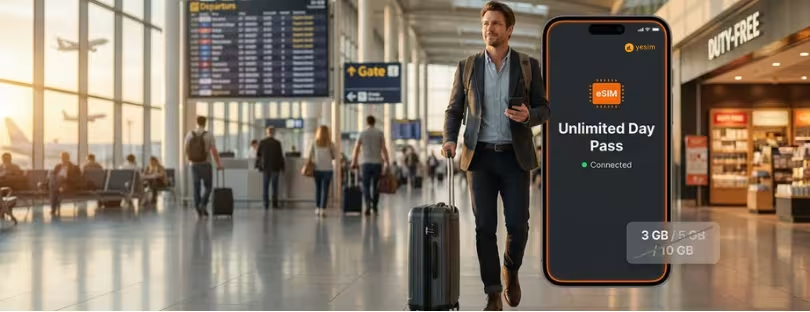
Meanwhile, a rapidly growing ecosystem of travel eSIM providers has emerged in parallel. Companies like Airalo, Ubigi, and Yesim offer international data plans that can be activated instantly for travelers.
These services rely entirely on eSIM technology, and their popularity has helped accelerate consumer awareness of digital SIMs.
Traditional operators and MVNOs are now catching up.
What This Signals for the Italian Market
Feder Mobile’s eSIM launch may appear like a small technical update, but it reflects a deeper structural change in telecom.
Connectivity is becoming increasingly digital, instant, and app-driven.
For operators, this means distribution models are shifting away from retail stores and plastic cards toward digital activation and remote provisioning.
For customers, it means fewer barriers when switching providers or adding additional mobile plans.
Conclusion
The introduction of eSIM by Feder Mobile highlights how quickly digital connectivity is becoming the default across telecom markets.
Large operators introduced the technology first, but MVNOs are now following the same path. In many ways, they have even stronger incentives to adopt it because eSIM reduces operational costs and simplifies distribution.
Looking across the market, the direction is clear. Domestic MVNOs are adding eSIM to modernize their services, while travel eSIM providers are building entire business models around it.
The result is a telecom ecosystem where connectivity behaves more like software than hardware.
Feder Mobile’s move fits neatly into that transformation. It may not be the most disruptive announcement of the year, but it confirms something important: the era of digital SIM activation is no longer limited to tech leaders or global travel platforms.
It is becoming standard telecom infrastructure.
Sources, including GSMA industry forecasts and AGCOM market data all point to the same conclusion. eSIM adoption is accelerating across both traditional operators and digital-first providers.
And with each new MVNO joining the trend, the transition from plastic SIM cards to fully digital connectivity becomes a little more irreversible.
Driven by wanderlust and a passion for tech, Sandra is the creative force behind Alertify. Love for exploration and discovery is what sparked the idea for Alertify, a product that likely combines Sandra’s technological expertise with the desire to simplify or enhance travel experiences in some way.