eSIM Adoption Surges as Shipments Reach 605 Million
The global eSIM ecosystem continued its rapid expansion in 2025, according to new market monitoring insights released by the Trusted Connectivity Alliance (TCA). The industry association, which represents companies responsible for roughly 85% of the world’s eSIM hardware production, reports that globaI eSIM shipments grew by 18% last year, reaching a record 605 million units. eSIM market growth
For a technology that only a few years ago was still considered niche, the numbers tell a clear story. eSIM is no longer an experimental feature. It is becoming a foundational layer of global connectivity.
But the TCA data also reveals something even more interesting: while eSIM adoption is accelerating across smartphones and IoT devices, traditional SIM cards remain surprisingly resilient. At the same time, new standards for IoT connectivity are quietly preparing the next major phase of the eSIM market.
For anyone following the evolution of digital connectivity, the latest numbers provide an important snapshot of where the industry stands today and where it may be heading next.
eSIM Shipments Reach a New Global Record
According to TCA’s latest monitoring report, global eSIM shipments reached 605 million units in 2025. Members of the association alone shipped 523 million eSIMs during the year.
The increase represents an 18% year-on-year growth, reinforcing a long-term trend that has been building for several years.
However, the story is not only about hardware shipments. TCA also reports a significant rise in consumer engagement with the technology itself. Consumer eSIM profile downloads increased by 43%, suggesting that more users are actively activating and switching mobile plans digitally rather than relying on physical SIM cards.
That distinction matters. Shipping a device with an eSIM chip is one thing. Actually using the technology is another.
The sharp increase in profile downloads indicates that users are becoming more comfortable with the idea of downloading connectivity rather than physically inserting it.
For travelers, remote workers, and increasingly for everyday mobile users, the convenience of switching networks digitally is starting to feel normal.
Devices Are Driving Awareness
One of the biggest drivers behind the surge in eSIM adoption is the growing number of devices that support the technology.
Until recently, eSIM was mostly associated with premium smartphones and a limited number of flagship models. That is no longer the case.
More mid-range and entry-level smartphones now include eSIM support, making the technology accessible to a broader consumer base. At the same time, several major manufacturers have launched flagship devices designed specifically around eSIM-only connectivity.
In North America, this shift has already reached a significant scale. Some smartphone models are now sold without a physical SIM slot at all, signaling a clear direction for the industry.
As these devices spread into more global markets, consumer awareness naturally increases. Users who may never have actively sought out eSIM are discovering it simply because their new device supports it.
This quiet shift in device design is one of the most powerful forces accelerating the adoption of digital connectivity.
Emerging Markets Catching Up
While North America remains the leading region for consumer eSIM adoption, the latest data shows strong growth across several emerging markets.
Adoption rates in the Middle East, Africa, and South America have effectively doubled, indicating that the technology is beginning to gain traction far beyond its early strongholds.
The growth in these regions reflects both device availability and network readiness. Local operators are gradually rolling out eSIM support and enabling digital profile downloads across their infrastructure.
However, the pace of deployment still lags behind more mature markets.
North American operators began investing heavily in eSIM infrastructure years earlier, giving them a head start in terms of activation flows, consumer education, and digital onboarding.
In many emerging regions, those systems are still being built. As they mature, adoption is expected to accelerate further through 2026 and beyond.
In other words, the global eSIM expansion story is still in its early chapters.
IoT Is Preparing the Next Wave
While consumer devices attract most of the attention, a major transformation is also taking place in the world of connected devices.
The GSMA’s new eSIM IoT specification, known as SGP.32, is designed specifically to simplify the remote provisioning and management of IoT connectivity.
This matters because IoT devices operate under very different conditions than smartphones. They often remain deployed for years, operate in remote environments, and require connectivity management at a massive scale.
The new specification aims to address those challenges by enabling more efficient and secure remote management of connectivity profiles.
TCA data indicates that the transition toward SGP.32 is already underway. The number of eSIM Subscription Manager platforms capable of supporting the new specification is increasing rapidly.
That infrastructure will play a critical role in enabling large-scale deployments across industries such as logistics, automotive, smart infrastructure, and industrial automation.
Guido Abate, Chair of the TCA Board, summarizes the shift clearly:
“The latest TCA data shows that global eSIM growth accelerated in 2025 as the benefits of the technology were realised across more regions, use cases and industries. With increases in deployments and adoption set to continue, ongoing industry efforts to advance enabling standards and infrastructure will be key to promoting safe, reliable and consistent eSIM implementations everywhere.”
In practical terms, that means the next big phase of eSIM growth may come not from smartphones, but from billions of connected machines.

The Traditional SIM Is Not Disappearing
Despite all the attention surrounding eSIM, the traditional SIM card remains remarkably resilient.
According to TCA estimates, the global market for physical SIM cards still reached approximately 3.5 billion units in 2025.
TCA members reported a 6% increase in SIM shipments compared to the previous year.
Growth was particularly visible in Europe, the Middle East, Africa, and parts of Asia.
This resilience highlights an important reality about the telecom industry. Infrastructure transitions rarely happen overnight.
Many markets continue to rely heavily on physical SIM cards due to legacy systems, regulatory requirements, and consumer habits. In certain regions, SIM distribution is still closely tied to physical retail channels and identity verification processes.
For operators serving large populations across developing markets, physical SIM cards remain a practical and reliable solution.
Rather than replacing SIM overnight, eSIM is gradually expanding alongside it.
For the foreseeable future, both technologies will coexist.
5G SIM Deployments Continue to Grow
Another notable trend highlighted in the TCA data is the continued expansion of 5G SIM deployments.
Shipments of recommended 5G SIM technology grew by 33% year-on-year in 2025.
These SIM solutions are designed to support advanced security and functionality in 5G standalone networks, enabling operators to fully utilize the capabilities of next-generation infrastructure.
India emerged as the largest market for 5G SIM shipments, reflecting the country’s rapid network expansion and enormous consumer base.
North America remained the second-largest 5G market, while Europe saw steady growth as operators continued rolling out standalone 5G networks.
The Middle East and Africa recorded the fastest percentage growth, demonstrating that demand for advanced connectivity is rising quickly across emerging markets.
In other words, even as eSIM adoption grows, the underlying SIM architecture is evolving in parallel with the rollout of new network technologies.
Sustainability Gains Momentum
Beyond connectivity itself, the SIM industry is also making noticeable progress in reducing environmental impact.
TCA reports that 45% of SIM shipments in 2025 were delivered in the half-SIM format, a packaging approach that significantly reduces plastic usage compared to traditional full-size cards.
The shift represents a substantial increase from 37% in 2024.
In Europe, more than 40% of SIM cards were manufactured using eco-friendly raw materials.
Similar progress is emerging in developing regions as well. In the Middle East and Africa, the number of SIM cards produced with sustainable materials more than doubled between 2024 and 2025.
While these changes may appear small individually, they add up quickly at global scale.
When billions of SIM cards are produced every year, even modest material improvements can significantly reduce environmental impact.
What the Numbers Really Mean
At first glance, the TCA report reads like a typical industry growth update. Shipments increased. Adoption expanded. Standards evolved.
But the deeper story is about the long transition from physical connectivity to digital connectivity infrastructure.
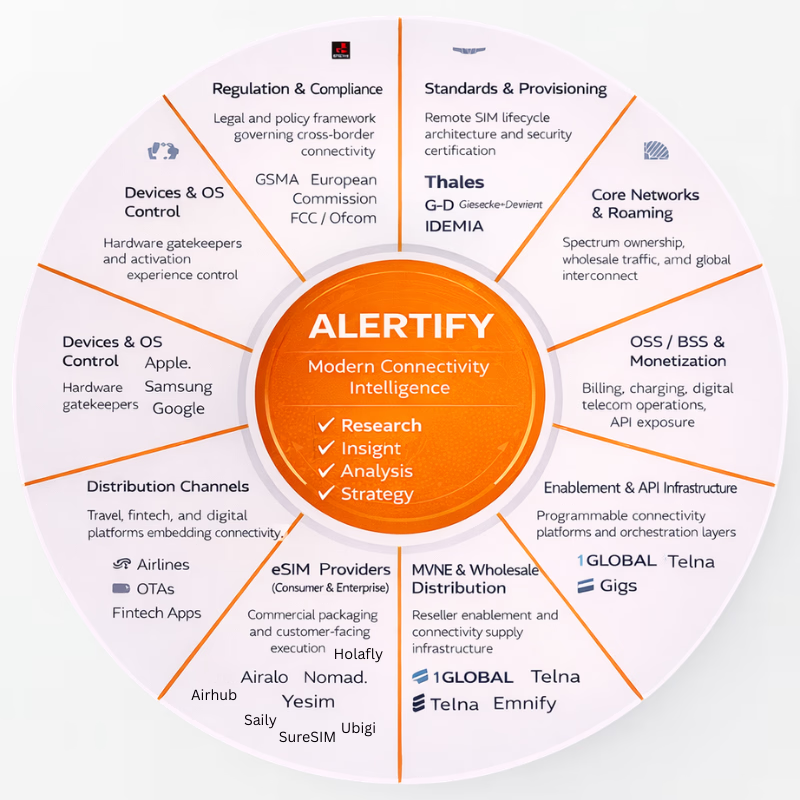
Organizations such as the GSMA, major telecom operators, device manufacturers, and connectivity platforms are gradually building the architecture for a world where network access can be provisioned instantly, remotely, and globally.
This transformation is already visible in consumer travel connectivity, where eSIM has enabled an entirely new category of digital roaming alternatives.
Companies like Airalo, Ubigi, Nomad, and others have built global travel data services that rely entirely on digital SIM provisioning.
At the same time, device manufacturers such as Apple and Google are increasingly designing hardware with eSIM at the center rather than as an optional feature.
Yet the TCA data also reminds us that telecom transitions move slowly. Physical SIM shipments remain in the billions, and many regions are only beginning their eSIM journey.
The most realistic future is not a sudden replacement of SIM technology but a gradual hybrid ecosystem where physical SIM, eSIM, and IoT-specific connectivity standards coexist. eSIM market growth
The Bigger Picture eSIM market growth
If the current trajectory continues, the next decade will likely see eSIM evolve from a consumer convenience into a core infrastructure layer for global connectivity.
The smartphone market will continue to drive awareness, but the real scale may come from IoT deployments, connected vehicles, and enterprise-level connectivity platforms.
For the telecom industry, this shift could reshape how networks are provisioned, how operators compete, and how users interact with mobile connectivity.
And for travelers, businesses, and connected devices alike, the idea of downloading connectivity instead of physically installing it is quickly becoming the new normal.