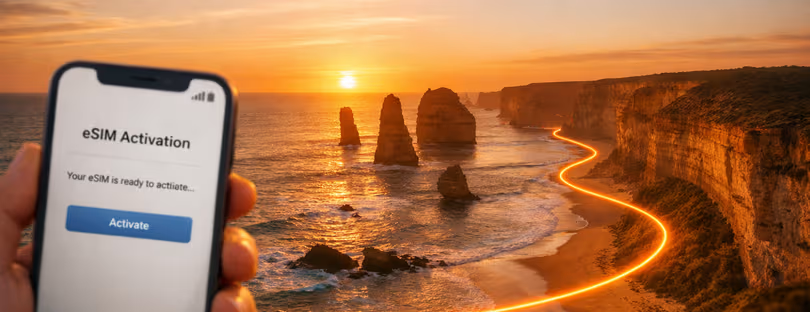
You’ve bought the eSIM. You’ve got the QR code. You’re staring at your phone thinking: now what?
eSIM activation is supposed to be simple. And in most cases, it is. But the reality is, this is still one of the biggest friction points in the entire eSIM experience.
Not because it’s technically hard. But because no one explains it properly.
So let’s break it down the way it actually works, what can go wrong, and why activation is quietly becoming the most important battleground in the eSIM market.
What eSIM activation really means
Before the steps, let’s clarify something most guides skip.
Activation is not the same as installation.
Installing an eSIM means downloading the profile onto your device. Activation means that profile becomes live and connects to a network.
Those two moments can happen instantly. Or hours later. Or only when you land in another country.
And this difference matters more than most users realize.
The standard activation flow
At a high level, almost every provider follows the same structure:
eSIM Activation Step by Step
A clean, practical walkthrough of how eSIM activation usually works, without the usual confusion.
Step 1
Buy the eSIM
You purchase a plan from a provider. After checkout, you usually receive one of the following:
a QR code
an activation code
or in-app installation
Step 2
Prepare your device
Before doing anything, make sure your device is actually ready for installation:
your phone must be unlocked
it must support eSIM
you need a stable internet connection
Most providers recommend using Wi-Fi for installation.
Step 3
Add the eSIM
This is where most users actually begin the setup process:
Go to Settings
Open Mobile Data / Cellular
Tap “Add eSIM” or “Add Mobile Plan”
Scan the QR code or enter details manually
At this stage, your device downloads the eSIM profile.
Step 4
Configure your line
Once installed, your phone will ask you to define how that line should behave:
label the eSIM (Travel, Business, etc.)
choose the default line for calls and data
enable or disable data switching
This is where many users accidentally misconfigure their setup and lose connectivity.
Step 5
Activate the plan
This is the critical part. Some eSIMs activate immediately, while others only become active:
when you reach your destination
or when you manually trigger activation
Many travel eSIM providers recommend activating right before departure or on arrival to avoid wasting validity.
Step 6
Turn on data roaming
Yes, this still confuses people. Even with an eSIM, you usually need to turn data roaming ON for the plan to work.
This inconsistency is one of the hidden reasons why eSIM adoption still feels uneven.
One-click activation is the real shift
Here’s where the market is quietly evolving.
The QR code is already becoming outdated.
More providers are moving toward:
in-app activation
one-click install
auto-configuration
Instead of scanning anything, you just tap “Install”.
From a user perspective, that’s a massive shift.
From a market perspective, it’s even bigger.
Because activation is no longer a technical step. It becomes part of the product experience.
Enterprise activation is a different game
Most consumer guides ignore this completely.
But in B2B, activation looks very different.
Companies don’t activate one eSIM. They activate thousands.
Using:
MDM systems
bulk QR provisioning
centralized dashboards
Enterprises can deploy entire fleets of devices remotely through orchestration platforms
This is where the real complexity sits.
And also where the real value is.
Why is activation the real product
This is the part most people miss.
Coverage is becoming commoditized. Pricing is converging. “Unlimited” is everywhere.
So what actually differentiates providers?
Activation experience.
The fastest, cleanest, most predictable activation wins.
Because:
It reduces support tickets
It improves conversion
It builds trust instantly
A bad activation experience kills the product before it even starts.
The bigger shift is happening
eSIM activation is moving from:
Manual setup → Embedded connectivity
Think about what’s coming next:
Airlines bundling eSIMs into tickets
Banks embedding connectivity into fintech apps
Phones activating plans automatically on arrival
Users won’t “activate” anything anymore.
Connectivity will just… happen.
And when that happens, the providers controlling activation flows will control distribution.
Not the ones with the cheapest plans.
What this means for travelers
For now, here’s the reality:
If you understand activation, you win.
You:
avoid wasting days
avoid support headaches
Get instant connectivity when it matters
If you don’t, the experience feels broken.
Same product. Completely different perception.
Final thoughts: activation is where the market splits
There’s a pattern emerging in the eSIM market.
Two types of players are forming:
1. Distribution-driven brands
Compete on price
Rely on marketplaces and affiliates
Often leave activation as-is
2. Experience-driven players
Optimize onboarding and activation
Invest in apps, UX, and automation
Reduce friction aggressively
The difference is not visible in ads.
But it shows immediately when you install the eSIM.
And this is where the market is heading.
According to GSMA and operator guidance, eSIM adoption is accelerating globally, but user experience remains a key barrier to mass adoption. Activation simplicity is consistently highlighted as a critical factor in reducing friction and increasing uptake.
That’s the real story.
Not just “how to activate an eSIM.”
But how is activation becoming the product itself?
And the providers who understand that are the ones quietly pulling ahead.
Driven by wanderlust and a passion for tech, Sandra is the creative force behind Alertify. Love for exploration and discovery is what sparked the idea for Alertify, a product that likely combines Sandra’s technological expertise with the desire to simplify or enhance travel experiences in some way.