Enterprise eSIM Global Coverage That Actually Works
“Global Coverage Isn’t About Convenience — It’s About Staying Reachable When It Matters”
Most people hear global coverage and think convenience: no SIM swap, no airport kiosk, no roaming horror story.
But enterprises (and honestly, any traveler who has ever had a bad day abroad) know the truth: coverage is really about reachability. The ability to get a message out, to receive an update, to open the map, to authenticate into a corporate app, to call for help, to prove you are safe, to keep a field job moving, to avoid a small issue becoming a full operational incident.
That is why the conversation is shifting from “cheap data abroad” to resilience. Not because it sounds more serious, but because networks fail, policies change, and real life does not wait for your signal bars to come back.
Coverage is not a map, it is a chain
Carrier coverage maps are marketing. Practical reachability is a chain:
- Your device (radio bands, eSIM capability, dual SIM setup)
- Your profile (which operator, which roaming agreements, what steering rules)
- The visited network (local congestion, outages, maintenance)
- Authentication and security layers (VPN, SSO, MFA)
- Your organization’s ability to see and support what is happening
Break any link and “global coverage” becomes “global frustration”.
Regulators have been blunt about how often parts of the chain fail. Ofcom’s Connected Nations 2024 report notes mobile network resilience incidents increased year over year, and outages above reporting thresholds impacted millions of customers and large volumes of user minutes. That is one market snapshot, but it matches the broader theme: resilience is no longer a niche concern.
The OECD has also highlighted how system failures dominate user-hour losses in parts of Europe, underscoring that modern connectivity risk is often internal failure, not just storms and disasters.
So yes, you can buy data in 200 destinations. The harder question is: what happens on the day your primary network is unavailable, degraded, or simply the wrong choice in that exact street, terminal, or industrial site?
Reachability is becoming a duty of care issue
Business travel and field mobility have matured into formal risk management disciplines. ISO 31030 is explicit that organizations should take a structured approach to travel risk management and mitigation.
Here is the awkward part: many duty-of-care programs assume connectivity exists. Alerts, check-ins, itinerary changes, location sharing, emergency instructions, and even basic “I’m OK” workflows depend on the traveler being online at the right moment.
That is why “coverage” is moving closer to the same category as battery health, secure access, and crisis comms. Not a perk. A dependency.
And dependency changes procurement behavior. If connectivity underpins safety and continuity, then the right question is not “who has the cheapest GB”, but “how do we prevent single points of failure”.

Why consumer travel eSIM logic breaks for teams
Consumer travel eSIMs solved a real problem: easier, cheaper data abroad for individuals.
But the enterprise gap shows up fast:
- No centralized visibility: IT cannot easily see who is online, where issues are happening, or who is burning data.
- No governance layer: travelers install random apps, expense it later, and the company inherits unmanaged risk.
- Inconsistent performance: many consumer brands sit on similar upstream infrastructure, which can make differentiation harder than the marketing suggests.
- No resilience posture: “it works most of the time” is not a strategy.
Meanwhile, the technical standards world is also signaling where the industry is going. GSMA’s eSIM specs formalize remote provisioning models (consumer and IoT) and push the ecosystem toward managed lifecycle control, not just QR convenience.
The direction of travel is clear: more management, more orchestration, more accountability.
What “resilience-first” connectivity looks like in practice
If you strip the buzzwords, resilience-first connectivity usually means four things:
Multi-network access, without fragile steering
You want the ability to attach to more than one network option when conditions change. That is different from being locked to a single roaming path that fails badly in one location.
Always-on backup behavior
Not “open an app and top up” when things break, but a backup connection that is already in place and can be used when primary service drops.
Real-time control and visibility
If connectivity is business-critical, someone on the enterprise side needs operational visibility: usage, status, policies, and the ability to respond.
Commercial logic that does not punish preparedness
Resilience should not require paying full roaming rates just to be safe. The model needs to align with “pay for what you actually use” while still keeping the backup ready.
This is also why you see connectivity management platforms emphasized across IoT and enterprise connectivity. Cisco’s IoT Control Center and Onomondo, for example, position around lifecycle management and operational control at scale. Even if their core focus is not business travel smartphones, the underlying principle is the same: managed connectivity beats unmanaged chaos.
Where SureSIM positions itself differently
SureSIM is leaning into the resilience narrative directly: global data, but with enterprise control, and specifically with a “backup connectivity” posture for business travel and field teams.
On its own materials, SureSIM describes an enterprise eSIM and data management platform built for IT teams and MSPs, emphasizing provisioning, visibility, and control.
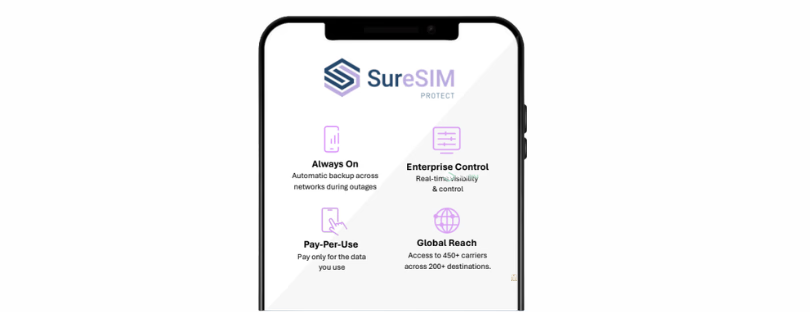
The most relevant piece for the resilience angle is SureSIM Protect: positioned as a multi-network backup eSIM for business travel, designed for failover and duty-of-care support, managed through a control-center style platform.
A few claims stand out as strategically important (and, frankly, more “enterprise” than most travel eSIM propositions):
- Multi-network backup and failover framing (not just “buy data”)
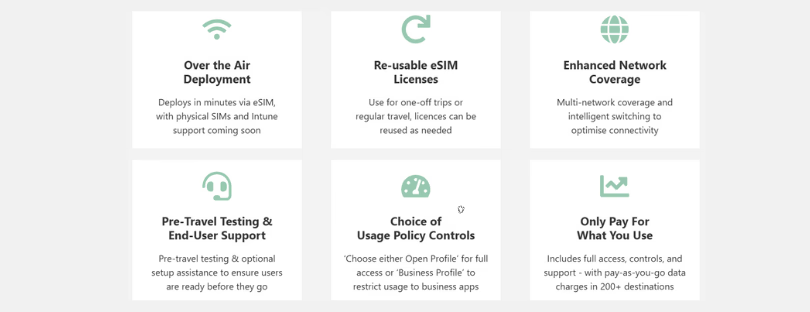
- Real-time visibility and control (deploy, monitor, manage centrally)
- A pay-for-use backup model (commercial alignment with preparedness)
- Broad carrier footprint claims (SureSIM references 450 carriers and 200+ destinations in its Protect positioning)
In a market full of “global coverage” slogans, that combination is a real differentiator if it performs as intended in the field: it is not trying to replace every corporate mobile contract, it is trying to remove the single point of failure that shows up at the worst time.
And that is the key. Resilience products win not by promising perfection, but by reducing the blast radius of inevitable failure.
What to ask before you buy any “global coverage” solution
If you are evaluating SureSIM or any alternative, these questions cut through the noise fast:
What happens when the primary network fails?
Is there automatic or at least frictionless fallback, or is the user stuck troubleshooting in the moment?
Is multi-network access truly available, or “multi-country” only?
Global geography is not the same as local redundancy. The hard failures are often local.
Who can see issues in real time?
If the traveler has a problem at 22:40 in a different time zone, does IT have visibility, or is it guesswork?
How is it governed?
Can you deploy and manage it consistently (corporate-owned and BYOD), or does it become an app-by-app mess?
Is the pricing model aligned with resilience?
Does it encourage preparedness (pay only when used, but ready when needed), or does it punish having a backup at all?
Conclusion: Resilience is becoming the real meaning of “global”
The enterprise connectivity story is quietly changing.
Consumer travel eSIMs made “get data abroad” mainstream. IoT platforms made lifecycle control and centralized visibility normal. Regulators and policy bodies are getting louder about resilience because outages and systemic failures are not rare edge cases anymore. Enterprise eSIM global coverage isn’t about roaming convenience. It’s about resilience, failover, and staying reachable when it matters most.
Against that backdrop, “global coverage” is being redefined. Not as convenience, but as reachability under stress.
SureSIM’s bet, especially with Protect, is that the next wave of connectivity buying will be led by IT, risk, and operations teams who are done treating mobile data as a travel expense category and are starting to treat it like a continuity layer.
And if that shift holds, the winners will not be the loudest travel eSIM brands. They will be the platforms that can prove one simple thing: when it matters, your people stay reachable.