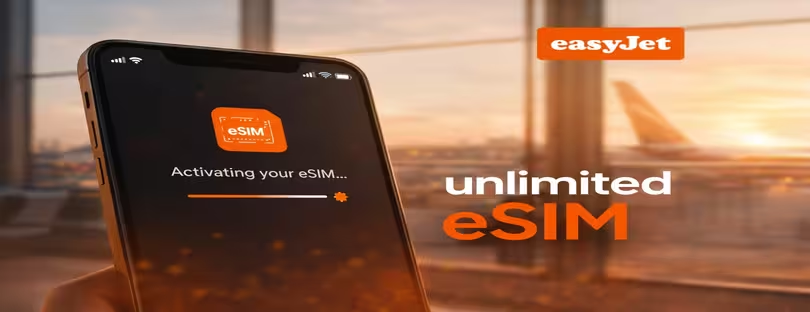
easySim Unlimited eSIM: What “Unlimited” Really Means
easySim.global has just rolled out unlimited data eSIM plans, and if you’re a regular customer, you probably already got the email. The brand — part of Sir Stelios Haji-Ioannou’s easy® empire, the same group behind easyJet, easyCar and a string of budget-first ventures — has built its eSIM offering around the same core philosophy: strip it back, keep it cheap, keep it simple.
Until now, that meant data-capped plans only. Which, to be fair, is a perfectly defensible position. Plenty of travelers know exactly how many gigabytes they need and have zero interest in paying a premium for headroom they’ll never use. But the market has been moving toward unlimited for a while, and easySim held out longer than most.
That’s changed. Unlimited bundles are now live across the USA, Türkiye, and most of Europe.
What “Unlimited” Actually Means Here
Here’s where it gets nuanced — and where it always does with travel eSIMs.
In easySim’s own words, sent directly to customers:
“Our popular fixed data eSIM bundles aren’t going anywhere — they remain the perfect choice for travellers who know exactly how much data they need. But many of our customers have asked for another option when they’d rather not think about limits at all.”
Fair enough framing. But dig into the Fair Usage Policy and the picture sharpens: you get 3GB of high-speed data per day, after which speeds drop to somewhere between 512Kbps and 1Mbps until the 24-hour cycle resets. Anyone who’s tried to load Google Maps or join a video call at sub-1Mbps knows that “continued access” at those speeds is technically true and practically miserable.
To easySim’s credit, they’re not hiding it. The FUP details are accessible without needing a law degree or three rounds of scrolling. That’s genuinely worth acknowledging — because the industry norm is closer to the opposite.

How This Stacks Up Against the Competition
The 3GB daily high-speed threshold puts easySim in the lower tier of the unlimited market, but not unusually so. Holafly, one of the most recognized unlimited-first eSIM brands globally, offers up to around 3–5GB of high-speed data per day, depending on the destination — though user reports suggest real-world performance can fall short of that. Truely pushes that ceiling to 5GB per day, while Sim Local goes further with up to 10GB of high-speed data daily, which positions them comfortably ahead for power users and remote workers who actually rely on connectivity to do their jobs.
The throttle floor matters too. eTravelSim, for instance, drops to 128Kbps after its daily high-speed allowance — well below even easySim’s 512Kbps floor. Holafly caps hotspot sharing at 1GB per day on unlimited plans, which is its own kind of fine print.
None of this is unique to easySim. It’s structural to how the wholesale eSIM market works. Providers buying capacity from roaming aggregators and regional wholesalers simply can’t offer genuinely unlimited high-speed data at travel eSIM price points without losing money. The ones who get closest to real unlimited speeds — think locally-sourced eSIMs tied directly to in-country network agreements — are exceptions built on fundamentally different infrastructure models.
The Bigger Picture
easySim’s move is less about innovation and more about parity. The brand was an outlier in refusing to offer unlimited plans at all, and now it isn’t. Whether the easy® brand positioning gives it a meaningful edge here is debatable — the easy name carries strong recognition in European travel circles, but eSIM purchasing decisions still skew heavily toward price, coverage transparency, and app experience. Brand heritage from the budget airline space doesn’t automatically translate.
What’s more telling is the trajectory of the unlimited plan debate industrywide. According to GSMA Intelligence and analyst commentary from firms like Kaleido Intelligence, the travel eSIM segment is maturing fast — moving from early-adopter curiosity to genuine mainstream uptake, especially post-2024 as eSIM-only devices (including Apple’s iPhone 17 lineup) push passive users into active consideration. In that environment, unlimited plans serve a marketing function as much as a practical one: they remove a decision point for customers who feel anxious about data limits, even if the actual experience is throttled after a few gigabytes.
Final Take
easySim entering the unlimited space is a natural progression for a brand built on accessibility — but the 3GB daily cap at full speed keeps it squarely mid-market. For casual travelers checking maps and messaging, that’s probably enough. For digital nomads or anyone with a remote work dependency, Sim Local or Truely offer better daily thresholds meaningfully, while Nomad and Airalo remain strong on coverage breadth and pricing flexibility for multi-destination trips.
If you are looking for something that actually feels close to real unlimited, Fairplay is probably the closest the market currently gets.
The real differentiator in 2026 isn’t whether a provider offers unlimited — almost everyone does now. It’s how honest they are about what unlimited actually means, and how well their underlying network agreements hold up in the markets that matter most. On the transparency front, easySim earns points. On raw performance ceiling, the field has stronger contenders.