Why Direct Carrier Billing Is Back on Operators’ Agenda
Direct carrier billing has been around for years. Most operators still treat it like a legacy add-on tied to ringtones, app purchases, or occasional subscriptions. That framing is outdated.
What’s emerging is something much more structural. A payment layer that sits directly on top of connectivity and is starting to scale again.
According to the global value of direct carrier billing transactions is expected to grow from around $50 billion in 2026 to more than $87 billion by 2030. That growth is not driven by one use case. It’s coming from multiple digital behaviors converging at the same time.
The real question is not whether carrier billing grows. It’s whether operators position it correctly before other players absorb the value.
What this actually solves
Direct carrier billing is simple in concept:
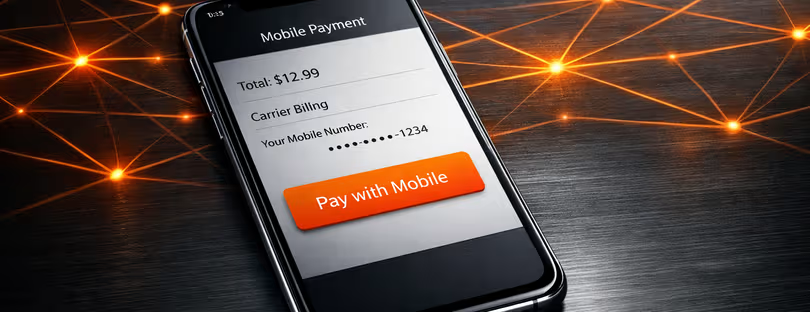
‘An online mobile payment method that enables consumers to make purchases and charge directly to their postpaid bill or deduct from their prepaid account balance, without requiring a premium-rate number or specific short codes.’
No cards. No banking layer. No external checkout.
That simplicity is exactly why it matters.
Every removed step increases conversion. And conversion is still one of the most underleveraged levers in telecom monetisation.
For merchants, this is not about adding another payment option. It’s about reducing drop-off at the moment of purchase.
 Subscriptions are where the model compounds
 Subscriptions are where the model compounds
Subscriptions are now the dominant model across software, media, and digital services. The report projects global subscription revenue reaching $1.2 trillion by 2030.
Carrier billing fits naturally into that environment.
Billing cycles align. Payments are consolidated. The user experience is frictionless.
But the real advantage shows over time.
Higher initial conversion combined with stable recurring billing creates compounding revenue effects. This is not about a single transaction. It’s about lifetime value.
There is also a second layer that operators often underestimate.
Access.
Carrier billing effectively turns a SIM into a payment tool. That opens digital services to users who are unbanked or simply prefer not to use cards.
It doesn’t replace fintech. It complements it.
Microtransactions: where friction kills revenue
At the other end of the spectrum sit microtransactions.
Gaming, in-app purchases, digital currencies. Small payments, high frequency, driven by impulse.
Carrier billing works here for a specific reason. It reduces the psychological friction of spending.
When purchases are added to a mobile bill, the immediacy of the payment disappears. Users feel less resistance, which increases transaction frequency.
This aligns directly with the behavioral model behind microtransactions.
The report also highlights an important technical shift. Traditional SMS-based verification introduced friction. New network-based verification APIs are removing that step while maintaining security.
For microtransaction-driven platforms, that change matters.
Even small delays can reduce conversion.
Expansion is happening beyond digital content
Carrier billing is no longer limited to app stores and subscriptions. It’s expanding into new environments.
Digital media remains the anchor. Music and video subscriptions continue to drive volume, and operators are being pushed to move beyond billing into bundling and distribution.
The creator economy is becoming a real opportunity. Platforms like TikTok and Twitch rely on frequent, low-value transactions such as tips and subscriptions. Carrier billing fits naturally here, but only if operators shift toward volume-based pricing instead of high fees.
Social commerce is still emerging. Discovery and purchase increasingly happen inside social platforms. Payment needs to be embedded and invisible. Carrier billing can play a role, particularly in markets with lower card penetration.
Digital ticketing is a more practical use case than it looks. Transport, local services, and events are increasingly mobile-first. The report introduces the concept of “temporary applications” delivered via messaging, allowing users to complete transactions without downloading an app.
That reduces friction in fragmented environments where users are constantly asked to install new apps.
Physical goods remain the most difficult category. High fees and regulatory constraints, particularly in Europe under PSD2, limit adoption. There are early signs of movement in areas like food delivery, but scaling this will require a fundamental shift in pricing models.

The constraint operators can’t ignore
The biggest limitation of direct carrier billing is cost.
Transaction fees can exceed 10 percent in some cases. That makes it unattractive for many merchants, especially outside digital goods.
At the same time, competition is intensifying.
Digital wallets and embedded fintech solutions offer lower costs and broader acceptance. They are also becoming more seamless.
This means carrier billing cannot compete on convenience alone anymore.
It needs a stronger differentiator.
That differentiator is starting to emerge through network intelligence.
Operators have access to real-time data about device identity, SIM authentication, and network behavior. When this is integrated into payments, particularly for fraud prevention, it creates a capability that traditional payment providers do not naturally have.
The report points to real-time fraud detection using network signals as a key opportunity.
But this only works if it translates into real value for merchants without increasing costs.
Conclusion: this is shifting from feature to infrastructure
Direct carrier billing is often positioned as just another payment method. That framing misses the bigger shift.
What’s developing is a telecom-controlled transaction layer for specific use cases where friction matters more than anything else.
It will not replace digital wallets. It is not designed for high-value transactions or broad retail commerce.
But in areas like subscription onboarding, microtransactions, digital content, and access for unbanked users, it has a clear role.
Compared to players like Apple Pay, Google Pay, or WeChat Pay, carrier billing lacks ecosystem control and scale. But it has something they do not.
Direct integration with the network.
If operators can turn that into better authentication, smarter fraud prevention, and seamless billing experiences, carrier billing moves closer to infrastructure.
And once payments become invisible, the player controlling that layer becomes significantly more valuable than the one providing connectivity alone.