Beeline × CMLink: One SIM for China & Russia
Cross-border travel between Russia and China has quietly become more complex in the past few years. Not because flights are harder to find, but because digital identity now matters as much as your passport.
If you’ve ever tried to manage banking apps, WeChat verification, Russian government services, or corporate logins across two countries, you already know the pain point. Verification codes go to the “wrong” number. Family calls the mainland China number while you’re using a Russian SIM. You end up carrying two phones or constantly swapping cards.
That’s exactly the gap that Beeline and CMLink are trying to close with their new co-branded beeChina plans.
The partnership enables its customers to link a Chinese number to Russian SIMs online for easier communications when traveling to China. In practical terms, it allows users to connect a mainland China number to a Russian Beeline SIM under a “One-card-multi-number” structure.
It sounds simple. But in today’s telecom environment, it’s actually a strategic move.
What “One-card-multi-number” Actually Means
At the core of the offer is a straightforward promise:
“Chinese and Russian numbers are on one SIM card.”
Instead of juggling two physical SIMs or relying on VoIP hacks, users can attach a mainland China number to their Beeline SIM and manage both identities from one device.
According to the product details, users can:
- Link a mainland China number to a Beeline SIM.
- Receive voice calls and SMS seamlessly.
- Receive verification codes sent to mainland China numbers without changing SIM cards or carrying multiple phones.
- Forward calls and SMS between the linked numbers.
This matters more than it sounds.
For many travelers, students, traders, and business operators moving between Russia and China, the issue is not just data connectivity. It is number persistence. Messaging apps, banks, government portals, and corporate systems are all tied to phone numbers.
When those numbers become inaccessible, daily life becomes complicated very quickly.
The Tariff Structure
The beeChina offer comes in three tiers:
| Plan | Data & Minutes | Price |
|---|---|---|
| beeChina START | 25 GB, 100 minutes | 750 rubles/month |
| beeChina PRO | 35 GB, 350 minutes | 940 rubles/month |
| beeChina MAX | 50 GB, 600 minutes | 1020 rubles/month |
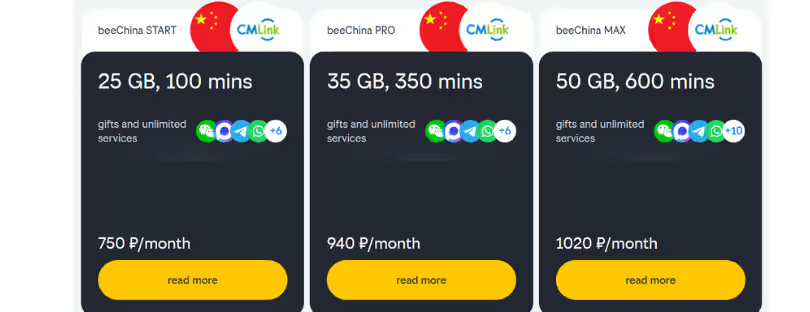
Each plan includes “gifts and unlimited services,” although the details depend on the specific bundle selected.
From a pricing perspective, these are mid-market plans. They are not ultra-cheap prepaid roaming packs. Nor are they enterprise-level global mobility contracts. They are positioned squarely for frequent cross-border users.
And that positioning is intentional.
Why This Matters Now
Telecom is moving away from simple roaming economics.
Traditionally, cross-border connectivity meant:
- Roaming charges
- International call markups
- Separate local SIM cards
- Complex call forwarding setups
But as eSIM adoption grows globally and digital identity becomes more critical, operators are increasingly building number-layer solutions rather than pure data-layer products.
This Beeline × CMLink collaboration reflects that shift.
Instead of focusing only on data volume, they’re focusing on number continuity.
That is a subtle but important evolution.
GSMA data shows that cross-border mobile use is steadily recovering and in some corridors surpassing pre-pandemic levels. At the same time, smartphone-based verification systems are becoming stricter, especially in China, where real-name registration rules and app ecosystems depend heavily on local numbers.
In that environment, maintaining access to a mainland China number while physically being in Russia becomes more than convenient. It becomes an operational necessity.
Not a Virtual Number — A Linked Identity
One of the frequent questions users ask is:
“Is it possible to get a Chinese phone number online?”
Virtual numbers exist, but they often fail when used for banking verification, WeChat registration, or government services. Many Chinese platforms block VoIP-based numbers.
What Beeline and CMLink are offering is different. It is not a random virtual overlay. It links a mainland China Mobile number directly into the SIM framework.
That distinction increases reliability.
It also explains why the FAQ section includes questions such as:
“Is it possible to buy a Chinese SIM card?”
“Can foreigners get a Chinese phone number?”
“Is it possible to use a Chinese SIM card in Russia?”
Because the regulatory framework around Chinese mobile numbers is strict. Real-name registration, ID verification, and physical SIM activation have historically been barriers for foreign users.
The co-brand model simplifies this process through operator integration rather than workarounds.
Who Is This Really For?
This is not a tourist product.
Short-term visitors to China typically use travel eSIMs or temporary local SIMs. For them, data is the priority.
This offer is designed for people living between systems:
- Students
- Cross-border traders
- Corporate employees
- Families with ties in both countries
- Individuals maintaining financial accounts in China
For this segment, losing access to a mainland China number can lock them out of apps, payments, or essential services.
In that context, 750 to 1020 rubles per month is less about data and more about digital continuity.

Market Context
Globally, we are seeing two telecom trends unfold at the same time:
- Travel eSIM providers focusing on flexible data coverage.
- Traditional operators building integrated identity solutions.
Companies like Airalo or Holafly compete on coverage footprint and “unlimited” messaging. But they do not provide persistent local number identity tied to national regulatory systems.
Beeline × CMLink are playing a different game.
They are strengthening bilateral operator cooperation.
This mirrors similar cross-border models seen in the EU, where operators integrate regional numbering, or in Southeast Asia where Singtel and AIS have built cross-market roaming packages.
The Russia–China corridor is unique, however, because of regulatory complexity and the importance of mainland Chinese number authentication.
The Bigger Signal
What makes this partnership interesting from an industry perspective is not the gigabytes.
It’s the architecture.
Telecom is slowly moving from roaming-based monetization toward identity-layer monetization.
Instead of charging high per-minute international fees, operators are packaging:
- Linked numbers
- Multi-number SIM capabilities
- Seamless verification continuity
- Lower-friction communication across borders
This is more aligned with how people actually live today.
Especially in geopolitical corridors where business, trade, and education flows remain strong despite broader global fragmentation.
Conclusion
The Beeline × CMLink beeChina plans are not flashy. They are not marketing-driven “unlimited” travel bundles. They are a practical infrastructure for a specific cross-border audience.
And that’s exactly why they matter.
In a market flooded with temporary eSIM offers and short-term roaming fixes, this partnership addresses something deeper: number persistence and regulatory-grade identity continuity. China Russia SIM card
Compared to global travel eSIM brands that focus primarily on data flexibility, this model operates closer to traditional operator integration — which means higher reliability for SMS verification, banking, and regulated app ecosystems.
Industry reports from GSMA and IDC continue to highlight how mobile identity is becoming central to digital services worldwide. Solutions that bridge number ecosystems across borders are likely to become more common, especially in high-traffic bilateral corridors.
For frequent Russia–China movers, beeChina is less about cheaper calls and more about digital stability.
And in 2026, stability is becoming a premium feature.