Chasing the Outbound: Why Your Customers Are Roaming Without You
For years, outbound roaming was predictable revenue.
A customer left the country.
Their phone connected automatically.
Usage went up.
Margins expanded.
Simple.
Today? That certainty is gone.
Your customers are still traveling. They’re still using data. They’re still consuming more connectivity than ever.
But they’re often not roaming with you.
And that shift isn’t accidental. It’s structural.
Outbound roaming is no longer a billing feature. It’s a distribution battle.
Roaming Used to Be Default
The old roaming model worked because it relied on inertia.
When customers crossed a border, they didn’t switch. They didn’t compare. They didn’t calculate wholesale exposure versus retail markup.
They just stayed connected.
“Roaming relied on inertia. Travel eSIM relies on preparation — and preparation is winning.”
Roaming was built on scarcity economics:
- Limited alternatives
- High switching friction
- Opaque pricing
- Delayed billing
The operator controlled the SIM.
The SIM controlled the network selection.
The network controlled the margin.
But that stack has been quietly dismantled.
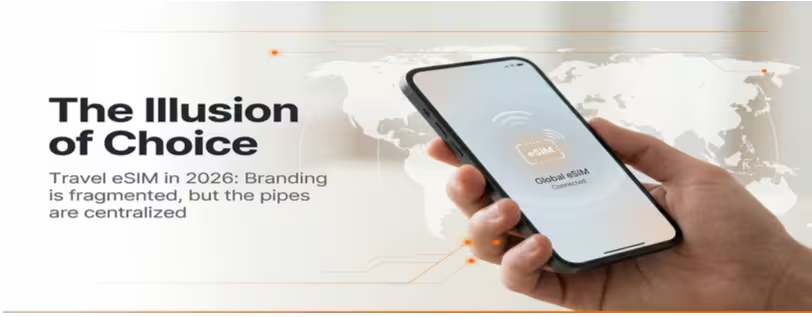
eSIM Didn’t Just Digitize SIM. It Broke the Default
Most people still describe eSIM as “a digital SIM card.”
That framing misses the real shift.
eSIM removed physical friction.
Once switching became software-based, roaming stopped being automatic.
Now the customer can:
- Install a travel eSIM before departure
- Activate a regional data plan in minutes
- Compare prices across multiple providers
- Avoid bill shock entirely
The moment activation became remote, roaming became optional.
And when roaming becomes optional, the margin becomes vulnerable.

You’re Not Losing to Telcos. You’re Losing to Interfaces.
This is where most operators misread the situation.
They assume they’re competing with other networks.
In reality, they’re competing with:
- eSIM marketplaces
- Aggregator APIs
- Airline upsells
- Travel platforms
- Fintech apps
- Even device-native connectivity portals
The power moved from infrastructure to interface.
Wholesale agreements still exist. Networks still exchange traffic.
But the customer decision now happens at the experience layer.
And whoever owns that layer captures the outbound moment.
The uncomfortable truth?
Infrastructure players fund the network. Interface players capture the margin.
Why Customers Quietly Switch
Let’s be honest. Most customers don’t switch out of rebellion.
They switch because roaming feels risky.
That “Welcome abroad” SMS still triggers anxiety.
How much per MB?
What happens after the cap?
Will this show up on next month’s bill?
Travel eSIM providers solved this psychologically before they solved it economically.
They sell:
- Certainty
- Prepaid transparency
- Trip-based packaging
- Visible data limits
- Instant activation
Even when their wholesale cost is similar, their framing feels safer.
And safety wins when someone lands in a foreign country at midnight.
The Real Economics Behind the Leakage
Let’s zoom out.
Traditional roaming economics rely on inter-operator tariffs and settlement agreements. Margins historically benefited from:
- High retail markups
- Delayed billing cycles
- Limited user awareness
- Complex pricing structures
Travel eSIM operates differently.
Most travel eSIM brands sit on top of aggregator infrastructure. They leverage:
- Multi-IMSI profiles
- Regional wholesale deals
- Dynamic network selection
- Centralized provisioning platforms
This allows them to arbitrage price differences and offer flat-rate plans across multiple countries.
Meanwhile, operators often hesitate to aggressively price outbound offers because they fear wholesale exposure or margin erosion.
So they defend pricing.
But customers defect anyway.
Which means the worst-case scenario happens:
You protect the margin on the few who stay.
You lose volume from the many who leave.
That’s not optimization.
That’s silent erosion.

Roaming Used to Be Guaranteed Revenue. Now It’s Optional Participation.
That’s the core shift.
Outbound is no longer yours by default.
It has to be earned.
The moment your customer leaves the country, they enter a new distribution arena.
One where:
- Travel apps pre-sell connectivity
- Airlines bundle data as ancillaries
- OTAs include SIM options at checkout
- Banks attach roaming benefits to premium cards
- Device manufacturers surface eSIM marketplaces natively
And increasingly, customers prepare before departure.
If you wait until they land to send an SMS offer, you’re already late.
The outbound decision now happens days — sometimes weeks — before travel.
The Pre-Travel Capture Wars Are Just Beginning
Here’s what’s coming next.
Airlines will embed connectivity in booking flows.
Travel platforms will bundle data with accommodation.
Fintech apps will attach regional data plans to travel spending.
Enterprise platforms will integrate global connectivity as part of duty-of-care.
Connectivity won’t be sold as roaming.
It will be embedded.
When that becomes standard, outbound roaming becomes background infrastructure.
The network still carries the traffic.
But the brand disappears from the moment.
And once brand presence disappears, lifetime value starts to weaken — even domestically.
Because if customers trust another interface abroad, they start questioning their home provider too.
Why Chasing the Outbound Feels So Hard
Operators see the leakage.
They respond with:
- Day passes
- Regional bundles
- Promotional SMS discounts
- EU-style fair-use extensions
But the response is often defensive.
It protects revenue per unit instead of maximizing engagement per traveler.
Meanwhile, travel eSIM players optimize for:
- Frictionless onboarding
- Predictable pricing
- Clean UX
- Clear data labeling
- Instant activation
They are product-first.
Traditional roaming is policy-first.
That difference matters.
This Is Not a Pricing Problem. It’s a Positioning Problem.
Operators can compete on price if they want.
But the real gap isn’t pricing.
It’s narrative.
Roaming still feels like an add-on.
Travel eSIM feels like a travel tool.
Roaming feels reactive.
Travel eSIM feels prepared.
Roaming feels like infrastructure.
Travel eSIM feels like an experience.
Until that perception shifts, outbound will continue drifting away.
The Strategic Question
The outbound moment is no longer guaranteed revenue.
It’s a competitive battlefield.
So the real question isn’t:
“Why are customers roaming without us?”
The real question is:
At what point did you stop owning the travel journey?
Because the winners in the next phase won’t necessarily be the networks with the best wholesale agreements.
They’ll be the players who capture the pre-travel decision.
Outbound used to be automatic.
Now it’s elective.
And elective revenue doesn’t belong to whoever built the network.
It belongs to whoever built the experience.