AT&T eSIM: Everything You Need to Know
AT&T eSIM is not exactly new, but the way AT&T now presents it feels more mature. This is no longer just a support-page feature for people upgrading their iPhone. It is becoming part of how AT&T sells wireless access to existing customers, prepaid users, and international visitors arriving in North America.
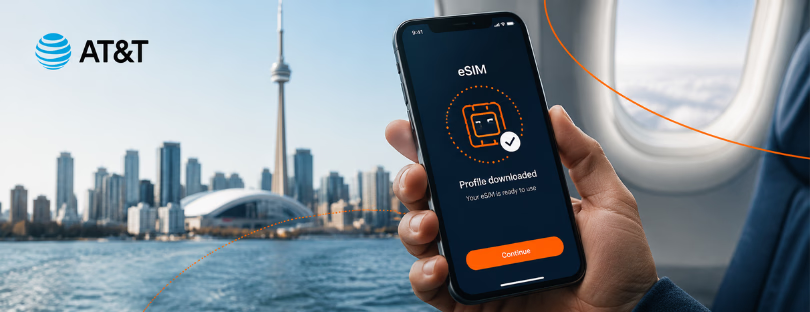
That matters because eSIM has moved past the “nice digital SIM” stage. Travelers expect to land, open an app, install a plan, and avoid finding a store, waiting for a plastic SIM, or guessing whether roaming will behave. AT&T’s own explanation is simple enough: an eSIM is a digital SIM built into the device, downloaded and activated without inserting a physical card. Once active, it connects to the network like a normal SIM, so calls, texts, and data work as usual.
The real story is that a major US carrier is trying to make eSIM feel less like a telecom setup and more like a travel utility.
What AT&T offers
There are two sides to AT&T’s eSIM story. For regular AT&T customers and prepaid users, eSIM is mainly about easier activation. AT&T says prepaid customers can download an eSIM to a phone or tablet, and users can check compatibility by dialing *#06# to see whether an EID number appears. If there is no EID, the device needs a physical SIM instead.
The setup is familiar now. On iPhone, the eSIM may download automatically during Wi-Fi setup, or users may scan a QR code from an activation kit. Samsung and Google phones follow similar paths.
READ MORE: AT&T Travel eSIM Targets Soccer Fans in North America
The more interesting product is eSIM by AT&T for travelers to the US, Mexico, and Canada. It is aimed at visitors who want local data without replacing their existing SIM. AT&T sells unlimited data for 1, 7, 15, or 30 days, with US-only pricing starting at $3.99 for one day and rising to $40.99 for 30 days. For US, Mexico, and Canada, the options start at 7 days and go up to 30 days. Each plan includes 5GB of hotspot data, with speeds up to 5G where available.
There is a catch, and AT&T is open about it: the traveler eSIM is data-only. It does not support regular voice calls or SMS/MMS. For many visitors, that will be fine because WhatsApp, FaceTime, Google Maps, Uber, banking apps, and email are the real essentials. But anyone who needs a US number for calls, SMS verification, or local business use should look carefully before buying.
Where it fits
AT&T is entering a space that travel eSIM specialists have shaped for years. Airalo, Holafly, Ubigi, Nomad eSIM, GigSky, Saily, and others trained travelers to think of mobile data as something you can buy before a trip, not negotiate at the airport. The difference is that AT&T owns the network experience in the US market, while most travel eSIM brands operate through wholesale agreements and local network partners.
That gives AT&T a trust advantage. For a visitor going to New York, Chicago, Los Angeles, Miami, or a US road trip, “AT&T directly” sounds reassuring. AT&T also says its US coverage reaches more than 99% of the US population, although coverage still depends on location and device.
READ MORE: AT&T and Gigs Redefine Mobile Plans with Embedded Connectivity
But AT&T is not automatically the best fit for every traveler. Someone visiting several regions outside North America will probably prefer a global or regional travel eSIM. A backpacker comparing every euro may find cheaper data-only plans from specialist providers. A business traveler who needs hotspot-heavy work sessions should notice the 5GB hotspot allowance.
The product is strongest for a visitor to North America who wants a familiar carrier name, fast activation, and no roaming-bill anxiety.
What could be sharper?
The main improvement AT&T could make is clarity around real-world usage. “Unlimited data” always sounds attractive, but travelers now know the word can hide speed management, hotspot limits, and fair-use realities. AT&T notes that speeds may be temporarily slowed when the network is busy, and hotspot speeds are reduced after 5GB. That is fair disclosure, but the buying experience would be stronger with simple scenario guidance: good for maps and messaging, fine for video calls, limited for laptop-heavy remote work.
The data-only limitation also deserves louder placement. Many travelers do not read footnotes until something goes wrong. For a tourist, no SMS may be irrelevant. For a freelancer trying to receive a bank code, it can become the whole problem.
Final take
AT&T eSIM shows where the US connectivity market is going. Traditional carriers are not ignoring travel eSIMs anymore; they are packaging their own networks into app-based, short-term products. Verizon promotes prepaid eSIM as an option for US visitors with talk, text, and data, while T-Mobile has pushed prepaid eSIM access for international travelers. AT&T’s version sits somewhere different: more carrier-direct and network-led than many travel eSIM brands, but less complete than a local prepaid line because it is data-only.
For Alertify readers, the takeaway is simple. AT&T eSIM is credible if North America is the trip and data is the priority. It is less convincing if you need a phone number, heavy hotspot use, or multi-region flexibility. The bigger signal is more important: eSIM is no longer a side feature. It is becoming the new front door to mobile service.