AI Earbuds with eSIM: TicNote Pods Explained
There’s a moment happening right now in travel tech and productivity where devices are quietly becoming more independent. Less tied to your phone. More capable on their own.
Mobvoi just stepped directly into that shift.
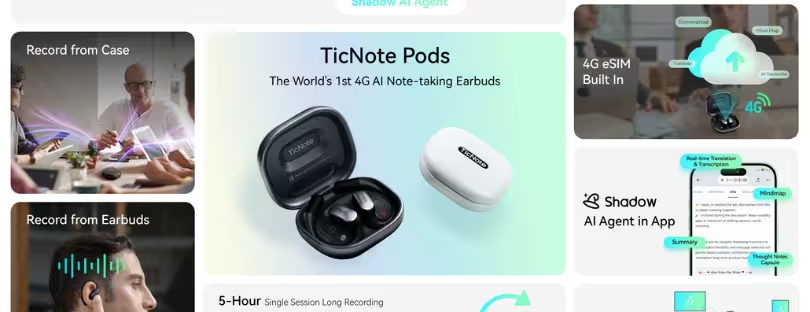
With the launch of TicNote Pods, the company is introducing what it calls the world’s first 4G-connected AI note-taking earbuds. On paper, that sounds like another “AI device” announcement. In practice, it’s something more interesting.
This is not just about recording audio. It’s about turning conversations into usable output, instantly, from a device you’re already wearing.
What TicNote Pods actually change
Most AI note-taking tools today live inside apps. You open them, record, upload, process, and then maybe revisit the output later.
TicNote Pods flip that model.
They sit directly in your ears, capture conversations in real time, and process them immediately through the cloud. No phone required. No manual uploads.
That’s possible because of one key layer: eSIM-powered 4G connectivity.
Instead of relying on your smartphone or Wi-Fi, the earbuds connect directly to the cloud using a built-in eSIM. That means transcription, summaries, and structured outputs start happening the moment the conversation ends.
For frequent travelers, remote teams, and anyone constantly moving between meetings, that independence matters more than it sounds.
The eSIM layer is the real story
Let’s be clear. The most important part of this product is not the earbuds. It’s the connectivity.
Embedding an eSIM inside a wearable like this removes friction completely. No tethering. No hotspot. No “wait until you’re back online.”
This is exactly the direction we’ve been seeing across the industry.
Connectivity is becoming invisible infrastructure. It’s no longer something you manage. It’s something that simply exists, wherever you are.
In that sense, TicNote Pods are not just an audio product. They are another proof point that eSIM is expanding beyond phones and into a much broader ecosystem of devices.
And that has implications far beyond note-taking.
How the product actually works
The experience itself is surprisingly straightforward.
You wear the earbuds like any standard pair. Or you leave them in the charging case and use the case as a recording device.
The system captures both sides of a conversation. That includes environmental audio and in-ear audio from calls or meetings. This dual approach solves one of the biggest problems in transcription tools: missing context.
Once recorded, everything is automatically processed.
Features that stand out
- 4G AI recording without a phone
- Dual recording modes (earbuds and case)
- Real-time transcription with speaker labels
- AI-generated summaries and action items
- Support for 100+ languages with translation
- Automatic sync to TicNote Cloud
Inside the cloud platform, things go further.
This is where Mobvoi is clearly trying to differentiate.
Instead of stopping at transcripts, the system turns conversations into structured outputs. Documents, task lists, even presentation drafts.
Powered by Shadow AI 2.0, the platform lets users interact with their recordings as if they were living project files.
Ask questions. Extract insights. Generate follow-ups.
It’s moving from “note-taking” to “execution layer.”

Built for a very specific user
This is not a casual consumer product.
It’s clearly designed for people who live in conversations.
Think consultants, journalists, founders, product teams, and yes, frequent travelers constantly moving between meetings, airports, and time zones.
The open-ear design, lightweight build, and long battery life all support that use case. But the real value comes from what happens after the conversation.
That’s where most tools fail today.
They give you notes. But they don’t help you move forward.
TicNote Pods are trying to close that gap.
Where it sits in the market
This is where things get interesting.
If you look at competitors, most fall into three categories:
Current alternatives
- AI transcription apps like Otter.ai
- Meeting assistants like Fireflies.ai
- Hardware recorders with AI features like PLAUDIO
All of them rely heavily on smartphones or laptops.
None of them is truly an independent device.
That’s the gap Mobvoi is targeting.
By combining hardware, AI, and eSIM connectivity into a single product, TicNote Pods create a new category rather than competing directly.
Pricing and positioning
At $299 for the 4G version, this is not a cheap accessory.
But it’s not meant to be.
Mobvoi is positioning this as a productivity tool, not just a gadget.
You also get 600 free transcription minutes per month, with paid plans scaling up significantly for heavier users.
That aligns with how AI tools are increasingly monetized today. Not through the device itself, but through ongoing usage.
The bigger picture: where this is heading
Zoom out, and this launch connects to several larger trends happening at the same time.
First, AI is moving from apps into hardware.
Second, eSIM is becoming a foundational layer for always-connected devices.
Third, productivity tools are shifting from passive to active systems that actually generate work.
According to recent projections from organizations like the Trusted Connectivity Alliance and Juniper Research, eSIM adoption is accelerating rapidly, especially beyond smartphones.
We’re starting to see it in laptops, cars, IoT devices, and now wearables like this.
TicNote Pods sit right at the intersection of those shifts.
They are not just a new product. They are a signal.

What this means for travel and connectivity
For the travel tech space, this is particularly relevant.
Devices like this reduce reliance on local SIM cards, roaming decisions, and Wi-Fi availability.
Everything runs through embedded connectivity.
For business travelers, that means fewer friction points.
For global teams, it means more consistent workflows regardless of location.
And for the broader eSIM ecosystem, it reinforces something we’ve been saying for a while.
eSIM is no longer just about saving on roaming.
It’s becoming the backbone of how devices operate globally.
Final thoughts
TicNote Pods are not perfect. And they won’t replace existing workflows overnight.
But they don’t need to.
What matters is what they represent.
A shift from disconnected tools to integrated systems. From manual processes to automated execution. From smartphone dependence to device independence powered by eSIM.
Compared to players like Otter or Fireflies, Mobvoi is not trying to win on software alone. It’s trying to redefine the entire experience by controlling the hardware, connectivity, and AI stack together.
That’s a much harder play. But also a more defensible one.
If this works, expect to see more devices like this.
Not just earbuds, but a whole category of AI-powered, always-connected tools that operate quietly in the background, turning everyday moments into structured output.
And that’s the real story here.
Not the earbuds.
But the beginning of a new layer of computing, where connectivity, AI, and hardware finally start working as one.