Yesim’s FinTech Armenia Entry Signals Bigger Shift
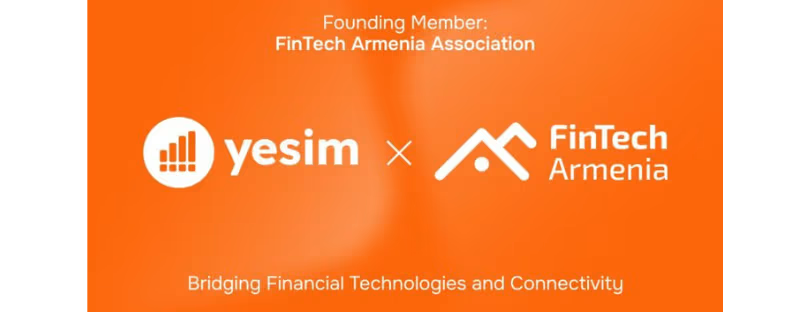
Yesim is making a move that says a lot about where the eSIM market is heading next. The Switzerland-registered connectivity provider, already serving more than 3 million users globally, has joined FinTech Armenia as a Founding Member. On paper, it is a partnership announcement. In practice, it is a signal that telecom and fintech are no longer separate conversations.
FinTech Armenia is not just another industry association. It positions itself as a regional and international hub connecting financial technologies, AI, payments, telecom, trading, crypto, and banking. In other words, it is trying to build the infrastructure layer for a more integrated digital economy in Armenia and beyond.
For Yesim, this is less about visibility and more about positioning.
“At Yesim, our mission is to build and offer the highest quality Telecommunications Infrastructure & Connectivity to our 3M+ customers worldwide.”
That line matters. Because Yesim is increasingly framing itself not just as a travel eSIM provider, but as part of a broader infrastructure layer that enables digital services globally.
Why this move matters now
The timing is not accidental. Over the past two years, telecom and fintech have started to overlap in ways that were not obvious before.
eSIM has removed one of the biggest frictions in connectivity. Payments have become embedded into apps and platforms. And identity verification is now tied directly to mobile networks.
Put that together and you get a new reality: connectivity is becoming a financial enabler.
Organizations like the GSMA have been pushing this direction for years through initiatives like Open Gateway APIs, which aim to make telecom capabilities accessible to developers and fintech platforms. At the same time, institutions like the World Bank continue to highlight that digital connectivity is a core driver of financial inclusion, especially in emerging markets.
Armenia is positioning itself right inside that intersection. The country has been actively investing in its digital economy, with a growing startup ecosystem and regulatory initiatives such as sandbox environments for fintech experimentation.
This is exactly where Yesim is placing itself.
What Yesim actually brings to the table
It is easy to read this as a branding move, but Yesim’s role is more functional than that.
The company operates across more than 200 destinations with access to over 1000 telecom operator relationships. That kind of network is not just useful for travelers. It is infrastructure.
In a fintech context, that infrastructure can support:
- identity verification through mobile connectivity
- cross-border digital services
- embedded connectivity in financial apps
- IoT and device-level financial interactions
Yesim has already been moving in this direction with products like its Partner API and OneBalance solution, which allow businesses to manage connectivity at scale.
So when they say they want to contribute to a stronger TelCo and FinTech ecosystem, it is not theoretical. They already have the building blocks.
Where they plan to engage
Yesim’s leadership team will be actively involved across several working groups within FinTech Armenia.
TelCo x FinTech
This is the core layer. It is where telecom capabilities get integrated into financial services. Think mobile identity, secure transactions, and API-driven connectivity.
CBA Sandbox
The Central Bank of Armenia sandbox is designed to allow controlled experimentation with new financial products. This is where telecom-enabled financial services can be tested before scaling.
Education
This is often overlooked, but it is critical. Building a digital ecosystem requires talent, not just technology.
Startups
Early-stage companies are usually where the most interesting use cases emerge. Being close to this layer gives Yesim visibility into future demand.
The bigger picture: telecom becomes programmable
The broader trend here is what many in the industry are starting to call programmable connectivity.
Instead of buying connectivity as a standalone product, businesses integrate it directly into their services. Users do not even think about it. It just works.
This is already happening in:
- fintech apps that rely on mobile identity
- travel platforms offering embedded connectivity
- IoT ecosystems where devices manage transactions autonomously
According to GSMA data, global eSIM adoption is expected to continue accelerating as more devices and services integrate remote provisioning. At the same time, digital payments are projected to grow steadily worldwide, driven by mobile-first markets.
The intersection of these two trends is where companies like Yesim are positioning themselves.
And platforms like FinTech Armenia are trying to build the ecosystem around it.
Why Armenia is an interesting test ground
Armenia may not be the first market that comes to mind, but it has some unique advantages.
It is small enough to experiment quickly, but connected enough to scale regionally. It has a strong tech talent base and increasing regulatory openness to innovation.
For companies like Yesim, this creates a relatively low-friction environment to test new models that combine telecom and financial services.
If it works, those models can be exported.
What this signals for the eSIM market
For readers who follow the travel eSIM space closely, this is an important shift.
The market is no longer just about:
- who has the cheapest data
- who offers unlimited plans
- who covers the most countries
Those things still matter, but they are becoming baseline expectations.
The real differentiation is moving toward:
- infrastructure ownership or access
- API capabilities
- integration into broader digital ecosystems
In other words, the battle is shifting from product to platform.
And that changes everything.
Conclusion: a quiet but strategic repositioning
Yesim joining FinTech Armenia is not a headline-grabbing move. But it is a strategic one.
It shows a clear understanding of where the market is going. Telecom is no longer just about connectivity. It is becoming a foundational layer for digital services, including finance.
Compared to many travel eSIM providers that are still competing on surface-level features, Yesim is leaning into a deeper role in the ecosystem. Not fully there yet, but clearly moving in that direction.
If this strategy plays out, the winners in the next phase of the eSIM market will not be the ones with the best marketing or the lowest prices.
They will be the ones that become invisible infrastructure.
And this is exactly the kind of move that starts that transition.