Xcertus Partners with Nomad eSIM to Redefine Travel Connectivity
When a traveler loses connectivity abroad, it is not a minor inconvenience; it is a system failure. Maps stop working. Support disappears. Payments get blocked. That context makes the Xcertus–Nomad eSIM partnership less of a product update and more of a structural move.

Connectivity failures expose how fragmented the travel experience still is. Assistance providers operate in one layer, insurers in another, airlines and OTAs in a third, while mobile connectivity sits entirely outside the system. Travelers are expected to glue these pieces together themselves, often under stress and in unfamiliar environments.
That fragmentation is exactly what Xcertus is now addressing.
Rather than treating mobile data as an optional add-on, Xcertus is integrating international connectivity directly into its travel assistance ecosystem through a strategic partnership with Nomad eSIM. The result is a more cohesive model where protection, support, and connectivity are designed to work together instead of competing for the traveler’s attention.
From an industry perspective, this is not just about offering eSIMs. It is about redefining what “assistance” actually means in a digitally dependent travel environment.
What Xcertus is actually building here
At its core, Xcertus operates in the travel assistance space, offering services designed to protect travelers before, during, and after their trips. Traditionally, that has meant medical assistance, emergency coordination, and insurance-related services.
With this partnership, Xcertus is explicitly expanding that definition.
By embedding Nomad eSIM’s international mobile connectivity into its ecosystem, Xcertus is reframing connectivity as part of traveler protection. Not a separate upsell. Not an external add-on. But a built-in layer of the journey itself.
That distinction matters.
Connectivity today underpins almost every critical travel interaction: emergency calls, navigation, access to digital tickets, banking apps, customer support chats, and real-time updates. Without reliable mobile data, even the best assistance service is partially blind.
This alliance allows Xcertus to offer a more complete travel solution, one where protection and connectivity are designed to work together, not in parallel.
Why Nomad eSIM fits this model
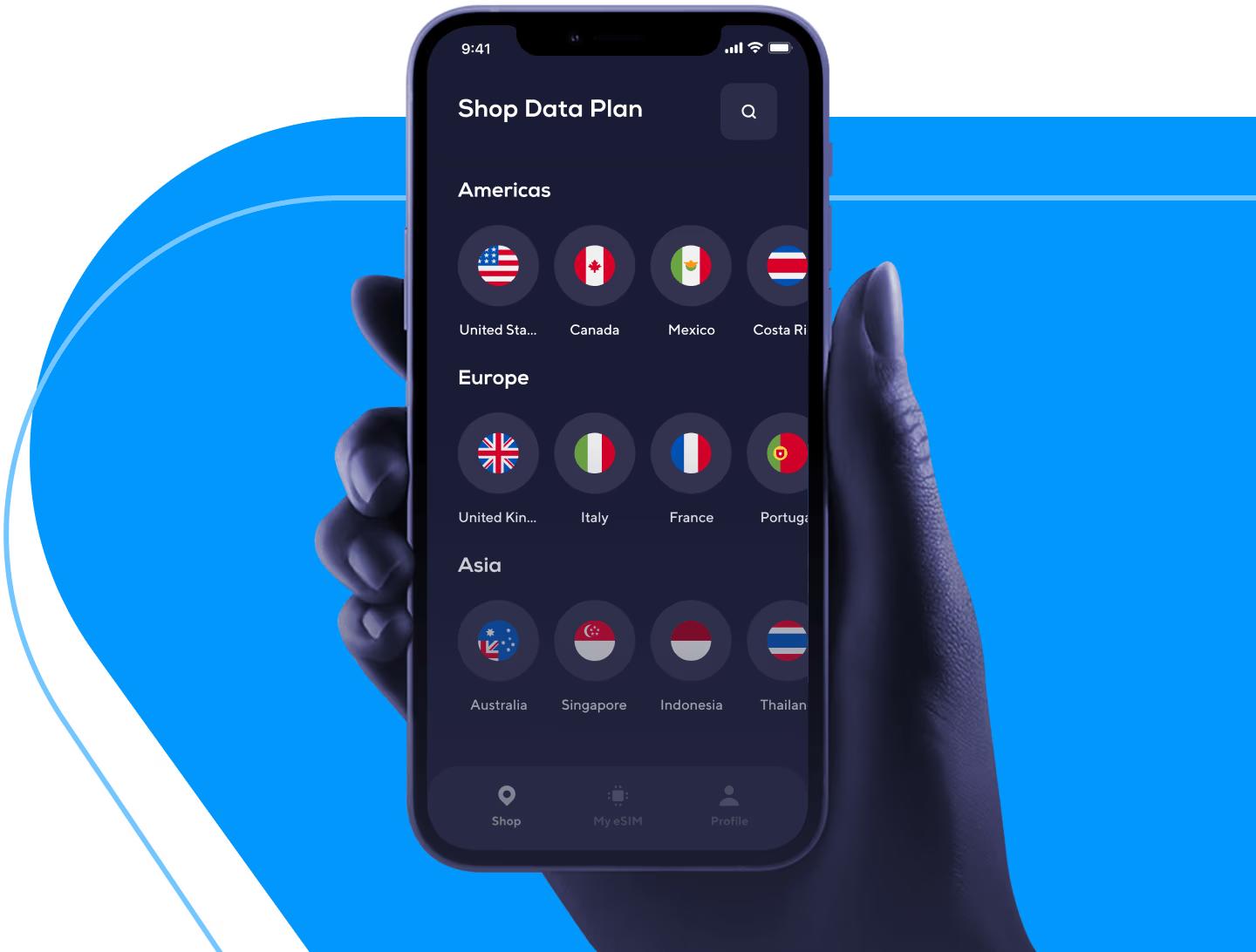
Nomad eSIM has quietly become one of the more recognizable international eSIM brands among frequent travelers, digital nomads, and remote workers. Its appeal lies in simplicity: broad global coverage, transparent pricing, and app-based activation that works without physical SIM cards or store visits.
For Xcertus, Nomad eSIM brings something crucial to the table: a mature, scalable connectivity product that can be embedded into an existing travel ecosystem without friction.
Just as importantly, Nomad has already built trust with a global audience that values convenience and predictability, two traits that align closely with travel assistance services.
This makes the partnership less about experimenting with new tech and more about operational integration at scale.
The bigger picture: eSIMs are moving upstream
To understand why this deal matters, it helps to zoom out.
The eSIM ecosystem is evolving quickly. What started as a consumer-driven alternative to roaming and physical SIM cards is now moving upstream into B2B partnerships, travel platforms, airlines, insurers, and assistance providers.
We are seeing this shift across the industry:
- Airlines bundling eSIMs into fare packages
- OTAs experimenting with connectivity add-ons
- Insurance and assistance companies embedding mobile data into policies
- Airports and mobility platforms offering digital connectivity as infrastructure
This partnership places Xcertus squarely in that second wave of eSIM adoption, where connectivity becomes part of the travel service stack rather than a standalone product.
Industry analysis from GSMA and Juniper Research consistently points to this direction, highlighting eSIM growth not only in consumer adoption but in enterprise and travel integrations as well.
READ MORE: Traveling Soon? Try Nomad eSIM’s 1GB Free Trial Before You Fly
Iberoamerica as a strategic battleground
The regional focus is also worth noting.
Iberoamerica represents a complex travel market, with high outbound travel volumes, strong regional mobility, and frequent long-haul international trips. At the same time, roaming costs remain unpredictable, and access to reliable local SIMs is often fragmented.
By becoming Nomad eSIM’s exclusive authorized distributor in this region, Xcertus gains both differentiation and leverage. It can offer a standardized, digital-first connectivity solution across multiple countries and travel corridors, while Nomad gains a strong local partner with established travel relationships.
In practical terms, this creates a bridge between global connectivity infrastructure and regional travel expertise.

How does this compare to other players?
Other travel assistance and insurance providers are also experimenting with connectivity, but many still treat it as a bolt-on benefit rather than a core pillar.
Some rely on voucher-based Wi-Fi access. Others offer limited roaming reimbursements. A few resell eSIMs without deeper ecosystem integration.
What sets this move apart is positioning.
Xcertus is not simply reselling Nomad eSIM. It is integrating connectivity into its assistance ecosystem and framing it as a fundamental component of traveler protection. That aligns more closely with how leading digital travel platforms are thinking about the future: modular, connected, and digitally native.
From an industry perspective, this mirrors broader trends toward ecosystem thinking seen in players like Allianz Partners, AXA Travel Insurance, and newer digital-first travel protection startups.
What does this signal mean for travelers
For travelers, especially frequent international ones, the implications are straightforward.
Less friction. Fewer apps. Fewer decisions under pressure.
When connectivity is bundled with assistance, travelers do not have to think about how they will get online in an emergency or whether their roaming bill will explode mid-trip. The experience becomes simpler and more predictable, which is ultimately what modern travelers value most.
From an Alertify perspective, this is exactly the direction we see the market heading: connectivity becoming invisible, embedded, and assumed.
Conclusion: a small announcement with big implications
This partnership may look modest at first glance, but it reflects a deeper shift in how the travel industry is redefining value.
As eSIM adoption matures, the winners will not be those selling data alone, but those embedding connectivity into meaningful travel experiences. Xcertus partnering with Nomad eSIM is a clear example of that evolution.
Compared with traditional assistance providers and even some newer digital players, this move shows stronger alignment with where the market is heading, not where it has been. It acknowledges that protection, technology, and connectivity are no longer separate verticals, but interdependent layers of the same journey.
For Iberoamerica in particular, this could set a benchmark for how travel ecosystems integrate eSIM technology going forward.
And for the wider industry, it reinforces a simple truth: in modern travel, being connected is not a feature. It is infrastructure.