UK eSIM Adoption Surges as Travel eSIM Goes Mainstream
For years, eSIM has been treated as “next year’s technology”. Always coming, never quite here. That narrative no longer holds.
According to the latest consumer research from CCS Insight, awareness and real-world usage of eSIM in the UK have surged to levels that would have seemed unrealistic just three years ago. Nearly three-quarters of UK consumers now say they are familiar with eSIM, up from just 27 percent in 2022. That is not gradual growth. That is a market waking up.
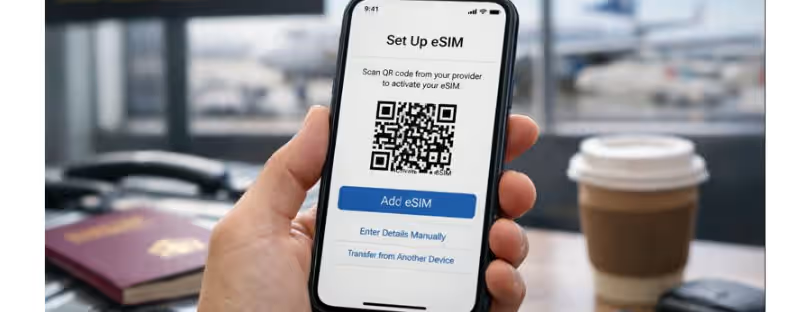
More importantly, this is no longer just awareness in theory. Almost one in three people who know about eSIM have already used it to sign up with a UK mobile provider. That is a critical distinction. eSIM has moved from being an abstract feature buried in phone settings to something people actively choose to use.
Apple’s influence is showing up clearly in the data
Unsurprisingly, iPhone users are leading the charge. Apple customers are the most likely to have activated an eSIM, reflecting Apple’s long-term push to normalise the technology. The introduction of the eSIM-only iPhone Air last year accelerated that shift and made eSIM unavoidable rather than optional.
This mirrors what we have already seen in markets like the US, where eSIM-only iPhones forced both consumers and operators to adapt quickly. The UK is now following a similar trajectory, though with less friction thanks to better operator readiness and clearer consumer education.
Samsung, while still dominant overall, has taken a more cautious approach with eSIM-first messaging. That may explain why iPhone users continue to be more confident experimenting with digital-only connectivity.
Travel eSIM is no longer a niche product
Perhaps the most telling insight from the survey is not about domestic usage at all, but about travel.
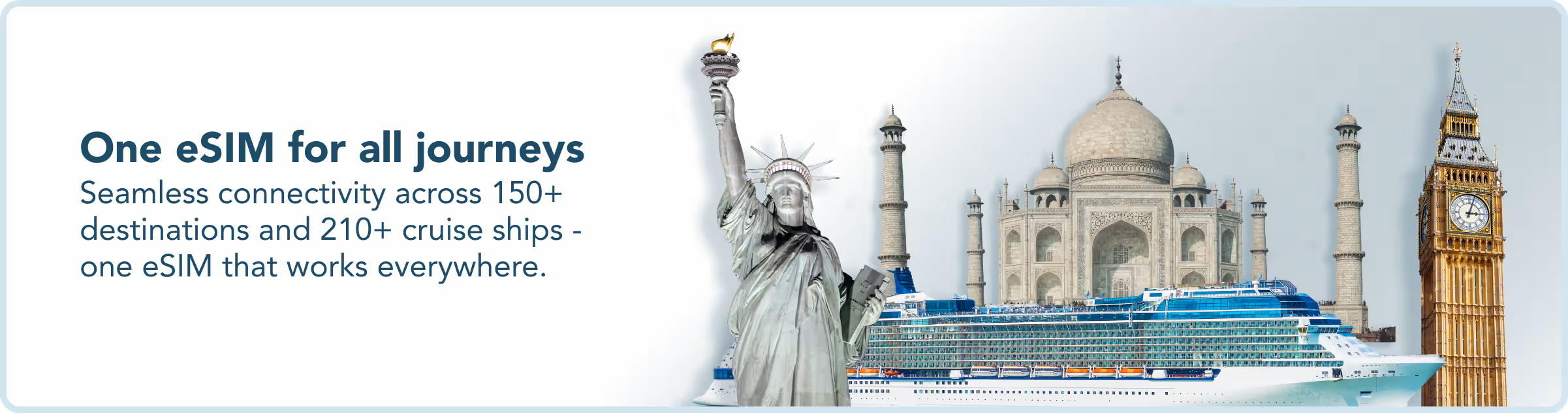
Almost a quarter of respondents said they have already used a travel eSIM provider. Among people who have travelled abroad in the past three years, that number rises to 32 percent. That is a massive adoption rate for what was considered a specialist product until recently.
Even more striking is intent. Seventy-three percent of respondents say they are considering using a travel eSIM on their next international trip. Among those who have already tried one, that figure jumps to 86 percent.
The reasons are refreshingly simple.
Why travellers are choosing travel eSIMs:
- Convenience and instant activation
- Avoiding roaming bill shock
- Better control over data spending
These motivations align closely with what Alertify readers have been telling us for years. Travel eSIM adoption is not being driven by tech curiosity. It is being driven by pain points that traditional roaming has failed to solve.

eSIM is becoming the default, not the alternative
Kester Mann, Director of Consumer and Connectivity at CCS Insight, summed up the shift succinctly, without exaggeration.
“We’ve seen a surge in awareness of eSIM, as well as encouraging intention to use the technology. Combined with rising compatibility in smartphones and support from operators, it won’t be long before eSIM becomes the de facto way to sign up to a mobile service,” he remarked.
That statement matters because it reframes eSIM as infrastructure, not innovation. When a technology becomes the default path to activation, everything around it changes. Pricing models shift. Distribution channels evolve. Even customer support expectations adjust.
For operators, this means fewer physical touchpoints and lower logistics costs. For consumers, it means faster onboarding and more flexibility. For travel eSIM providers, it means competing in a market that is finally mainstream.
SIM-only plans and data-heavy habits are reshaping usage
Alongside eSIM growth, the survey highlights another long-running but accelerating trend: SIM-only plans. Nearly 45 percent of UK consumers now use a SIM-only plan, up roughly ten percentage points compared to five years ago.
Longer phone replacement cycles are part of the story, but value is the bigger driver. Consumers are increasingly separating hardware from connectivity and shopping each on its own terms. This behaviour aligns perfectly with eSIM adoption, where switching providers becomes less of a commitment and more of a choice.
The research also explored how people actually use their data. More than 40 percent of respondents say they regularly use their phone as a personal hotspot, with two thirds doing so at least once a week. Notably, the second most common place for tethering is the home.
Mann sees potential disruption here.
“This could start to offer a competitive threat to some entry-level home broadband services,” he said. “People in smaller households may find it more cost-effective to tether to a hot spot from a mobile plan with a generous amount of mobile data than to sign up with a mainstream broadband provider”.
Unlimited data plans, which are also gaining popularity, only strengthen that possibility.
Brand loyalty remains stubbornly high
Despite all this change, one thing remains remarkably stable: brand dominance. Apple and Samsung account for 85 percent of primary smartphones in the UK, up from 80 percent last year.
Even more concerning for competitors is loyalty. Eighty percent of iPhone users and 73 percent of Samsung users say they intend to stick with the same brand next time they upgrade.
This matters for eSIM and travel connectivity because device ecosystems shape user behaviour. Apple’s deeper integration of eSIM workflows gives it an outsized influence on how quickly consumers adopt digital connectivity products, especially when travelling.

The bigger picture for the connectivity market
Beyond eSIM, the survey also touched on growing acceptance of refurbished devices, mixed feelings around mobile price rises, and a surprising openness to buying mobile plans from non-traditional providers such as banks, energy companies, or insurers.
Taken together, these signals point to a market that is less loyal to operators, more pragmatic about value, and increasingly comfortable unbundling services.
Conclusion: eSIM is following the same path as streaming and fintech
Where this all leads
What stands out in this research is not just how fast eSIM awareness has grown, but how closely its adoption pattern mirrors other digital shifts.
eSIM today looks a lot like streaming did when consumers first realised they no longer needed physical media, or like fintech when people realised banks were no longer the only place to manage money. Convenience comes first. Trust follows. Loyalty becomes conditional.
Compared with markets like the US and parts of Asia, the UK has reached this inflection point slightly later, but with fewer barriers. Operator support is stronger, device compatibility is near-universal at the premium end, and travel eSIM brands are far more visible than they were even two years ago.
Research from firms such as GSMA, Juniper Research, and Counterpoint consistently shows that travel eSIM usage is one of the fastest-growing segments within mobile connectivity globally. CCS Insight’s findings confirm that the UK is now firmly part of that story.
The next phase will not be about explaining what eSIM is. It will be about who delivers the best experience, the clearest pricing, and the most transparent value. For travellers, that competition is long overdue.