One Plan, Multiple eSIMs, Cruise & In-flight Data – Meet UFO SIM
There’s no shortage of eSIM providers promising “global connectivity” in 2026. But every now and then, a launch comes along that actually tries to rethink how people use mobile data when they travel. UFO SIM Australia eSIM
That’s exactly what UFO SIM is attempting with its newly launched eSIM service in Australia.
On paper, it looks familiar: global coverage, quick activation, competitive pricing. But dig a bit deeper, and you’ll see the real play here isn’t just connectivity. It’s how that connectivity gets shared, reused, and extended across devices and people.
And that’s where things get interesting.
A different take on global eSIM coverage
UFO SIM positions itself as a truly global product, with coverage spanning more than 3,000 cities worldwide. That includes key travel corridors across Asia, Europe, and North America, from Japan and China to the UK and the United States.
Pricing starts from around AU$2 per GB, which puts it firmly in the competitive mid-market tier. Not the cheapest, but not premium either.
What stands out more is the flexibility. Instead of pushing rigid plans, UFO SIM allows travelers to build data packs based on where they’re actually going. That aligns with a broader shift we’re seeing in the market, where static “one-size-fits-all” bundles are slowly being replaced by more dynamic, trip-based data models.
And then there’s the permanence factor.
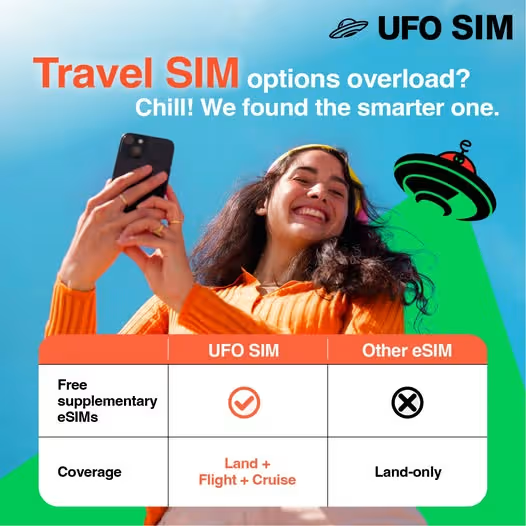
Unlike traditional SIM cards or even some eSIM offers that expire or become irrelevant after a trip, UFO SIM keeps your eSIM active indefinitely. You install it once, and reuse it across future journeys.
That’s not just convenient. It’s part of a broader shift toward “connectivity as a reusable asset” rather than a disposable purchase.
∞
Unlimited eSIM Validity
Install it once and keep it ready for future trips without buying a new eSIM every time.
4
One Plan, Four eSIMs
One purchase can support multiple eSIMs, making travel connectivity easier across devices and users.
↔
Sharing Data with Family
Keep everyone connected on the same trip without the hassle of separate plans for every person.
✈
Inflight Data
UFO SIM keeps you connected from takeoff to landing. No more waiting for airport Wi-Fi. No more dead zones at 35,000 feet.
⚓
Cruise Data
UFO SIM ensures you stay in touch while cruising the open seas. Share breathtaking ocean views in real time, check emails, or video call family from the deck of your ship.
The real differentiator: sharing data without friction
Where UFO SIM really tries to stand out is with its FamilyTravel feature.
Instead of treating an eSIM as tied to a single user or device, UFO SIM makes it shareable.
FamilyTravel explained
Buy one plan, receive up to four eSIMs
Share the same data pool across multiple devices or users
No additional fees for extra eSIMs
Works across phones, tablets, and other connected devices
In practical terms, that means a family of four can travel with a single data plan, each using their own eSIM profile.
This is a subtle but important shift.
Most eSIM providers today still assume a single-user model. If you want connectivity for multiple people, you either buy multiple plans or rely on hotspots. Both options come with trade-offs, from cost to battery drain.
UFO SIM removes that friction completely.
And it goes further.
Users can also transfer unused data to other UFO SIM users in small increments, as long as certain thresholds are met. It’s not fully “pooled data” in the telecom sense, but it’s close enough to feel like a shared ecosystem rather than isolated plans.
Built for multi-device travel
Modern travel isn’t just about your phone anymore.
People carry tablets, laptops, secondary phones, and even connected cameras. And managing connectivity across those devices is still surprisingly messy.
UFO SIM leans into this reality.
By offering multiple eSIM profiles under one purchase, it effectively replaces the need for:
constant tethering
portable Wi-Fi devices
juggling multiple local SIMs
For digital nomads or business travelers, this is arguably more valuable than raw pricing.
It’s about reducing complexity.
Beyond land: inflight and cruise connectivity
Another angle UFO SIM is exploring is connectivity beyond terrestrial networks.
The company offers dedicated in-flight and cruise data packages, allowing users to stay connected while traveling on selected airlines and cruise lines.
This is still a niche feature across the industry, but it reflects a growing trend. Travelers increasingly expect uninterrupted connectivity, not just at their destination, but throughout the journey.
Providers that can extend coverage into these “in-between” spaces are likely to gain an edge.
Activation in minutes, not hours
Like most modern eSIM services, UFO SIM emphasizes speed.
The setup process is straightforward:
Purchase online
Scan a QR code
Connect within minutes
The company claims activation takes under three minutes, which is now becoming the baseline expectation in the eSIM space.
That said, execution matters more than claims. Smooth onboarding remains one of the biggest conversion drivers in this market, especially for less tech-savvy users.
Where this fits in the wider eSIM market
Zooming out, UFO SIM’s launch taps into several broader trends shaping travel connectivity right now.
First, the shift from individual plans to shared usage models.
Second, the move toward reusable, long-term eSIM profiles instead of one-off purchases.
And third, the growing expectation of seamless, always-on connectivity across devices and environments.
If you compare this with established players:
Airalo still leads on simplicity and global coverage
Nomad focuses on flexibility and pricing transparency
Providers like Yesim are moving toward infrastructure-driven models with subscriptions and enterprise layers
UFO SIM is carving out a different angle.
It’s not trying to win on unlimited data. It’s not the cheapest either.
Instead, it’s positioning itself around shared connectivity and multi-device usability.
That’s a less crowded space, but also one that requires behavior change from users.
Final thoughts
UFO SIM’s launch in Australia is less about another eSIM entering the market and more about testing a different logic of how connectivity should work.
The traditional model, one user, one SIM, one plan, is starting to feel outdated in a world where people travel in groups and use multiple devices simultaneously.
UFO SIM challenges that by turning connectivity into something shareable, flexible, and persistent.
The question is whether the market is ready for it.
Industry data from organizations like the Trusted Connectivity Alliance shows that eSIM adoption is accelerating rapidly, with hundreds of millions of new profiles being downloaded annually. At the same time, research from Juniper points to strong growth in travel eSIM revenues, driven by convenience and cost control.
But most of that growth still comes from familiar models.
Driven by wanderlust and a passion for tech, Sandra is the creative force behind Alertify. Love for exploration and discovery is what sparked the idea for Alertify, a product that likely combines Sandra’s technological expertise with the desire to simplify or enhance travel experiences in some way.