Uber App Explained: How It Became Mobility Infrastructure
There was a time when opening the Uber app meant one thing: getting a ride. Tap, wait, go. Simple.
Today, that same app feels very different. It’s still about movement, but not just your movement. It’s quietly becoming a control panel for how cities move. And if you look closely, it’s no longer just competing with taxis or even other ride-hailing apps. It’s competing for a much bigger role.
From “Where to?” to Everything
Uber started in 2009 with a very specific problem. Finding a ride in a crowded city was frustrating, unreliable, and often overpriced. The early version of the app solved that with a simple interface and real-time tracking.
That real-time element was the breakthrough. Suddenly, you could see your driver, estimate arrival time, and know the price before stepping into the car. That alone changed user expectations permanently.
But the app didn’t stay in that lane for long.
Today, Uber operates in around 70 countries, serving over 200 million monthly users and coordinating tens of millions of trips and deliveries daily. That scale fundamentally changes what the app is. It’s not just a service. It’s infrastructure.
And infrastructure behaves differently than products.
The App You Open Without Thinking
One of the most interesting shifts is behavioral. You don’t “decide” to use Uber the way you choose a hotel or compare eSIM providers. You default to it.
That’s by design.
Uber’s app is built around predictive behavior. It knows your common destinations, suggests routes, and optimizes pickup points. Under the hood, it processes billions of data events daily to personalize and streamline the experience.
The result is subtle but powerful. The decision-making layer disappears.
You don’t search. You tap.
And that’s where Uber starts to look less like an app and more like an operating system for mobility.

Beyond Rides: The Quiet Expansion
If you only use Uber for rides, you’re missing the bigger picture.
The company has been steadily expanding the app into adjacent services: food delivery, business travel, freight, and now even parking and premium chauffeur services.
Inside the app, these features don’t feel like separate products. They feel like tabs in the same ecosystem.
That’s intentional.
Uber is building what many in tech call a “super app” model. Not quite at the level of Asian platforms like Grab or WeChat, but clearly moving in that direction.
The logic is simple. The more things you can do inside one app, the less reason you have to leave it.
And the more valuable each user becomes over time.
Pricing, Subscriptions, and Behavioral Nudges
Another shift happening inside the Uber app is economic, not just functional.
We’re seeing a clear move toward subscription logic and behavioral pricing. Features like shared routes, savings tools, and the Uber One membership are designed to increase frequency, not just transactions.
This mirrors what’s happening across digital services.
It’s no longer about one-off purchases. It’s about locking in habits.
In that sense, Uber is starting to behave more like a streaming platform than a transport company. You’re not just buying rides. You’re subscribing to convenience.
Safety, Trust, and the Platform Layer
Of course, none of this works without trust.
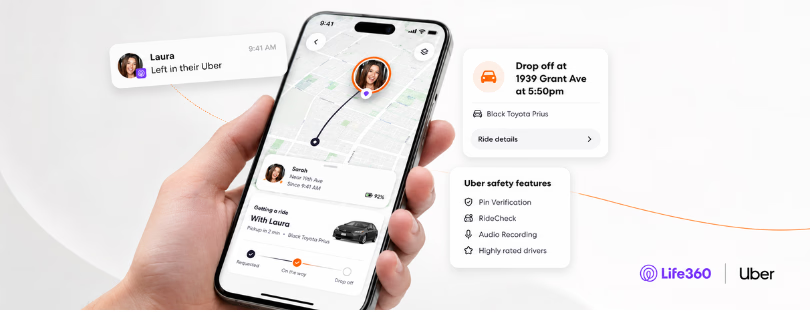
Uber has invested heavily in safety features inside the app, from real-time trip sharing to new options like matching women riders with women drivers.
At the same time, its history includes controversies around data privacy, regulation, and labor practices.
That tension still exists.
The app feels seamless on the surface, but underneath it’s a complex system balancing user trust, regulatory pressure, and global scale. And that balance is what defines whether platforms like Uber can truly become long-term infrastructure.
The Next Layer: Autonomous and Invisible
If you want to understand where the Uber app is going, look at what’s happening right now, not what’s already shipped.
Uber is actively integrating autonomous vehicles into its platform, including robotaxi pilots in Europe, starting in cities like Zagreb.
That’s not just a feature update. That’s a structural shift.
Because once you remove the driver, the entire economics of the platform changes.
Margins improve. Availability increases. And the app becomes even more invisible. You’re no longer matching with a person. You’re interacting with a system.
At that point, Uber stops being a marketplace and becomes pure infrastructure.
|