


Most people rarely think about telecom services.
Until the Wi-Fi drops in the middle of a video call.
Until your phone suddenly loses signal abroad.
Until that “quick” video you wanted to watch starts buffering endlessly.
In those moments, telecom stops being invisible and suddenly becomes very real.
But behind every phone call, WhatsApp message, Zoom meeting, or Netflix stream sits a massive global infrastructure quietly doing its job. Networks, satellites, fiber cables, switching systems, and software platforms are constantly moving your data around the planet in milliseconds.
So let’s strip away the jargon and break it down. What exactly are telecom services, why do they matter so much, and how are they changing in the era of eSIM and global connectivity?
What Telecom Services Actually Are
Telecom, short for telecommunications, simply means sending information across distance using electronic networks.
In everyday life, that includes things like:
- Phone calls
- Text messages
- Mobile data
- Internet access
- Video streaming
- Messaging apps
- Cloud communication
Every time your phone connects to a network, you are using telecom services.
The companies behind these services operate vast infrastructure networks that include:
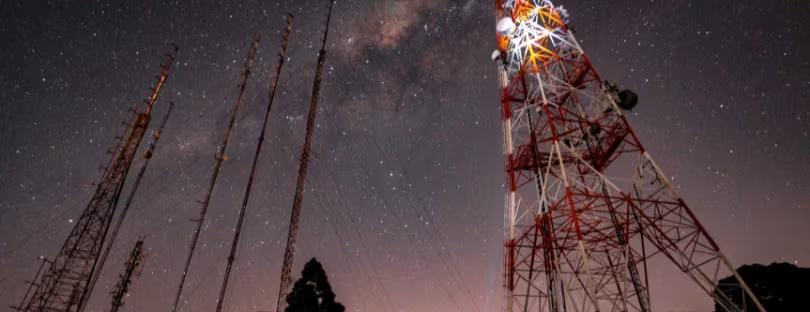
- Mobile towers
- Fiber optic cables
- Undersea data cables
- Satellite links
- Data centers
- Core network systems
It sounds complicated. But from a user perspective, telecom services simply mean one thing: staying connected wherever you are.
A Very Short Telecom History
Telecommunications didn’t begin with smartphones.
The first major telecom technology was the telegraph in the 19th century, which allowed messages to travel across continents almost instantly. Then came the telephone, radio, and television.
But the real revolution happened when telecom merged with computing and the internet.
Voice networks became digital.
Data traffic exploded.
Mobile phones became smartphones.
Today, telecom is no longer just about voice communication. It is about moving data.
And a lot of it.
According to industry data from organizations like the GSMA and International Telecommunication Union, global mobile data traffic grows by double digits every year as video streaming, cloud services, and connected devices expand worldwide.
The Key Players Behind Your Connectivity
Telecom is powered by several different types of companies.
The most visible are Mobile Network Operators (MNOs) such as Vodafone, Orange, Deutsche Telekom, and Telefónica. These companies own the physical infrastructure: towers, spectrum licenses, switching networks, and core telecom systems.
Then there are Mobile Virtual Network Operators (MVNOs).
These companies do not own infrastructure but instead lease network capacity from operators and sell services under their own brands. Many travel eSIM providers fall into this category.
Finally, a growing number of software-based telecom companies now operate in the space as well. Platforms such as Twilio or Zoom Communications deliver communication services through APIs and cloud platforms rather than traditional networks.
Telecom is no longer just hardware and towers. It is increasingly software-driven connectivity.
Mobile, Internet, and the Digital Backbone
Most telecom services fall into three major categories.
Mobile services
These include voice calls, SMS messaging, and mobile data access through cellular networks.
Broadband internet
This includes fiber, cable, or DSL connections that power home and office Wi-Fi.
Enterprise connectivity
Businesses rely on telecom infrastructure for cloud services, secure data transfer, payment processing, and communication systems.
Behind all of this sits a hidden digital backbone made up of global fiber networks, data centers, and network routing systems.
You rarely see this infrastructure. But it is what allows a message sent from Barcelona to reach someone in Tokyo within seconds.


Roaming and the Global Connectivity Problem
One area where telecom becomes very visible to consumers is roaming.
Roaming happens when your phone connects to a foreign network outside your home country. The visited network provides coverage while your home operator bills you for the usage.
Historically, roaming has been expensive because it involves complex agreements between operators.
This is one of the reasons travel connectivity solutions such as travel SIM cards and eSIMs have grown so quickly. Instead of relying on your home operator’s roaming tariffs, these solutions connect you directly to local networks at more predictable rates.
For frequent travelers, this has become one of the most significant changes in telecom over the past decade.
Telecom Is Now Critical Infrastructure
Telecom used to be seen as a convenience. Today it is essential infrastructure.
Modern economies rely heavily on digital connectivity.
Businesses depend on telecom networks for cloud computing, collaboration tools, and online transactions. Remote work and digital education rely entirely on stable broadband and mobile connectivity.
Healthcare systems increasingly use telemedicine platforms that require reliable networks to operate.
Even everyday activities like ride-hailing, navigation, food delivery, and mobile payments all depend on telecom infrastructure working smoothly.
In many ways, telecom has become as fundamental as electricity or transportation networks.
The Industry Still Has Problems
Despite its importance, telecom still has plenty of challenges.
Consumers often complain about confusing tariffs, hidden fees, and rigid contracts. Coverage gaps remain a major issue in rural regions and developing markets.
Privacy and data protection are also growing concerns. Telecom networks carry enormous volumes of personal information, and protecting that data is becoming a critical responsibility.
Another major challenge is the digital divide. While urban regions enjoy fast 5G networks, many communities around the world still lack reliable internet access.
Closing that gap is one of the biggest priorities for regulators and telecom companies alike.
What the Future of Telecom Looks Like
The telecom industry is undergoing another major transformation.
Technologies like 5G are dramatically increasing network speeds and reducing latency, enabling new applications such as smart cities, autonomous vehicles, and immersive digital experiences.
At the same time, eSIM technology is making connectivity more flexible. Instead of swapping physical SIM cards, users can now activate networks digitally and switch providers instantly.
Another major shift is happening in satellite connectivity. Companies like SpaceX with Starlink are working to bring high-speed internet to remote areas that traditional telecom infrastructure cannot easily reach.
These developments are pushing telecom toward a future where connectivity is global, digital, and increasingly software-defined.
Final Thoughts
Telecom services rarely get attention when they work well. They quietly sit in the background while we message friends, join meetings, stream movies, and navigate unfamiliar cities.
But the truth is simple.
Without telecom infrastructure, modern life would stop almost instantly.
It is the invisible network that powers communication, business, travel, and everyday digital life. And as technologies like 5G, satellite internet, and eSIM continue to evolve, that network will only become more central to how the world functions.
So the next time your phone connects instantly to a network halfway across the planet, remember that behind that simple signal icon lies one of the most complex and important infrastructures ever built.
