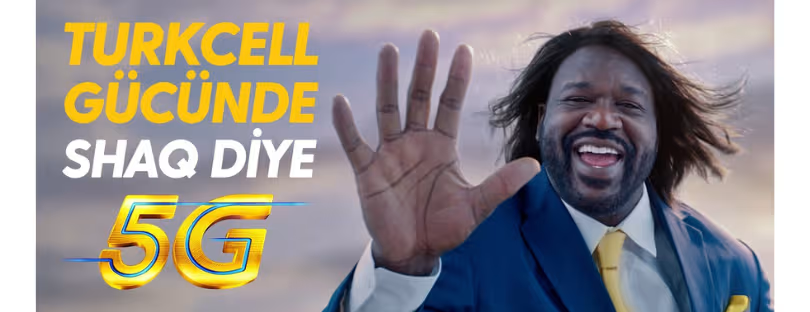
Turkcell + Shaq: The Real Strategy Behind This 5G Launch
Most telecom campaigns still look the same. Faster speeds, wider coverage, a few technical claims, and that’s it. Turkcell clearly didn’t want to do that. turkcell 5g campaign
With its latest campaign starring Shaquille O’Neal, Türkiye’s leading operator is stepping into the 5G era with something that feels closer to entertainment than telecom marketing. And that’s exactly what makes it interesting. This isn’t just about launching 5G. It’s about shaping how people perceive it.
Turning 5G into a narrative
The campaign opens with a simple but clever setup. Shaq lands in Türkiye, gets asked by reporters why he’s there, and improvises: “Hair transplant.”
That one line drives everything that follows.
What starts as a joke quickly turns into a chain of exaggerated, almost surreal scenes. Shaq appears in different environments, from dancing in a village with long black hair to standing on a cold mountain peak, fully committed to the story he accidentally created.
It’s playful, slightly absurd, and very deliberate.
Instead of explaining what 5G does, Turkcell shows it through movement, transitions, and consistency across environments. The underlying message is clear. Once you make a promise, you follow through everywhere. That’s how they frame speed, capacity, and coverage.
And honestly, that’s a smarter way to communicate 5G than another spec sheet.
Why Shaq actually works
On paper, Shaquille O’Neal might feel like an unexpected choice. But in reality, he fits the strategy perfectly.
Telecom is increasingly using global figures to cut through noise. But the risk is always the same. If it feels forced, it doesn’t land.
Here, it works because Shaq brings scale and personality at the same time. He’s globally recognizable, but he doesn’t feel corporate. The humor feels natural, not scripted.
That matters more than it seems.
Telecom has always struggled with tone. Too technical and you lose people. Too polished, and it feels fake. This campaign lands somewhere in between, which is exactly where 5G communication needs to be right now.
Production as a signal of infrastructure
The scale of production says a lot about how seriously Turkcell approached this.
- 35 days of pre-production
- 180 crew members
- Multiple filming units
- Around 70 days of post-production
And one detail that stands out. Nine custom wigs were designed specifically for Shaq, with several produced in the US.
At first glance, it sounds like a fun, creative detail. But it’s also symbolic.
Telecom infrastructure is invisible. You can’t show spectrum or network layers in a way that feels real to users. So brands translate that complexity into production scale. If the campaign feels big, seamless, and controlled, it reflects how the network is meant to perform.
It’s not just storytelling. It’s signaling.

A shift in how 5G is marketed
What Turkcell is doing fits into a broader industry shift.
5G is no longer new. According to GSMA Intelligence and Ericsson Mobility Reports, coverage is expanding rapidly and users already expect fast, reliable data. That means technical superiority alone is no longer enough to differentiate.
Operators are changing how they communicate:
|
Experience over specs
Instead of saying “faster,” they show how connectivity behaves in real situations.
|
Entertainment over explanation
Campaigns are designed to be watched, not decoded.
|
Cultural relevance
Local context is blended with global appeal.
|
Turkcell’s campaign hits all three. Shaq brings global reach. The hair transplant storyline ties directly into Türkiye’s real-world reputation. The visuals make performance feel tangible.
What this says about Turkcell’s position
There’s a clear message behind the creativity.
Turkcell is positioning itself as ready. Not just launching 5G, but implying long-term preparation and infrastructure depth.
That’s important in competitive markets where timing matters as much as technology. Being first is one thing. Being perceived as the leader is another.
This campaign is about that perception.
Instead of proving capability with technical data, Turkcell is building confidence through narrative. And for most users, that’s actually more persuasive.
Why this matters for travelers
From a travel tech perspective, this kind of messaging is more relevant than it looks.
Travelers don’t think in terms of bandwidth or latency. They think in terms of reliability. Will it work when I land? Will it stay consistent?
That’s where campaigns like this connect.
By showing performance across different environments, Turkcell indirectly addresses the biggest concern travelers have. Not speed, but certainty.
As eSIM adoption grows and users become more flexible in choosing providers, this kind of perception becomes even more important. People don’t want to compare networks. They want to trust one.
Where Turkcell stands globally
If you compare this to other operators, the positioning is interesting.
European telecom brands like Vodafone or Deutsche Telekom tend to stay conservative, focusing on reliability and trust. Asian operators, especially in markets like South Korea, go bigger with storytelling and production.
Turkcell sits somewhere in between.
The message is grounded in infrastructure, but the execution is bold and entertainment-driven. That hybrid approach could work well as competition around 5G perception intensifies globally.
Conclusion: 5G is no longer the story
The most important takeaway here is simple. 5G itself is no longer the headline.
According to GSMA and Ericsson data, global 5G adoption is accelerating quickly, and for users, fast connectivity is becoming the default expectation. That changes how operators compete.
It’s no longer about who has the fastest network. It’s about who makes that speed feel relevant.
Turkcell’s campaign is a clear move in that direction. Instead of explaining technology, it builds a narrative around consistency, scale, and everyday experience.
Compared to more traditional approaches in Europe, this feels more aligned with what we’re seeing in markets like South Korea or Japan, where operators invest heavily in storytelling to make infrastructure visible.
The real question is what happens next.
Because the brands that win in this phase won’t be the ones with the loudest claims. They’ll be the ones that remove the need for users to think about connectivity at all.
And that’s the paradox.
The best network is the one you stop noticing.