Top 10 eSIM Trends in 2026
You’ve just landed in Tokyo. No kiosk, no queue, no “we only take cash.” Just a quick tap on your phone, and you’re connected before your luggage hits the belt.

That’s the reality eSIMs are building—and in 2026, it becomes the norm.
The days of swapping tiny bits of plastic to get online abroad are fading fast. eSIMs have shifted from a “nice-to-have” feature for tech-savvy travelers to the default connectivity standard across devices, industries, and continents.
Once limited to premium smartphones, eSIM is now baked into wearables, laptops, cars, and travel gadgets. Apple may have lit the spark with its eSIM-only iPhones, but the fire is spreading—and fast.
At Alertify, we’ve been tracking this evolution from the front lines: comparing 110+ providers, testing plans in 200+ destinations, and helping travelers find the smartest way to stay connected.
Here are the 10 eSIM trends shaping 2026—backed by real-world data, market logic, and a look at what it all means for global connectivity.
1. eSIM Adoption Goes Mainstream—Plastic SIMs Fade Fast
By 2026, hundreds of millions of devices will ship with eSIM built in—smartphones, wearables, laptops, and vehicles alike. The shift is irreversible.
Apple continues rolling out eSIM-only iPhones to new markets, with Android manufacturers following suit. Analysts expect the share of eSIM-only devices in Europe and North America to rise sharply this year, though full market saturation will take a few more cycles.
For consumers, that means no more fiddling with tiny SIM trays. For operators, it means fully digital onboarding through Remote SIM Provisioning (RSP) — the GSMA framework that securely downloads an eSIM profile from an SM-DP+ server to the embedded eUICC in your device.
In other words, the SIM card as we know it is becoming a relic.
2. Travel eSIMs Replace Roaming as the Default
Paying €10 a day for data abroad? That’s so 2019.
In 2026, travel eSIMs—data-only, app-activated plans—are taking over. GSMA Intelligence expects the number of active eSIM connections to roughly double between 2025 and 2026, driven largely by travel use.
The reason is simple: flexibility. Travelers can compare plans, switch regions, and top up data—all without visiting a single store. Providers like Airalo, Airhub, Nomad, and Yesim are pushing user experience further with instant activation, regional bundles, and transparent pricing.
Travelers get control; operators get competition. It’s a win-win (except for traditional roaming).

3. MVNOs and Travel eSIM Brands Start to Merge
Here’s where things get interesting.
According to Juniper Research, 2026 marks a wave of MVNO (Mobile Virtual Network Operator) and travel eSIM convergence. Expect fintech apps, airlines, and even hotel chains to launch their own branded eSIMs—built on MVNO infrastructure.
Imagine booking a flight and adding “Connect on Arrival” at checkout. Or your hotel is giving you a free local data plan for the stay.
Connectivity is becoming another line item in the travel experience—seamlessly bundled, white-labeled, and powered by digital-first eSIM platforms.
4. Embedded Connectivity Spreads Across Devices and Vehicles
eSIM isn’t just about phones anymore.
Cars, wearables, laptops, cameras, and even luggage trackers are joining the connected ecosystem. eUICC chips allow manufacturers to ship devices globally, then activate local profiles over the air.
TechRadar recently described connected cars as “the new mobile offices,” and it’s true—in-vehicle eSIMs now manage infotainment, navigation, and diagnostics.
For travelers, this multi-device connectivity means you’re always online—from smartwatch to dashboard. For IoT and auto brands, it’s a way to localize services in every market without physical SIM logistics.
5. Provisioning Gets Seamless—The “One-Tap” Era Arrives
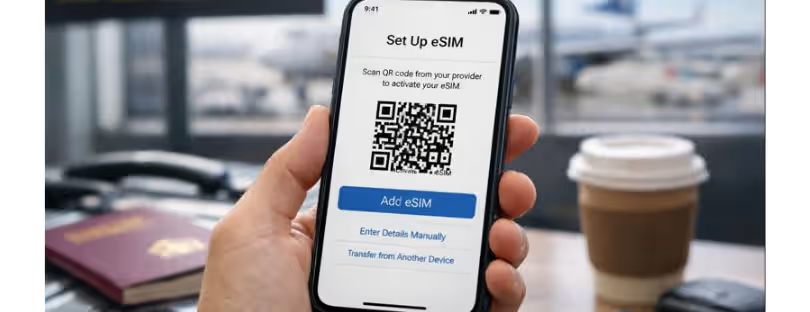
Remember scanning QR codes and manually entering activation codes? Those days are numbered.
The consumer eSIM stack—built on SM-DP+ (Subscription Manager–Data Preparation), SM-DS (Discovery Service), and the on-device Local Profile Assistant (LPA)—is being refined for true one-tap setup.
Leading travel eSIM apps already let you install and activate within 60 seconds. It’s frictionless, instant, and exactly how users expect digital services to work.
Provisioning isn’t just easier—it’s invisible.
6. Regulation and Roaming Policies Catch Up
Regulators are finally catching up to technology.
In the European Union, “Roam Like at Home”—the regulation that lets EU citizens use their domestic plan abroad—has been extended through 2032. It’s a major enabler for cross-border digital services, including eSIM activation and regional bundles.
Elsewhere, countries in the Asia-Pacific, Latin America, and Africa are gradually approving eSIM provisioning frameworks. Adoption remains uneven, but the direction is clear: global alignment.
For travelers, this means broader compatibility and fewer “unsupported” markets. For eSIM providers, it’s a golden era to expand coverage footprints.

7. Security, Enterprise, and Digital Identity Take Center Stage
Security and enterprise readiness are becoming core drivers of eSIM adoption.
Each eSIM profile is digitally signed and authenticated under the GSMA’s Remote SIM Provisioning standards, making it inherently more secure than physical SIMs.
Enterprises are now deploying eSIM across laptops, IoT sensors, and corporate smartphones to manage global fleets remotely — a key shift toward centralized mobility management.
GSMA’s new SGP.31/32 specifications for IoT and enterprise eSIM further enable large-scale device orchestration and simplified logistics.
As eSIM becomes a trusted layer for digital identity, IoT, and secure connectivity, businesses are beginning to treat it as strategic infrastructure, not just a telecom feature.
“Beyond consumer travel, the enterprise and IoT sectors are now driving eSIM innovation,” Alertify’s analysis said. “From logistics to corporate mobility, companies are using eSIM to connect global workforces and devices securely — marking a decisive shift from consumer convenience to business-critical infrastructure.”
8. Satellite Meets eSIM—A New Connectivity Frontier
Get ready for the sky to join your network.
2026 introduces multi-orbit satellite integration into mainstream connectivity. The 3GPP’s Non-Terrestrial Network (NTN) specifications enable phones and IoT devices to connect seamlessly via satellites when terrestrial coverage fails.
In practice, that means eSIM plans could include “satellite ”fallback”—with the same digital profile acting as your credential for both land and sky.
It’s early days, but the partnerships forming between satellite operators and mobile carriers hint at a near future where “no signal” truly becomes a thing of the past.
9. Competition Heats Up—The End of Operator Exclusivity
eSIM has leveled the playing field.
You no longer need to be a legacy telecom giant to offer mobile data—just an API connection and the right wholesale deals. Fintechs, travel agencies, and even content platforms are stepping into the connectivity game.
Le Monde recently noted how eSIMs are eroding operator revenue by making switching effortless. And that’s the point: travelers now have the power to choose.
The result? Better prices, more innovation, and an explosion of niche eSIM brands targeting specific travel types—from backpackers to business frequent flyers.

10. Flexible, Data-Only, and Travel-First Plans Dominate
The final (and maybe most important) trend: freedom.
By 2026, most major eSIM platforms will offer flexible data subscriptions that adapt to how—and where—you travel. Monthly credits, regional bundles, and instant top-ups will replace rigid contracts.
You’ll be able to move from Paris to Seoul without changing plans or paying hidden fees. Just seamless, app-managed connectivity that travels with you.
The phrase “local SIM” will soon sound as outdated as “dial-up internet.”
Bonus Trend: AI-Powered Plan Matching
Personalization is coming to connectivity.
New tools—including Alertify’s upcoming Smart Travel Connectivity Hub—use AI to recommend the best eSIM plan based on your trip length, country mix, and typical data use.
Think of it as your travel connectivity assistant: finding the perfect plan before you even pack.
The Invisible Revolution—And What It Means for You
2026 isn’t just another chapter in telecom history. It’s the year connectivity becomes invisible—built into your devices, managed by apps, and optimized by AI.
For travelers, it means freedom and transparency.
For eSIM providers, it means smarter UX and sharper competition.
For travel brands, it means new opportunities to engage, upsell, and build loyalty through connectivity.
At Alertify, we’ll keep decoding this fast-changing landscape—from eSIM innovations and roaming reforms to new partnerships reshaping global travel tech.
Because the future of travel doesn’t start when you land.
It starts the moment your phone connects.