Thales and Verifone Bring eSIM to Payment Terminals
The global eSIM conversation often revolves around travel connectivity, smartphones, and consumer data plans. But one of the most important battlegrounds for eSIM adoption is actually far away from airports and tourists. eSIM payment terminals
It sits on shop counters.
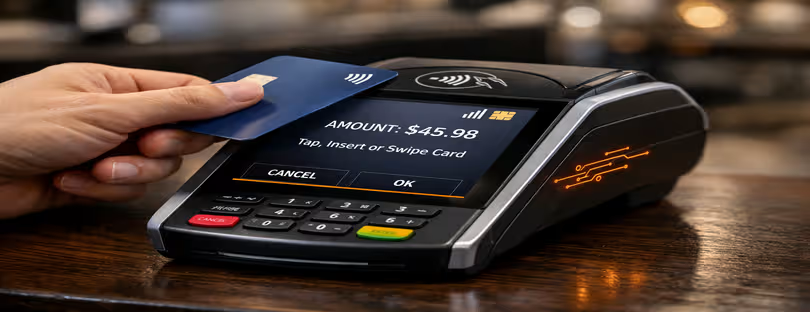
Every time someone taps a card or a phone to pay, a small connected computer processes that transaction. Those devices, known as point-of-sale terminals, are quietly becoming one of the fastest-growing categories of connected hardware.
And this week, two major technology companies moved to reshape how those devices connect to mobile networks.
Thales and Verifone announced a partnership to integrate eSIM technology into Verifone’s next-generation payment terminals. The goal is simple on paper but significant in practice: remove physical SIM cards from payment devices and replace them with remotely managed connectivity.
In other words, the payment terminal becomes another device in the growing global eSIM ecosystem.
Why Payment Terminals Need Connectivity
Modern payment terminals are not just card readers. They are connected systems that communicate with banks, payment networks, and security platforms every time a transaction happens.
Connectivity is therefore critical.
Traditionally, that connection came from one of three sources:
- Wi-Fi in the store
- Ethernet cables
- Cellular connections using removable SIM cards
Cellular connectivity has always been particularly important. It ensures that payments continue to work even if local networks fail or when terminals operate in mobile environments like taxis, delivery services, or pop-up stores.
But the use of traditional SIM cards created operational challenges.
Hardware often had to be customized for different countries. SIM cards had to be installed manually. Connectivity providers had to be chosen before devices even left the factory.
For companies deploying thousands or millions of devices, that complexity becomes a major logistical headache.
That is where eSIM enters the picture.
The Shift From SIM Cards to Remote Connectivity
By integrating Thales eSIM technology directly into its terminals, Verifone removes the need for removable SIM cards entirely.
Instead of inserting a SIM, connectivity profiles can be downloaded remotely.
This means devices can be manufactured in a single standardized configuration, shipped anywhere in the world, and activated once they arrive at their destination.
The result is a far simpler global deployment model.
For manufacturers, it reduces production complexity. For distributors, it simplifies logistics. For operators, it enables flexible connectivity choices without physically touching the device.
In short, connectivity becomes software rather than hardware.
The Role of the Thales eSIM Platform
At the center of the partnership is the Thales eSIM management platform, which enables connectivity provisioning, updates, and lifecycle management remotely.
This platform supports the latest IoT standards from the GSMA, particularly the SGP.32 specification designed for large-scale connected devices.
Unlike earlier eSIM frameworks that were optimized mainly for smartphones, SGP.32 is built specifically for the Internet of Things. It allows devices to switch operators, download profiles, and manage connectivity securely across different networks and regions.
This standardization is crucial.
Payment terminals operate in highly regulated environments where security, reliability, and interoperability are non-negotiable.
The ability to manage connectivity remotely while maintaining strong security controls is, therefore a major advantage.
A Manufacturing Transformation for Verifone
For Verifone, the implications go beyond connectivity.
This model fundamentally changes how payment terminals are manufactured and deployed.
Devices no longer need to be built with country-specific SIM slots or configured for specific mobile operators. Instead, a single hardware version can be produced and shipped globally.
Connectivity is activated only after deployment.
That approach dramatically improves supply chain flexibility.
It also accelerates time-to-market, something that has become increasingly important in a payments industry where merchants demand fast rollout of new hardware and services.
As Ryan Ahern, VP of Global Hardware Product Strategy at Verifone, explained:
“At Verifone, we’re focused on simplifying how payment devices are deployed and managed at global scale,”said Ryan Ahern, VP, Global Hardware Product Strategy at Verifone.“By integrating Thales’s eSIM technology directly into our terminals, we eliminate the need for removable SIM cards and country-specific variants. That means faster rollouts, streamlined manufacturing, and secure, remotely managed connectivity from day one.”
In other words, the device becomes globally ready from the factory.
What It Means for Merchants
For merchants and payment service providers, the change may be less visible but equally important.
Payment terminals must remain online constantly. Even brief outages can disrupt sales and damage customer trust.
Embedded eSIM connectivity makes that reliability easier to maintain.
Because connectivity profiles can be updated remotely, operators can switch networks if performance changes or coverage issues arise. Devices can also be activated faster when installed in new locations.
This reduces installation friction and ongoing maintenance costs.
It also ensures that payment connectivity becomes a built-in capability rather than a separate operational task.

The Bigger Trend: eSIM Moves Into Infrastructure
While the travel eSIM market gets most of the headlines, deals like this highlight a much bigger shift.
eSIM is rapidly becoming infrastructure.
Connected devices across industries are adopting it: vehicles, smart meters, logistics trackers, industrial equipment, and now payment terminals.
Each of these categories involves millions of devices that must operate across multiple countries and networks.
Traditional SIM logistics simply do not scale well in that environment.
That is why companies like Thales are positioning themselves as infrastructure providers for the connected device economy.
Eva Rudin, VP Mobile Connectivity Solutions at Thales, framed the partnership in exactly those terms:
“We are proud to partner with Verifone to simplify connectivity for the payment ecosystem,”said Eva Rudin, VP Mobile Connectivity Solutions at Thales. “Our eSIM technology and management platform remove the complexity of global deployments and manufacturing, enabling customers to connect their devices securely, efficiently and with confidence, today and in the future. Through this partnership, Thales and Verifone reaffirm their shared commitment to innovation, security and simplicity, supporting the evolution of connected payment infrastructures worldwide.”
The Growing Competition in IoT Connectivity
Thales is not the only player targeting this market.
Companies such as Giesecke+Devrient, Kigen, and 1NCE are also competing aggressively in the global IoT connectivity space.
Each offers platforms designed to manage large fleets of connected devices.
What differentiates Thales is its strong heritage in secure hardware and digital identity technologies, which are particularly important in payment environments where transaction security is critical.
That makes payment terminals a natural expansion point for the company’s eSIM platform.
For Verifone, the partnership reflects another strategic priority: simplifying the complexity of global payment infrastructure.
Payment networks are already evolving toward cloud platforms, software-defined terminals, and integrated digital services.
Connectivity must evolve alongside them.
Why This Matters for the Future of eSIM
The travel eSIM market is often measured in millions of users.
But the IoT market is measured in billions of devices.
According to the GSMA, the number of IoT connections worldwide is expected to exceed 30 billion by the end of the decade. A significant portion of those devices will rely on embedded connectivity.
Payment terminals are just one example of that transition.
From a technology perspective, they illustrate something important: eSIM is no longer just a convenience feature for travelers. It is becoming the default architecture for connected hardware.
Devices that once depended on physical SIM cards are gradually moving to remotely managed connectivity layers.
The payments industry is now part of that shift.
Conclusion
The partnership between Thales and Verifone might look like a simple connectivity upgrade, but it reflects a much deeper transformation in how connected devices are designed and deployed.
By embedding eSIM technology directly into payment terminals, Verifone removes one of the most persistent operational bottlenecks in global device deployment: the physical SIM card.
What replaces it is a software-defined connectivity model that can be activated, managed, and updated remotely.
That model is quickly becoming standard across industries.
Automotive manufacturers are using it to connect vehicles globally. Logistics companies rely on it for tracking fleets. Utilities deploy it in smart meters. And now payment networks are adopting it to power the next generation of connected commerce.
Similar strategies are already visible across the IoT connectivity market, where companies such as Giesecke+Devrient, Kigen, and 1NCE are building platforms designed to manage millions of devices remotely. The GSMA’s SGP.32 standard is accelerating this transition by creating a unified framework for secure eSIM management in IoT environments.
In that context, the Thales-Verifone partnership is not just about payment terminals.
It is another sign that connectivity itself is becoming programmable infrastructure.
And as more devices shift toward remote provisioning and software-defined networks, eSIM technology will quietly move from being a niche telecom feature to one of the foundational layers of the global digital economy.